
As an Amazon Associate, 456 AutoFix earns from qualifying purchases. Product links below go to Amazon, where you can confirm the right part for your vehicle.
Pulling a camper or a boat trailer puts the rear axle under more strain than almost anything else a truck does. Choosing the best differential fluid for towing starts with the grade printed in your owner’s manual, then narrows to an oil that holds its film when the gears run hot for hours.
This guide explains why a loaded axle is hard on its oil, when a 75W-140 makes sense, and which six synthetic gear oils are worth a look. Servicing the gearbox in the same truck? Our transmission fluid guide for high-mileage cars handles that half of the driveline.
Quick answer
What gear oil should a towing axle run?
Start with the grade and spec in your owner’s manual. If it lists 75W-140 for trailer towing, a full synthetic GL-5 such as Valvoline SynPower 75W-140 or AMSOIL Severe Gear 75W-140 handles heat well. Limited-slip axles need friction modifier, which Valvoline SynPower already contains.
Our Quick Picks
Three 75W-140 oils that cover most towing axles: one built around factory truck specs, one for heat, and one made for limited-slip units.

Valvoline SynPower 75W-140
Synthetic gear oil that lists Ford, GM and Chrysler specs and a towing claim.

AMSOIL Severe Gear 75W-140
Extreme pressure gear lube that resists breakdown and helps lower running temperatures.

Liqui Moly Hypoid Gear Oil LS 75W-140
Fully synthetic hypoid oil sold in a limited-slip version.
What a Trailer Does to the Oil in Your Axle
The ring and pinion in a rear axle carry every pound of torque the engine sends to the wheels. Hook up a few thousand pounds of trailer and that load climbs, especially on grades, from a stop and in stop-and-go traffic. The gears slide against each other harder, and the oil between them gets hotter.
Heat is what wears gear oil out: it thins the oil and uses up its additives faster, and a synthetic base generally holds up better. That is why most owner’s manuals list a shorter “severe service” interval for trucks that tow, plow or haul.
75W-90 or 75W-140 for a Loaded Truck?
A 75W-140 is thicker at operating temperature than a 75W-90, so it keeps a stronger film between the gear teeth when the axle runs hot. Some truck makers list it for trailer towing, and some axles call for it all the time. Others specify a thinner oil, such as 75W-85 or 75W-90, for fuel economy and cold-weather flow.
Thicker is not automatically safer. A heavier oil can cost a little efficiency. If the manual gives a towing grade, use it; if it gives only one grade, stick with that grade and change it on the severe-service schedule instead.
Best Differential Fluid for Towing: Six 75W-140 Oils Up Close
Every pick below is a full synthetic 75W-140, the grade most often listed for towing axles. Specs and claims come from each Amazon listing, so check them against your manual before you order.
1. Valvoline SynPower 75W-140: Full Synthetic GL-5 Gear Oil with Limited-Slip Additive
- SAE 75W-140 full synthetic
- Meets API GL-5 and Ford, GM and Chrysler specs
- Limited-slip additive already included
- Case of 12 one-quart bottles
Valvoline SynPower 75W-140 is a full synthetic gear oil aimed squarely at axles that carry heavy loads. Valvoline’s listing says it gives 30% better protection against towing and heavy loads and 1.5 times stronger extreme pressure protection, both measured against its own test standards. It also lists a working range from -50 F to 300 F, which covers a cold start in January and a long climb with a trailer in July.
The spec list is the main reason to look at this bottle. It meets API GL-5 and names Ford M2C-192A, GM 12346140 and Chrysler MS-8985, which are the numbers many domestic truck manuals print next to a 75W-140 recommendation. The oil already contains limited-slip additive, and Valvoline states that a supplemental friction modifier is not required for those specs. The listing also mentions corrosion inhibitors and resistance to oxidation and thermal breakdown.
This listing is a case of 12 quarts, which suits someone with more than one truck, a trailer-heavy fleet or a plan to change front and rear axles together. A single axle job will leave spare bottles on the shelf. It is not a match for an axle that specifies a thinner grade, such as 75W-85, or for a manual gearbox that needs a GL-4 fluid.
View Valvoline SynPower 75W-140 on Amazon
2. AMSOIL Severe Gear 75W-140: Synthetic Extreme Pressure Gear Lube in an Easy-Pack
- 100% synthetic SAE 75W-140
- Extreme pressure (EP) formula
- Resists breakdown from high heat
- Quart Easy-Pack container
AMSOIL Severe Gear 75W-140 is the heavier member of AMSOIL’s Severe Gear line, a 100% synthetic extreme pressure gear lube. The name gives away its purpose: the listing describes an oil made for axles that work hard, the kind of duty that comes with a loaded trailer behind a pickup or a camper hitched to an SUV.
According to the listing, the oil resists breakdown from high heat, which helps prevent acid, carbon and varnish formation, and it helps reduce operating temperatures. It also protects against rust and corrosion and is described as supporting long oil, seal and equipment life. For a towing axle, heat control is the feature that matters most, since high temperature is what thins gear oil and uses up its additive package during a long pull.
It comes in a one-quart Easy-Pack, a flexible container that makes it simpler to feed oil into a fill hole tucked behind an axle housing. A typical rear axle needs more than one, so check your fill capacity before ordering. The listing does not say whether it includes limited-slip additive, so owners of clutch-type limited-slip axles should confirm that with AMSOIL or the bottle label before skipping a separate friction modifier.
View AMSOIL Severe Gear 75W-140 on Amazon

3. Liqui Moly Hypoid Gear Oil LS 75W-140: Fully Synthetic GL-5 for Limited-Slip Axles
- Fully synthetic SAE 75W-140
- API GL-5 hypoid gear oil
- LS formula for limited-slip differentials
- 1-liter bottle, SKU 20042
Liqui Moly Fully Synthetic Hypoid Gear Oil LS 75W-140 is a gear oil sold under SKU 20042. The listing title sums up what it is: a fully synthetic GL-5 hypoid oil in the 75W-140 grade, with LS in the name to mark it as the version meant for limited-slip differentials. That combination is exactly what many tow vehicles with a limited-slip rear axle call for.
Hypoid oils are built for the curved-tooth ring and pinion found in most rear axles, where the teeth slide against each other under heavy pressure. The GL-5 rating means it carries the high level of extreme pressure additive those gears need, and the fully synthetic base helps it hold its thickness when a long haul heats the housing. The LS label signals that it is formulated for the clutch packs in a limited-slip unit.
The Amazon listing gives little beyond the title, so check Liqui Moly’s product data or the bottle for approvals and for whether your particular unit still needs added friction modifier. It is sold by the liter, slightly more than a quart, so most rear axles will take two or three bottles. It is a poor fit for open axles that specify a thinner grade, and for manual gearboxes that need GL-4.
View Liqui Moly Hypoid Gear Oil LS 75W-140 on Amazon
4. Royal Purple Max-Gear 75W-140: Synthetic Hypoid Gear Oil with Synerlec Additive

- SAE 75W-140 synthetic gear oil
- Made for heavily loaded hypoid gears
- Synerlec additive technology
- Rust and corrosion protection, 3-quart pack
Royal Purple Max-Gear 75W-140 is a synthetic automotive gear oil for hypoid gear sets, the curved-tooth ring and pinion found in most truck and SUV rear axles. The listing describes it as a tough, high-performance oil meant to protect heavily loaded gears while keeping power moving through the driveline, which lines up well with what an axle goes through on a towing trip.
The formula pairs synthetic base oils with Synerlec, Royal Purple’s own additive technology, which the company says helps the oil outperform ordinary gear oils. The listing also highlights rust and corrosion protection. That is useful for trucks that see salted winter roads, sit parked between trailer seasons or get their axles wet at a boat launch, since moisture inside a housing is a common cause of rusty bearings.
This version is a pack of three quarts, a sensible amount for many single rear axle changes, though some heavy-duty axles take more. Check your capacity in the manual before ordering. The listing does not spell out its API rating or limited-slip additive, so read the bottle or Royal Purple’s product sheet to confirm it meets your axle’s GL-5 requirement and whether a friction modifier is needed for a limited-slip unit.
View Royal Purple Max-Gear 75W-140 on Amazon
5. TRIAX Synergy Gear MAX 75W-140: PAO Synthetic GL-5 Axle Oil, Limited Slip Ready
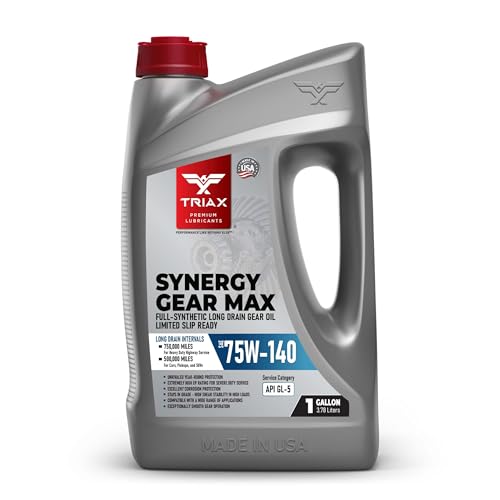
- PAO synthetic 75W-140, API GL-5
- Limited slip ready
- -60 F pour point
- One-gallon jug
TRIAX Synergy Gear MAX 75W-140 is a PAO synthetic extreme pressure oil for axles and differentials, sold in a one-gallon jug. TRIAX positions it as a long-drain oil and lists hypoid and ring gears, limited-slip and open differentials, heavy-duty highway use and off-road work among its applications, which covers most of what a towing truck asks of its axle.
The listing says it meets and exceeds API GL-5 and limited-slip requirements across several OEM specifications, and that it resists shearing under extreme torque. TRIAX quotes very long drain intervals for heavy-duty pickups and highway trucks. Those are the maker’s own figures; for a truck that tows, the severe-service interval in your owner’s manual should still decide when the oil comes out. A -60 F pour point also means it flows on the coldest winter mornings.
The gallon size is the practical draw. One jug can often handle a front and rear axle on a four-wheel-drive truck, or two rear axles if you keep more than one tow vehicle. It is more oil than a single small axle needs, though, and a gallon jug calls for a pump or a transfer bottle to reach the fill hole. As with any limited-slip oil, check whether your specific unit wants an added modifier.
View TRIAX Synergy Gear MAX 75W-140 on Amazon
6. Lucas Oil 10121 75W-140: Synthetic Transmission and Differential Lube, 1 Quart

- SAE 75W-140 synthetic gear oil
- Lucas lists it for limited-slip differentials
- Aimed at less gear noise and longer bearing life
- Holds lubricity at high temperature
Lucas Oil 10121 is a 75W-140 synthetic gear oil that Lucas labels as a transmission and differential lube. It is sold by the single quart, which makes it easy to buy exactly what one axle needs or to keep a bottle in the truck for a top-up after a seal repair or a long trip.
The listing makes three main claims. It describes the oil as a super-slick, long-lasting lubricant, it says it helps reduce gear noise and extend bearing life, and it says it stands up to high temperatures while keeping its lubricity. Heat tolerance is the point that matters for towing, because a rear axle working against a trailer for hours runs far hotter than one cruising empty on the highway.
The Amazon listing is short on spec detail, but Lucas’s own product page adds that the oil is designed for heavy-duty and high-performance use and is excellent for limited-slip differentials. Neither source states an API rating or factory approvals, so read the label before you pour it into an axle with a specific factory fluid requirement. Despite the transmission wording, it should only go into a gearbox when the vehicle maker approves a 75W-140 oil there. It suits owners who want a widely sold 75W-140 for a towing axle.
View Lucas Oil 75W-140 Synthetic Gear Oil on Amazon
Matching an Oil to Your Rig
There is no single best differential fluid for towing every truck, because axles differ in design and in what their makers approve. The table below sorts the six oils by the situation they suit, based on what each listing states.
| Towing setup | What to look for | Oils from this guide | Confirm before buying |
|---|---|---|---|
| Half-ton or three-quarter-ton pickup with a factory towing grade | 75W-140 GL-5 meeting the maker spec | Valvoline SynPower 75W-140 | The spec number in your manual |
| Limited-slip rear axle | Oil with friction modifier already in it | Valvoline SynPower, Liqui Moly Hypoid LS, TRIAX Synergy Gear MAX | Whether extra modifier is needed |
| Long hauls in summer heat | Synthetic built for heat breakdown resistance | AMSOIL Severe Gear 75W-140, Royal Purple Max-Gear | That the axle allows 75W-140 |
| Fleet or several trucks | Bulk size with a broad spec list | TRIAX Synergy Gear MAX (gallon), Valvoline SynPower (case) | Fill capacity per axle |
Maker pages often carry more detail than a store listing. Lucas, for example, describes its Synthetic SAE 75W-140 Gear Oil as built for heavy-duty use and suited to limited-slip differentials, a point its Amazon listing leaves out. That kind of fine print is worth reading before any bottle goes into a truck.

Trailer Season on West Michigan Roads
Boat launches are a hidden risk for a rear axle. When a hot axle housing dips into cold lake water, it can pull water in through the vent, and the oil turns milky or foamy. If you back a trailer into the water often, pull the fill plug now and then and look at the oil.
- Before the first trip of spring: check the axle cover and pinion seal for wet spots left by a winter of road salt.
- After a long haul: feel for a housing that is far hotter than usual, and listen for new whining.
- At the change: crack the fill plug loose before pulling the drain plug or cover, so you never end up with an empty axle you cannot refill.
- For the refill: a hand pump or a fluid extractor built for oil changes pushes thick 75W-140 into the fill hole far more easily than squeezing a bottle.

Cold mornings thicken a 140 grade, so drive a few gentle miles before pulling hard. Getting the whole rig ready for the season? Our picks for power steering fluid and fuel system cleaner cover two more fluids a towing truck leans on.
Axle Whine, Leaks and Getting a Second Opinion
Fresh oil protects gears; it cannot repair them. Even the best differential fluid for towing will not quiet a pinion bearing that is already worn, stop a leaking seal or undo the damage from running an axle low on oil. A howl that changes with throttle or oil streaks on a rear tire point to a mechanical issue.

When you book an oil change at our Creston shop, tell us about the noise or the leak and we will look over the axle while the truck is in the air. A factory scheduled maintenance service also follows your maker’s own checklist, which for many trucks includes the axle fluid and its severe-service interval.
More Buying Guides
Frequently Asked Questions
Is 75W-140 better than 75W-90 for towing?
Only when your owner’s manual or axle maker allows it. Many trucks list 75W-140 for trailer towing because it holds a thicker film when hot. If your manual gives a single thinner grade, keep that grade and shorten the change interval instead.
Do I need to add friction modifier for a limited-slip axle?
Not if the gear oil already contains it. Valvoline SynPower 75W-140 states that no supplemental modifier is required for the Ford, GM and Chrysler specs it meets. Oils without it, or a factory unit with its own requirement, may need a bottle added, so follow the manual.
How often should I change differential fluid if I tow?
Use the severe-service interval in your owner’s manual, which is usually much shorter than the normal one. Change it sooner if the oil looks milky after a boat launch or smells burnt after a long, hot haul.
Can I mix two brands of 75W-140 gear oil?
Topping up with a different brand of the same grade and API rating is generally fine in a pinch. For a full change, use one oil so the friction modifier and additive package stay consistent, which matters most in a limited-slip axle.
Rear axle humming louder every time you hitch up? Phone 456 AutoFix at 616-279-3832 between 8am and 5pm on weekdays, or set up an appointment on our contact page.
Busy hauling during the week? Our after-hours drop-off lets you leave the truck at 456 Carrier St NE and get on with your day.