
As an Amazon Associate, 456 AutoFix earns from qualifying purchases. Product links below go to Amazon, where you can confirm the right part for your vehicle.
A clicking starter on a frozen morning is when cheap cables show their weak spots. The best jumper cables are thick enough to carry real current, long enough to reach between two awkwardly parked cars and fitted with clamps that bite and stay put.
This guide explains how gauge, length and clamp design affect a jump, compares a set of cables with a portable jump box, and then looks at six cable sets for cars, SUVs and light trucks. If you would rather not depend on a second vehicle at all, see our roundup of the best jump starter for cold weather.
Quick answer
Which jumper cables should you keep in the trunk?
For most cars and SUVs, a 4 gauge set around 20 feet long, such as the Cartman or TOPDC, covers nearly every situation. Large gas V8s and diesels benefit from 2 gauge, like the NOONE with polarity protection. A 6 gauge set such as the AWELTEC suits small cars.
Our Quick Picks
Three places to start: a 20 foot, 4 gauge set for most vehicles, a 2 gauge set with polarity protection for big engines and a lighter 6 gauge kit for small cars. All six picks are covered below.

Cartman 4 Gauge 20 ft
A long, all-round set that reaches across most parking setups.

NOONE N220 2 Gauge 20 ft
Thicker wire and a warning light if the clamps go on backwards.

AWELTEC 6 Gauge 20 ft
A lighter, long set with handy extras in the bag.
Best Jumper Cables Gauge, Length and Clamps Explained
A few listing details tell you most of what you need to know, and the clamps are where many bargain sets let you down.
- Gauge: the AWG number describes wire thickness, and a lower number means thicker wire. Thicker wire carries more current with less loss, so 4 gauge moves noticeably more starting power than 8 or 10 gauge.
- Length: 16 to 20 feet lets the donor car park beside you, behind you or across a lane in a parking lot. Short 10 or 12 foot sets only work when the two cars can sit nose to nose.
- Conductor: most sets use copper clad aluminum (CCA), which is lighter than solid copper but needs a thicker gauge to do the same work.
- Clamps: look for strong springs, toothed jaws that grip both top post and side post terminals, and rubber covers on the handles.
If you only want one answer, the best jumper cables 4 gauge sets are the sensible middle ground. They are heavy enough for most gas engines and still coil into a bag that fits beside the spare tire.
Jumper Cables vs Jump Box: Which Belongs in Your Car?
Cables need a second running vehicle, while a portable jump box carries its own battery. That makes a jump box the better tool when you park alone, commute in the dark or often find nobody nearby to help.
Cables never need recharging and do not lose capacity in a cold trunk, so the best jumper cables still earn a place even beside a jump box. Our guide to the best jump starter for trucks covers the box side of that choice for larger engines.
The Best Jumper Cables to Buy, Reviewed One by One
Our six best jumper cables picks run from all-round 4 gauge kits to a heavier 2 gauge option and a lighter 6 gauge set, with gauge and length as each listing states them.
1. Cartman 4 Gauge 20 ft: Heavy Duty Jumper Cables with Rubber-Insulated Clamps
- 4 gauge, 20 ft CCA cable
- Clamps fit top and side post batteries
- Rubber-covered clamp handles
- Rated for use down to -13F (-25C)
Cartman’s 4 gauge set pairs a mid-weight wire with a generous 20 foot run, which is the combination most drivers end up wanting once they have tried to jump a car in a cramped driveway. The listing describes the conductors as high-density copper clad aluminum and says the length is meant to reach a battery on the opposite side of the vehicle.
The clamps are covered in non-conducting rubber and, according to Cartman, are designed to fit both top post and side post batteries. That matters if you own, or often help, a vehicle with side terminals, since some clamp jaws struggle to grip those flat bolts. Cartman lists the cables as usable down to -13F (-25C), and the set comes with a carry bag to keep the coil together between uses.
The maker names full-size cars, cargo vans, midsize pickup trucks and freight vehicles as good matches. That makes this set a sensible single choice for a household with a sedan and a small truck. Owners of large diesel pickups may want a heavier 2 gauge set, and the -13F rating is not as low as some rivals list, so drivers who regularly face extreme cold should compare that figure before they buy.
View Cartman 4 Gauge 20 ft on Amazon
2. TOPDC 4 Gauge 20 Feet: Heavy Duty Booster Cables with UL Certified Clamps

- 4 gauge, 20 ft CCA cable
- Clamps passed UL certification
- PVC jacket rated -40F to 140F
- 600D Oxford fabric carry bag
TOPDC builds this 20 foot set around 4 gauge copper clad aluminum wire with a PVC outer jacket. The maker says the jacket resists freezing, cracking and folding, and it lists an operating range of -40F to 140F. For anyone who keeps cables in a car parked outside all winter, that stated range is a useful number to compare across listings.
Each set has four large alligator clamps with jagged teeth and strong springs, and TOPDC says the clamps have passed UL certification. The jaws are covered in insulating rubber and are described as gripping both top post and side terminal batteries. The cables ship in a zippered 600D Oxford fabric bag, and a labeled step-by-step guide is included, which helps if you rarely jump a car and need a reminder of the order.
TOPDC names SUVs, full-size, midsize and compact cars as suitable vehicles, and the 20 foot length gives plenty of slack when the two vehicles cannot park nose to nose. As with any 4 gauge set, it is aimed at everyday gas engines rather than large diesels. If you want a slightly shorter kit for a small trunk, the 16 foot sets further down this list take up less room.
View TOPDC 4 Gauge 20 ft on Amazon

3. Energizer 4 Gauge 16 ft: Tangle-Free Booster Cables with Carrying Bag
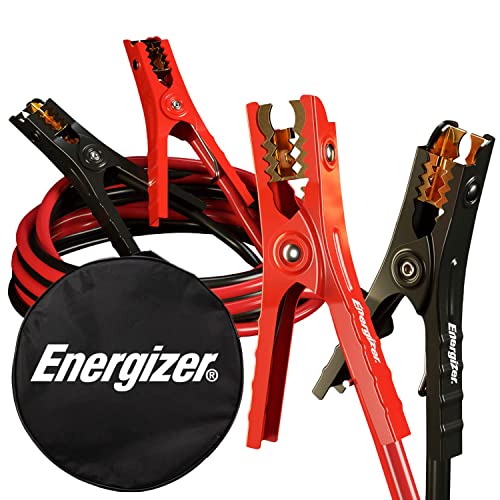
- 4 gauge, 16 ft booster cables
- Copper clad aluminum conductors
- Stays flexible at -40C, per the listing
- Carrying case included
Energizer’s 16 foot set uses the same 4 gauge thickness as the longer kits above but trims the length, which saves weight and trunk space. The listing describes the conductors as copper clad aluminum and says the cables remain flexible even at -40C, a helpful detail when you are uncoiling them with cold hands in a parking lot.
The cables are sold as tangle-free and arrive in a travel bag for storage and carrying. Energizer lists trucks, SUVs, full-size, midsize and compact cars as suitable, so the gauge is not limited to small vehicles. What you give up compared with a 20 foot set is reach: 16 feet still works side by side or nose to nose, but it can fall short when the donor car has to park behind you or across a lane.
This set suits drivers who want a recognizable name and a compact bag for a sedan or crossover. Anyone who often helps neighbors in tight garages or long driveways may be happier with a 20 foot option. As with every cable set, read your owner’s manual first, because some vehicles route jump-starting through remote terminals under the hood rather than the battery itself.
View Energizer 4 Gauge 16 ft on Amazon
4. Goodyear 4 Gauge 16 ft: Jumper Cables with PVC Case and Printed Instructions

- 4 gauge, 16 ft cables
- Tangle-free design
- Pictured and written instructions included
- Built-in cable ties and zippered case
Goodyear’s 4 gauge, 16 foot set is aimed squarely at people who do not jump cars often. The listing highlights included instructions with both pictures and written steps, which is a practical help when a dead battery has you stressed and you cannot remember which clamp goes where. The cables come in a bright blue case with a yellow zipper that is easy to spot in a cluttered trunk.
Goodyear describes the wire as heavy duty and able to bend and twist at awkward angles, so it can reach whether the donor battery sits in front of or beside the dead one. The cables are sold as tangle-free, and built-in cable ties keep them neatly bundled once you are done. The maker lists coupes, sedans, minivans, SUVs and pickup trucks as compatible.
This is a good set to hand to a new driver or keep in a family car. The listing also mentions using the cables with an external jump starter, which some boxes allow. Like the Energizer, its 16 foot length is better suited to side-by-side or nose-to-nose parking than to long reaches, and drivers of large diesels should look at the 2 gauge set instead.
View Goodyear 4 Gauge 16 ft on Amazon

5. NOONE N220 2 Gauge 20 Feet: 800A Booster Cables with Reverse Polarity Protection
- 2 gauge, 20 ft CCA cable
- Reverse polarity protector with light and buzzer
- Listed for up to 7.0L gas and 5.0L diesel
- Rated -40F to 140F, exceeds UL1839
NOONE’s N220 steps up to 2 gauge wire and adds a feature most cable sets lack: a reverse polarity protector built into the line. According to the listing, if the clamps are connected backwards, a red light turns on, a buzzer sounds and the current is cut off. A green light confirms a correct connection, which takes some of the guesswork out of a jump for less experienced users.
The maker lists an 800A peak rating and says the set suits vehicles with up to 7.0 liter gas and 5.0 liter diesel engines, on both 12V and 24V systems. The conductors are high-density copper clad aluminum inside a thick double-layer rubber jacket, and NOONE states that the cables exceed UL1839 standards and work from -40F to 140F. Clamp faces are covered in non-conductive rubber, and a carrying case is included.
This set suits owners of large SUVs, full-size pickups and many diesel trucks, or anyone who simply wants extra margin. The trade-off is weight and bulk, since 2 gauge cable is noticeably thicker to coil and store than 4 gauge. The protector is a helpful safeguard, but it is not a reason to skip the correct hookup order shown later in this guide.
View NOONE N220 2 Gauge 20 ft on Amazon
6. AWELTEC 6 Gauge 20 Feet: Booster Cables with Carry Bag, Gloves and Wire Brush
- 6 gauge, 20 ft CCA cable
- Rated -40F to 140F
- Safety gloves and iron wire brush included
- Carry bag for storage
AWELTEC’s kit pairs a lighter 6 gauge wire with a full 20 foot length, so you keep plenty of reach while carrying less copper clad aluminum than a 4 gauge set. The listing gives an operating range of -40F to 140F, and the company describes the cables as automotive grade and suited to cars and trucks.
The extras are what set this kit apart. Along with the cables and a carry bag, AWELTEC includes a pair of safety gloves and an iron wire brush. The brush is useful when a battery terminal has a crust of white or green corrosion, since clamps grip poorly on a dirty post. Cleaning the contact patch before clamping can be the difference between a quick start and a car that only clicks.
Because 6 gauge is thinner than the other picks here, this set fits best with compact cars and smaller four-cylinder engines. It can still help a larger vehicle, but expect to let the donor car run longer before trying to start. Drivers of V8 trucks or diesels should choose one of the 4 gauge or 2 gauge sets above. For a light, long kit that comes ready for messy terminals, it is a practical option.
View AWELTEC 6 Gauge 20 ft on Amazon
Best Jumper Cables Side by Side
When two sets look similar, choose on length first, since a set that cannot reach the other battery is no help.
| Pick | Gauge and length | Stand-out detail | Good fit |
|---|---|---|---|
| Cartman | 4 gauge, 20 ft | Clamps fit top and side posts | Most cars, vans, midsize pickups |
| TOPDC | 4 gauge, 20 ft | UL certified clamps | Cars and SUVs, cold climates |
| Energizer | 4 gauge, 16 ft | Flexible jacket, carry bag | Everyday cars and crossovers |
| Goodyear | 4 gauge, 16 ft | Printed instructions, cable ties | First-time users |
| NOONE N220 | 2 gauge, 20 ft | Reverse polarity protection | Large gas engines, diesels |
| AWELTEC | 6 gauge, 20 ft | Gloves and wire brush included | Compact cars, small engines |

Jumper Cables and Battery Hookup: The Safe Order
Even the best jumper cables can cause trouble if the clamps go on in the wrong order. Park the cars close without touching, switch off both ignitions and all accessories, and put on eye protection. Then connect in this sequence:
- Red clamp to the positive (+) terminal of the dead battery.
- The other red clamp to the positive terminal of the donor battery.
- Black clamp to the negative (-) terminal of the donor battery.
- The last black clamp to a clean, unpainted bolt or bracket on the dead car’s engine, away from its battery.
Start the donor car, let it run a few minutes, then try the dead car. Remove the clamps in reverse order, never letting the jaws touch. That sequence matches the steps in the Haynes guide to jump-starting a dead battery, which also tells you to check the owner’s manual first. Many newer cars have remote jump terminals under the hood instead of easy access to the battery itself.

Winter in West Michigan is hard on both sides of the jump. Cold slows the chemistry inside a battery, so a weak one that started fine in October can fail on the first single-digit morning. Cheap vinyl jackets also stiffen in that cold, so a stated low temperature rating is worth checking. Keep the set in its bag so road salt and slush stay off the clamps.
When a Jump Start Is Not the Real Fix
One jump after leaving the headlights on is normal. Needing a jump every few days is not, and it usually points to an old battery, a charging fault or something draining power while the car is parked. The likely culprits are laid out in our guide to why a car battery dies overnight.

If the battery itself is past its prime, our guide to the best car battery brands can help you pick a replacement. Dim lights while driving, a battery warning lamp or repeated dead starts after a new battery are signs to book car electrical repair in Grand Rapids so the charging system and any parasitic draw can be tested properly.
More Buying Guides
Frequently Asked Questions
What gauge jumper cables should I buy?
For most cars, SUVs and light trucks, 4 gauge is a good all-round choice. Choose 2 gauge or heavier for large V8s and diesel engines, and treat 6 gauge as the lightest sensible option for small cars. Avoid thin 8 or 10 gauge sets if you can.
How long should jumper cables be?
Sixteen to 20 feet is the practical range. That length lets the donor car park alongside or behind you when a nose-to-nose setup is impossible, such as in a garage, a driveway or a tight parking lot.
Does the jumper cable brand matter?
Less than the specs do. Compare gauge, length, the conductor material and clamp quality before the name on the bag. A well-known brand with thin wire will still struggle to start a big engine.
Can jumper cables damage my car?
They can if the clamps are reversed or touch each other, which may cause sparks or harm electronics. Following the correct hookup order, keeping both ignitions off while connecting and checking your owner’s manual keeps the risk low.
Battery keeps going flat no matter how many jumps it gets? Give 456 AutoFix a call at 616-279-3832, open 8am to 5pm Monday through Friday, or send us a request through the contact page.
Can’t get away during shop hours? Bring the car to 456 Carrier St NE, Grand Rapids, and use our after-hours key drop.