
As an Amazon Associate, 456 AutoFix earns from qualifying purchases. Product links below go to Amazon, where you can confirm the right part for your vehicle.
The 7.3L Power Stroke has a reputation for running forever, but the radiator in front of it is usually the original part or a cheap replacement that has seen twenty Michigan winters. Picking the best radiator for 7.3 powerstroke trucks starts with one question: is your truck an older body style or a Super Duty?
Below we sort out the two generations, explain what to look for in a core, and review six radiators listed for this engine.
Quick answer
Which radiator fits a 7.3 Power Stroke best?
First match the generation. For 1999-2003 Super Duty trucks, the Mishimoto MMRAD-F2D-99 is an all-aluminum upgrade and the TYC 2171 is a stock-style swap. For 1995-1997 trucks, Mishimoto’s MMRAD-F2D-95 is the matching unit. Towing heavy in summer favors a thicker aluminum core.
Our Quick Picks
Three quick picks: an all-aluminum Mishimoto for 1999-2003 Super Duty trucks, an OE-style TYC for a stock-style swap and Mishimoto's matching unit for 1995-1997 trucks. All six radiators are reviewed below; confirm year, model and engine on Amazon before ordering.

Mishimoto MMRAD-F2D-99
All-aluminum radiator with welded tanks that lines up with the factory shroud.

TYC 2171
Factory-style replacement that drops in where the original radiator came out.
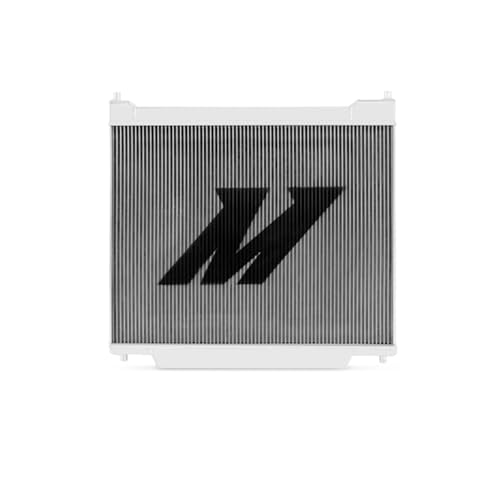
Mishimoto MMRAD-F2D-95
Matching all-aluminum radiator for the older body style trucks.
Two Body Styles, Two Different Radiators
Ford used the 7.3L Power Stroke in two trucks. The older body style, often called OBS, carried it in F-250 and F-350 pickups through 1997. The Super Duty F-250 and F-350 arrived for 1999 and used the engine until 2003, and the Excursion shared it from 2000.
The radiators do not swap between those trucks. The Super Duty unit is taller and narrower, and most replacements for it carry the common interchange number 2171, which also covers the 6.8L V10 gas trucks of the same years. OBS radiators are wider and square, close to 30 inches each way.
- 1999-2003 Super Duty and 2000-2003 Excursion: look for listings that name the 7.3L diesel or the 2171 number.
- 1995-1997 F-250 HD and F-350: look for listings written for those years and check the hose neck positions.
- Early 1994-1995 trucks: compare neck locations with your old radiator first.
What Separates One 7.3 Radiator From Another
The factory radiator pairs an aluminum core with plastic end tanks, and old units usually leak at that seam. DENSO, a major supplier of original equipment radiators, explains on its radiator product page that tank material, fin pitch, core size and flow layout are what set a radiator’s cooling ability.
- OE-style or all-aluminum: a stock-style unit costs less, while welded aluminum tanks remove the seam that cracks with age.
- Core depth: two rows is close to stock; four rows add capacity but need clean airflow to pay off.
- Transmission cooler: on automatic trucks, confirm the cooler fittings match your lines.
- Shroud fit: the engine-driven fan needs a shroud sealed against the core.
Best Radiator for 7.3 Powerstroke: Six Picks by Year Range
The first four radiators are listed for the 1999-2003 Super Duty, and the last two are for 1995-1997 trucks. Confirm year, model, engine and transmission on Amazon before you buy.
1. Mishimoto MMRAD-F2D-99: 2-Row Aluminum Radiator for 1999-2003 Ford 7.3L Powerstroke
- Listed for 1999-2003 Ford 7.3L Powerstroke
- Two-row, 2.2-inch brazed aluminum core
- TIG-welded aluminum end tanks
- Magnetic drain plug; uses the stock fan shroud
Mishimoto’s MMRAD-F2D-99 is built specifically for the 1999-2003 Ford 7.3L Powerstroke, which covers the F-250 and F-350 Super Duty and the Excursion diesel of those years. The listing describes it as a direct fit that aligns with the stock fan shroud, so the factory fan and shroud go back on without cutting or spacers. That matters on these trucks, because the engine-driven fan relies on a tight shroud seal to pull air through the whole core.
The core is two rows deep and 2.2 inches thick, made from brazed aluminum, and the end tanks are TIG welded aluminum rather than the crimped plastic tanks the factory used. Removing that plastic-to-aluminum seam is the main reason owners choose this kind of radiator, since the seam is where aging stock units usually start to weep. A magnetic drain plug at the bottom collects small metal particles circulating in the coolant.
This radiator suits a truck that pulls campers, equipment trailers or a fifth wheel, or one you plan to keep for many more years. It does not fit 1995-1997 trucks, which use a different radiator, and you should check your hoses and cap while the system is open.
View Mishimoto MMRAD-F2D-99 on Amazon
2. TYC 2171 Radiator: OE-Style Replacement for 1999-2004 Heavy-Duty Ford F-Series
- Listed for 1999-2004 heavy-duty F-Series pickups
- Direct OE-style replacement fit
- Louvered aluminum fins and aluminum tubes
- Double header plates and internal tank ribs
TYC’s 2171 is an OE-style radiator listed for 1999-2004 heavy-duty Ford F-Series pickups, and 2171 is the interchange number most sellers use for the Super Duty radiator shared by the 7.3L diesel and the 6.8L V10. Since the 7.3L ended in 2003, a diesel owner should confirm year, cab, engine and transmission in Amazon’s fit tool before ordering.
TYC describes the unit as a direct replacement with drop-in fitment, using aluminum tubes and folded, louvered aluminum fins with tube and fin pitch comparable to the original. The listing also points to reinforcements aimed at the failure points of older radiators: aluminum inlet rings, internal ribs in the tanks, expansion grooves and double header plates where the tanks join the core.
This radiator suits a stock truck that commutes, plows a driveway or hauls light loads, where factory cooling capacity was never a problem. It keeps the original layout, so hoses, shroud and mounts transfer over as they came off. Owners who tow heavy in hot weather or want to be done with tank seams may prefer an all-aluminum unit instead, and the 1995-1997 trucks need a different radiator altogether.

3. ALLOYWORKS 4-Row Aluminum Radiator: 2.5-Inch Core for 1999-2004 Ford Super Duty 7.3L

- Listed for 1999-2004 F-250 to F-550 and 2000-2005 Excursion
- Four-row aluminum core, about 2.5 inches deep
- Aluminum tanks and fittings, 1.77-inch necks
- Leak and pressure tested, per the listing
ALLOYWORKS lists this four-row radiator under the 2171 interchange for 1999-2004 F-250, F-350, F-450 and F-550 Super Duty trucks and 2000-2005 Excursions with the 6.8L or 7.3L engine. The title says it works with automatic and manual transmissions. As with any listing that spans two engines and several years, confirm your exact truck in Amazon’s fit tool before buying.
The core measures about 26.4 by 29.4 inches and roughly 2.5 inches deep, according to the listing, with the overall unit at about 30.3 by 31.7 inches. Both the inlet and outlet are 1.77 inches. The tanks and fittings are aluminum, with a raw finish and no plastic parts, and the seller says each unit is leak and pressure tested.
A deeper four-row core makes the most sense for a 7.3 that pulls heavy trailers, climbs long grades or sees hot summer days at low speed, where the fan does most of the work. The extra depth only helps when the condenser and intercooler in front of it are clean, so rinse that stack during installation. Compare the shroud and mounting points with your old radiator when it arrives, and keep the original cap rating.
View ALLOYWORKS 4-Row 2171 on Amazon
4. DNA Motoring OEM-RA-2171: 2-Row Aluminum Radiator with Trans Cooler for 1999-2004 Super Duty

- Listed for 1999-2004 F-250 to F-550, 6.8L and 7.3L
- Two-row T-6061 aluminum core
- Core 26.5 x 29.4 x 2.25 in, 1.75-inch necks
- Transmission oil cooler included, automatic models
DNA Motoring’s OEM-RA-2171 is an OE-style aluminum radiator listed for 1999-2004 F-250 through F-550 Super Duty trucks and 2000-2005 Excursions with the 6.8L or 7.3L engine. The listing says it fits automatic transmission models, so manual-transmission owners should look elsewhere or check with the seller first. Confirm year, engine and transmission in Amazon’s fit tool before ordering.
The core is made from T-6061 aluminum in a two-row tube and fin layout, and the listing gives core dimensions of 26.5 inches wide, 29.4 inches tall and 2.25 inches deep. Both necks are 1.75 inches. A transmission oil cooler is built into the radiator, while an engine oil cooler is not, which matches how the factory automatic trucks were set up. DNA Motoring describes it as a direct bolt-on replacement for the stock unit.
This one suits an owner with an automatic truck who wants an aluminum replacement without paying for a premium brand. Its two-row core is close to stock capacity, so it restores normal cooling rather than adding a large margin for heavy towing. Check that the cooler fittings line up with your transmission lines, and replace the lower hose and clamps while you are in there.
View DNA Motoring OEM-RA-2171 on Amazon

5. Mishimoto MMRAD-F2D-95: 2-Row Aluminum Radiator for 1995-1997 Ford 7.3L Powerstroke
- Listed for 1995-1997 Ford 7.3L Powerstroke
- Core 29.87 x 23.54 in, 2.28 in thick, 2 rows
- 1.77-inch inlet and outlet
- All-aluminum with magnetic drain plug
For the older body style trucks, Mishimoto makes the MMRAD-F2D-95, listed for 1995-1997 Ford F-250 and F-350 pickups with the 7.3L Powerstroke. These trucks use a wider, squarer radiator than the Super Duty, and the listing gives an overall size of 29.9 by 29.9 inches and 4.5 inches deep. Some sellers note that very early trucks used different neck positions, so compare the inlet and outlet sides on your old radiator.
The core measures 29.87 by 23.54 inches and is 2.28 inches thick with two rows of tubes. The inlet and outlet are both 1.77 inches, and the tank walls are listed at 0.08 inches thick. Construction is all aluminum, so there are no plastic tank seams to crack, and a magnetic drain plug catches small metal debris in the coolant. Mishimoto states a lifetime warranty on the listing.
This radiator suits an OBS owner who plans to keep the truck for years, uses it to tow or simply wants to stop worrying about a 25-year-old tank seam. It will not fit a 1999-2003 Super Duty, and a fresh set of hoses is worth fitting at the same time.
View Mishimoto MMRAD-F2D-95 on Amazon
6. ALLOYWORKS 4-Row Aluminum Radiator: 2.75-Inch Core for 1995-1997 Ford 7.3L Powerstroke

- Listed for 1995-1997 F-250, F-350 and F59 7.3L
- Four-row T-6061 aluminum core, 2.75 in deep
- Core 23.57 x 29.82 in, overall 29.9 x 29.9 in
- 1.77-inch inlet and outlet, no plastic parts
ALLOYWORKS lists this four-row radiator for 1995-1997 Ford F-250, F-350 and F59 chassis with the 7.3L Powerstroke diesel. The listing itself asks buyers to use Amazon’s vehicle fitment tool before ordering, which is sound advice for any radiator on a truck that is now more than 25 years old.
The core is listed at 23.57 inches tall, 29.82 inches wide and 2.75 inches deep, inside an overall size of 29.9 by 29.9 inches. The inlet and outlet are both 1.77 inches. ALLOYWORKS says the radiator is built entirely from T-6061 aluminum with no plastic mixed in, so the tanks are welded to the core rather than crimped. Four rows of tubes give more surface for heat to leave the coolant than a stock-depth core.
This radiator suits an OBS truck that pulls a heavy trailer, carries a slide-in camper or works on hot summer days at low speed. The deeper core is heavier and needs a clean path for air, so check the condenser and intercooler in front of it during the swap. Test-fit the shroud before filling the system, and keep a cap with the rating your truck calls for.
View ALLOYWORKS 4-Row OBS on Amazon
7.3 Power Stroke Radiators at a Glance
Start with your model year, then pick the core that suits how the truck is used.
| Radiator | Listed years | Core | Suits |
|---|---|---|---|
| Mishimoto MMRAD-F2D-99 | 1999-2003 7.3L | 2-row aluminum, welded tanks | Owners done with plastic tanks |
| TYC 2171 | 1999-2004 heavy-duty F-Series | OE-style aluminum core | Stock daily drivers |
| ALLOYWORKS 4-row 2171 | 1999-2004 Super Duty, 2000-2005 Excursion | 4-row aluminum | Frequent heavy towing |
| DNA Motoring OEM-RA-2171 | 1999-2004 Super Duty, automatic | 2-row aluminum with trans cooler | Automatic trucks on a budget |
| Mishimoto MMRAD-F2D-95 | 1995-1997 7.3L | 2-row aluminum | OBS trucks kept for the long haul |
| ALLOYWORKS 4-row OBS | 1995-1997 F-250, F-350, F59 | 4-row aluminum | OBS trucks that tow |
Where a listing reaches 2004 or 2005, those years apply to V10 gas trucks, since the 7.3L diesel ended in 2003. A radiator swap is also a good time to inspect the rest of the cooling system.

On a 7.3 with high miles, a weeping water pump or tired hoses can undo a new radiator within a season. Our guide to water pump brands covers what to look for if the pump shows seepage at the weep hole.
Salt, Campers and Cold Starts in West Michigan
These trucks stack an A/C condenser and an intercooler in front of the radiator, and road salt, sand and leaves pack into the gaps. Rinse the stack from the engine side with a gentle hose every spring.
- Coolant strength: a 50/50 mix gives freeze protection for a Grand Rapids winter; check it with a tester, as covered in our coolant tester buying guide.
- Diesel additives: heavy-duty diesels can suffer cylinder wall pitting when coolant additives run low, so use a coolant suited to your engine. Our diesel truck coolant guide explains the options.
- Fan clutch: a slipping clutch leaves the truck hot at low speed with a camper behind it, whatever the radiator.

Summer towing is where the best radiator for 7.3 powerstroke trucks earns its keep, since a slow climb with a trailer leaves the fan doing most of the work.
Safety note: never open the cap or the degas bottle on a hot engine. Let the truck cool fully, wear eye protection and gloves, and catch old coolant in a pan, since it is toxic to pets and children.
Still Running Hot? Sensors, Codes and Our Shop
A new radiator only fixes a radiator problem. If the gauge still climbs, suspect a stuck thermostat, trapped air or a gauge sender giving a false reading.

A bad coolant temperature sensor can make a 7.3 run rough or feel flat. Our article on a car that hesitates when accelerating covers other causes. If a light is on but the truck seems fine, read about a check engine light that stays on while the engine runs normally.
For codes you can’t trace, our check engine light diagnostic service in Grand Rapids reads stored codes and live sensor data, including the coolant temperature the computer actually sees.
More Buying Guides
Frequently Asked Questions
Will a 1999-2003 radiator fit a 1997 7.3 Power Stroke?
No. The 1995-1997 trucks use a wider, square radiator with different mounts and hose positions. Buy a unit listed for your model year, such as the Mishimoto MMRAD-F2D-95 for 1995-1997 trucks.
Is an aluminum radiator worth it on a 7.3?
On an older truck that tows or will be kept for years, many owners think so, because welded aluminum tanks remove the plastic seam that tends to crack. For a stock truck with light duty, an OE-style unit like the TYC 2171 restores factory cooling.
What is the best radiator for 7.3 powerstroke towing?
A thicker aluminum core helps when the truck pulls heavy loads in hot weather. The ALLOYWORKS 4-row units are listed for both generations, and the Mishimoto radiators add welded tanks, but the fan clutch and shroud must also be in good shape.
Why does my 7.3 still overheat after a new radiator?
Common causes are a slipping fan clutch, a stuck thermostat, trapped air, or debris packed between the condenser, intercooler and radiator. A faulty temperature sensor or gauge sender can also show heat that isn’t really there.
Got a warning light or a temperature reading that doesn’t add up on your diesel? Give 456 AutoFix a call at 616-279-3832 any weekday from 8am to 5pm, or use our contact page to set up a diagnostic appointment.
Need the truck checked without missing work? Our after-hours drop-off at 456 Carrier St NE, Grand Rapids, MI 49505 lets you leave it with the keys and a short note on when the light or the heat shows up.