
As an Amazon Associate, 456 AutoFix earns from qualifying purchases. Product links below go to Amazon, where you can confirm the right part for your vehicle.
A torque wrench in a working bay gets picked up dozens of times a day, dropped on concrete, left on a fender and asked to read the same on Friday as it did on Monday. The best torque wrench for mechanics is the one that keeps its accuracy through that routine, fits the tight spots and comes with paperwork you can check.
This guide covers what to read on a spec sheet, then six shop-grade wrenches across click, split beam and electronic designs. If wheels are most of your torque work, our lug nut torque wrench guide narrows the field to that one job.
Quick answer
Which torque wrench should a working mechanic buy?
Most techs do well with a 3/8-inch wrench around 10 to 100 ft-lb plus a 1/2-inch wrench for suspension and wheels. A split beam like the Precision Instruments PREC2FR100F handles daily use, and an electronic torque-angle wrench such as the TEKTON TRQ81122 covers torque-to-yield bolts.
Our Quick Picks
Three quick picks for a working bay: an electronic all-rounder, a split beam for daily cycles and a torque-angle wrench for engine work. All six are reviewed below.
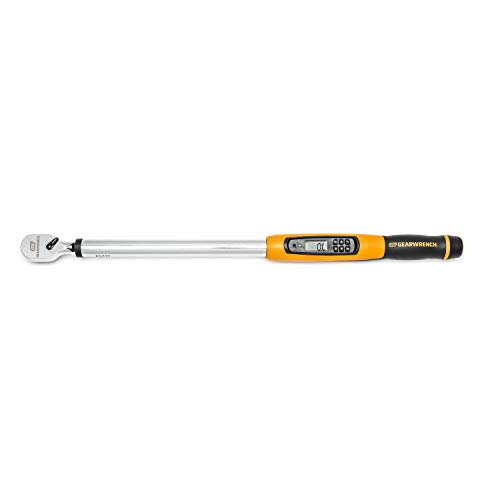
GEARWRENCH 85077
A digital readout and three kinds of alert for loud, busy bays.

Precision Instruments PREC2FR100F
A click wrench that skips the wind-down after every job.

TEKTON TRQ81122
Measures torque and degrees of turn in one tool.
What a Shop Wrench Has to Survive
A home wrench might see a few oil changes and a brake job each year. A shop wrench sees that before lunch, so the qualities that matter shift toward durability and repeatability.
- Head size: a slim head and fine-tooth ratchet reach caliper brackets and manifold studs without pulling parts off first.
- Two drive sizes: 3/8-inch covers most engine and brake fasteners, while 1/2-inch handles hubs, control arms and wheels.
- A serialized certificate: it tells you how the wrench measured when it left the factory, which gives you a baseline for later checks.
- Serviceability: wrenches with replacement ratchet kits and recalibration support last longer than sealed budget tools.
A torque wrench is one piece of a larger kit. Our guide to the mechanic tool set for a home garage covers the sockets and ratchets that go with it.
Reading the Accuracy Line on a Spec Sheet
Accuracy figures like “plus or minus 4%” sound simple, but two details change what they mean. First, many makers quote a tighter figure clockwise than counterclockwise, which only matters if you torque left-hand threads. Second, the figure usually applies from 20% to 100% of the scale, so the bottom fifth of the range is less trustworthy.
In practice, pick ranges so your common specs fall in the middle of a wrench. A 10 to 100 ft-lb wrench is comfortable from about 20 ft-lb upward, and smaller valve cover or intake bolts belong on an inch-pound tool. Beginners building a first kit can start with our starter list of car maintenance tools instead.
Best Torque Wrench for Mechanics: Six Shop-Grade Picks
The six below cover the three main mechanisms in both common drive sizes. Every accuracy and range figure comes from the listing, so check the current listing before you order.
1. GEARWRENCH 85077: 1/2-Inch Electronic Torque Wrench with Target Torque Alert
- 1/2-inch drive electronic torque wrench
- +/-2% clockwise, +/-3% counterclockwise accuracy
- Vibrating handle, buzzer and LED at target
- Reads in Nm, ft-lb, in-lb, kgf-m and kgf-cm
The GEARWRENCH 85077 is a 1/2-inch drive electronic torque wrench built for the heavier fasteners in a bay: hub nuts, control arm bolts, subframe hardware and wheels. Instead of a spring and a click, it measures torque electronically and shows the reading on a screen, so you set a target with buttons rather than turning a handle scale.
The listing quotes accuracy of plus or minus 2% clockwise and 3% counterclockwise between 20% and 100% of the wrench’s capacity. A Target Torque Alert warns you as you approach the setting, then the handle vibrates, a buzzer sounds and an LED lights when you reach it. That combination helps in a noisy shop where a faint click is easy to miss. The 72-tooth ratchet needs a 5-degree swing, the handle and housing resist oil and solvents, readings come in five units, and GEARWRENCH says it meets or exceeds ASME B107.28M.
It runs on two AA batteries, which are not included, so keep spares in the drawer. The listing gives a one-year limited warranty with calibration accuracy covered for 90 days, which makes a recalibration plan part of owning it. Confirm the torque range on the current listing before ordering, and pair it with a 3/8-inch wrench for small engine fasteners.
View GEARWRENCH 85077 on Amazon
2. TEKTON TRQ81122: 3/8-Inch Electronic Torque Wrench, 10-100 ft-lb with Angle Mode
- 3/8-inch drive, 10-100 ft-lb range
- +/-2% torque and +/-1% angle accuracy
- Torque, angle or torque plus angle modes
- 90-tooth flex ratchet head
The TEKTON TRQ81122 is a 3/8-inch drive electronic torque wrench with a range of 10 to 100 ft-lb. Its standout feature for engine work is angle measurement: the listing describes three modes for torque alone, angle alone, or torque followed by angle. That suits torque-to-yield head bolts, main caps and other fasteners where service information lists a torque value and then a number of degrees.
TEKTON lists accuracy within plus or minus 2% for torque and 1% for angle, with the actual figure stated on a serialized certificate for each wrench. It says the wrench is calibrated across its full range to the ISO standard and therefore also meets the ASME standard. The 90-tooth flex head uses a single half-moon pawl that keeps ten teeth engaged, which the maker says prevents skipping under load. Large buttons, a backlit screen, lights, beeps and handle vibration tell you when you reach the target.
The kit includes a 3/8-inch female to 1/4-inch male reducer, a case and the calibration certificate, while batteries are sold separately. The range tops out at 100 ft-lb, so lug nuts and many suspension bolts still need a 1/2-inch wrench. For engine assembly and timing jobs, it can replace a separate angle gauge on the cart.
View TEKTON TRQ81122 on Amazon

3. Precision Instruments PREC2FR100F: 3/8-Inch Split Beam Wrench, 20-100 ft-lb with Flex Head
- 3/8-inch drive split beam design
- 20-100 ft-lb range
- Flex head for awkward angles
- Dated calibration certificate, made in USA
The Precision Instruments PREC2FR100F is a 3/8-inch drive split beam torque wrench with a flex head and a range of 20 to 100 ft-lb. Split beam wrenches still click when they reach the setting, but the adjustment doesn’t compress a long internal spring the way a typical micrometer wrench does. That is why many technicians like them for daily work: there is less to remember at the end of the day.
The listing states that the wrench ships with a dated calibration compliance certificate, comes packaged in a storage case and is made in the USA. The flex head lets you angle the handle around a strut tower, a radiator support or a cluttered intake, while the 20 to 100 ft-lb range covers caliper brackets, many oil drain plugs, water pumps and plenty of engine hardware. Setting it is quick, which helps when you jump between specs on one job.
Because the listing gives only a few details, check the current product page for the exact accuracy figure and ratchet details before ordering. The bottom of the range starts at 20 ft-lb, so small fasteners such as valve cover bolts call for an inch-pound wrench. For wheels and heavy suspension bolts, add a 1/2-inch wrench alongside it.
View Precision Instruments PREC2FR100F on Amazon
4. CDI 1002MFRMH: 3/8-Inch Micrometer Click Wrench, 10-100 ft-lb, Made in USA

- 3/8-inch drive, 10-100 ft-lb / 16.9-132.2 Nm
- +/-4% CW and +/-6% CCW accuracy
- Serialized, NIST-traceable certificate
- Quick release head and pull-down lock ring
The CDI 1002MFRMH is a 3/8-inch drive micrometer click torque wrench covering 10 to 100 ft-lb, or 16.9 to 132.2 Nm on its second scale. It is the traditional shop design: twist the handle to the value, lock it and pull until the wrench clicks. There are no batteries to replace and little to go wrong when it is stored and handled properly.
CDI lists accuracy of plus or minus 4% clockwise and 6% counterclockwise from 20% to 100% of full scale. Every wrench carries its own serial number and a NIST-traceable calibration certificate, per the listing. The wrench is 16 inches long, with a head 1.43 inches across and 1.20 inches deep, and it has a quick release button for sockets. The scales are laser marked, a spring-loaded pull-down ring locks the setting and the handle is lightly knurled for grip.
The listing says the wrench is made in City of Industry, California, and comes in a blow-molded case. The wider counterclockwise tolerance matters only for left-hand threads, but it is worth knowing if you torque those often. Like most micrometer click wrenches, it should be stored as the maker directs, and very small fasteners belong on an inch-pound tool.

5. Wera Click-Torque C 3: 1/2-Inch Click Wrench, 40-200 Nm with Reversible Ratchet

- 1/2-inch drive, 40-200 Nm range
- +/-3% per DIN EN ISO 6789-1
- Reversible 45-tooth ratchet
- Audible and tactile release at the setting
The Wera Click-Torque C 3 is a 1/2-inch drive click torque wrench with a range of 40 to 200 Nm, which works out to roughly 30 to 148 ft-lb. That span covers many wheel, hub, control arm and subframe specs on cars and crossovers. It uses a reversible ratchet with 45 teeth, so you can run a fastener down and torque it without swapping tools.
Wera lists the wrench as precise to plus or minus 3% according to DIN EN ISO 6789-1:2017-07. Setting the value is helped by audible and tactile clicks as you pass the scale marks, which makes it quicker to dial in the same number again. When you reach the set torque, the release gives an audible and tactile signal. The two-component handle is shaped for right-hand use and built to cope with workshop handling.
Because the scale reads in newton-meters, it pairs naturally with European and Asian service data that publishes metric specs, and you avoid converting numbers on the fly. If your reference shows only ft-lb, a quick conversion chart taped to the case helps. The 40 Nm floor means smaller fasteners need a 3/8-inch or inch-pound wrench, and the 200 Nm ceiling rules out some truck hubs and wheels.
View Wera Click-Torque C 3 on Amazon
6. SK 1/2-Inch Digital Torque Wrench: 17-340 Nm with LED Flash Notification

- 1/2-inch drive, 17-340 Nm range
- +/-2% CW and +/-3% CCW accuracy
- Green light at 90%, red at 100%
- Preset torque levels and auto-sleep
The SK 1/2-inch digital torque wrench reads from 17 to 340 Nm, roughly 12.5 to 250 ft-lb, which covers most passenger car and light truck wheel and suspension specs in one tool. A clear digital display shows the reading in four units of measure, so you can match whatever your service information uses without converting by hand.
SK lists accuracy of plus or minus 2% clockwise and 3% counterclockwise from 20% to 100% of maximum range, plus or minus one increment. Lights tell you where you are as you pull: green at 90% of the target and red at 100%. That early warning helps you slow down before you overshoot. The listing also mentions a five-minute auto-sleep, a calibration function and preset torque levels for jobs you repeat often.
An anti-slip handle is shaped to reduce fatigue over a long shift. The wrench comes in a portable storage organizer that holds the two AA batteries it needs, and the listing says those are included. Its wide range makes it a reasonable single 1/2-inch wrench for a shop that handles both cars and pickups, while small engine fasteners still suit a 3/8-inch or inch-pound wrench.
View SK 1/2-Inch Digital Torque Wrench on Amazon
Matching the Mechanism to the Job
No single design wins every job, which is why many techs carry two or three wrenches. The table sums up where each type earns its place on the cart.
| Mechanism | Strengths | Limits | Typical jobs |
|---|---|---|---|
| Micrometer click | Simple, no batteries, quick to set | Store at the lowest setting; feel the click in noisy bays | Brakes, wheels, general bolts |
| Split beam | No winding down after use, tough for daily cycles | Heavier and pricier than basic click wrenches | High-volume brake and suspension work |
| Electronic | Readout, alerts, angle mode on some models | Needs batteries; electronics dislike solvent baths | Head bolts, torque-to-yield, engine assembly |
Torque-to-yield bolts deserve a special note. Service information for many cylinder heads, main caps and some suspension parts lists a torque value followed by one or more angle steps, and an angle mode removes the guesswork of a separate gauge.

For wheel work on a busy day, an impact gun runs nuts down and the torque wrench finishes them. Our impact wrench guide for tire work covers that half of the job, and the Porsche torque wrench picks show how high specs on center-lock hubs push you toward a bigger drive.
Calibration and Cold-Bay Care
A certificate is a snapshot, not a promise. Makers suggest recalibration on a schedule or after a set number of cycles, and any drop onto concrete is a good reason to have a wrench checked early. NIST explains what the word “traceable” does and doesn’t cover in its policy on metrological traceability, which is worth reading before you rely on a certificate.
- Never break bolts loose with it: a breaker bar does that job and the torque mechanism stays untouched.
- Wind click wrenches down: follow the maker’s storage instructions, which for most click designs means the lowest setting.
- Keep electronics dry and clean: wipe them off rather than dunking them in a parts washer.
- Log your checks: a simple date and cycle note on the case helps you spot drift.

West Michigan winters add one more variable. A wrench that spent the night in an unheated bay or a truck toolbox feels stiff, and grease in the mechanism thickens in the cold. Let it warm up indoors before precision work, and wipe off road salt that drips from wheel wells onto anything left near the floor.
When the Job Belongs on Our Lift
The right wrench makes routine work repeatable, but some jobs need more than a torque spec. Timing components, suspension parts with alignment-critical bolts and multi-step factory service items benefit from a full lift, current service data and a second set of eyes.

If your car is due for the work its manual lays out by mileage, our factory scheduled maintenance in Grand Rapids follows those intervals for foreign and domestic vehicles. You keep your own wrench for the quick jobs at home.
More Buying Guides
Frequently Asked Questions
Is a split beam torque wrench better than a click wrench?
Split beam wrenches are a click design too, but the setting doesn’t load a long spring, so they don’t need winding down after use. That suits daily shop work. A quality micrometer click wrench is still accurate when stored and calibrated as the maker directs.
How often should a mechanic recalibrate a torque wrench?
Follow the maker’s guidance, which is usually based on time or number of cycles. Heavy daily use, a drop or readings that feel off are reasons to have it checked sooner by a calibration lab.
Do I need a torque wrench with angle measurement?
If you work on engines with torque-to-yield head or main bolts, angle mode saves time and avoids a separate gauge. For brakes, wheels and general bolts, a click or split beam wrench is enough.
What is the best torque wrench for mechanics who only buy one?
A 3/8-inch wrench covering roughly 10 to 100 ft-lb handles the widest range of engine and brake fasteners. Add a 1/2-inch wrench later for wheels and suspension, where specs often run past 100 ft-lb.
Torqued everything to spec and still hearing a clunk or feeling a pulse in the pedal? Ring our Creston shop at 616-279-3832 any weekday from 8am to 5pm, or send us a note on the contact page to set up a visit.
Busy until closing time? Our after-hours drop-off at 456 Carrier St NE lets you leave the car and keys outside business hours.