As an Amazon Associate, 456 AutoFix earns from qualifying purchases. Product links below go to Amazon, where you can confirm the right part for your vehicle.
A cheap inspection camera is fine for finding a dropped bolt. The best borescope for mechanics has to do more: steer its tip toward a valve face, fit through an injector bore, survive a fender and record clear footage you can show the car’s owner before you quote a teardown.
This guide looks at the features that matter on a working bench, then six articulating and trade-grade cameras. If you only need a simple fixed-tip camera for occasional checks, our guide to borescopes for car inspection covers those models.
Quick answer
Which borescope should a mechanic buy?
For daily engine work, choose a steerable dual-lens camera such as the Teslong TF600, with 4-way articulation and a 6-inch screen. Techs who scope plug holes on hot engines should look at the slim FOXWELL Y400. For diesel glow plug and injector ports, the 5 mm Milwaukee M12 unit is built for that job.
Our Quick Picks
Three cameras that cover most shop inspection work; all six are reviewed in detail below.

Teslong TF600
Joystick control sweeps the tip around a cylinder without twisting the cable.

FOXWELL Y400
A slim steerable tip with heat shutdown for plug-hole work.
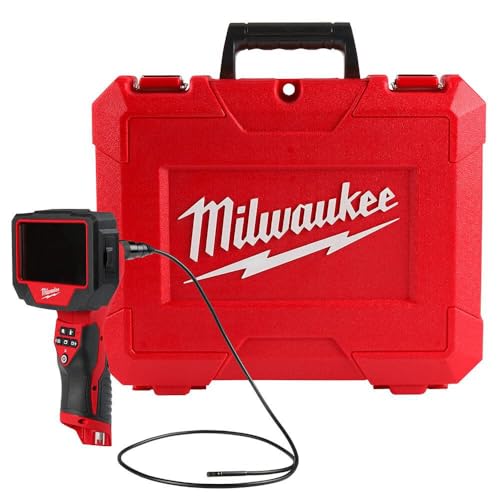
Milwaukee M12 Auto Technician Borescope
Sized for glow plug and injector bores, on the M12 battery platform.
What a Shop Camera Has to Get Right
A shop borescope gets dropped, dragged across greasy manifolds and pushed into warm engines. These specs decide whether one lasts.
- Head size: common spark plug threads are 14 mm, with 12 mm and 10 mm on some engines, and injector or glow plug bores can be tighter still. A head of 6.5 mm or less leaves room to bend the tip.
- Steering: an articulating tip lets you look back toward the valves or sideways at a cylinder wall without pulling the probe out and bending it by hand.
- Heat tolerance: look for a temperature alert or automatic shutdown if you scope engines soon after a road test.
- Recording: photos, video and storage on a card make it easy to attach evidence to a work order or send it to a customer.
- Build: an IP67 probe, a sturdy case and a battery that lasts a shift.
Two-Way, Four-Way or No Steering
A two-way tip bends up and down along one plane, controlled by a thumb wheel. A four-way tip adds left and right movement, usually through a joystick, so you can circle the inside of a cylinder without twisting the cable. Two-way covers most plug-hole checks; four-way is quicker when you scope several cylinders a day.
Best Borescope for Mechanics: Six Pro Cameras Up Close
Five of these steer or carry a dedicated automotive head, and one is a trade inspection system for larger openings. Confirm the probe diameter on each listing against the smallest bore you work in.
1. Teslong TF600: 4-Way Articulating Dual-Lens Borescope with 6″ 1080P Screen
- Joystick tip with 360° rotation and 210° flexion
- 6.5 mm probe with dual 1.0MP cameras
- 6-inch 1920×1080 IPS screen, 6000mAh battery
- Voice notes, 32GB card, IP67 probe
The TF600 is Teslong’s four-way articulating camera, built around a 6.5 mm dual-lens probe on a 5-foot cable. A joystick on the handle drives the tip through 360 degrees of rotation and 210 degrees of flexion, so you can look at a valve seat, then swing the view across the cylinder wall, without backing the probe out. Two 1.0MP cameras switch between forward and side views, and 6+1 adjustable LEDs light both.
The handset carries a 6-inch IPS screen with 1920×1080 resolution, which is large enough to show fine scoring or carbon texture to a customer standing beside the fender. Teslong lists toughened glass and a drop-resistant build, plus a 6000mAh rechargeable battery that charges over Type-C. A built-in speaker and microphone let you record a voice note with each video, which makes it easier to tag footage by cylinder for a work order.
A 32GB card, a hard plastic case and the IP67-rated probe round out the kit. The joystick takes some practice before movements feel natural, and a 5-foot cable is short for long frame rail runs, where a longer semi-rigid camera works better. For daily engine diagnostics, though, four-way control and the large screen are the main reasons to choose it.
2. FOXWELL Y400: 220° Two-Way Articulating Borescope with 6.2 mm Probe
- 6.2 mm (0.24 in) probe for spark plug holes
- 220° two-way thumb-wheel steering
- 2X/4X zoom and 6 LEDs with 3 levels
- Shuts down at 158°F (70°C), 5-7 hour battery
FOXWELL, which lists more than ten years of diagnostic experience, builds the Y400 as its articulating inspection camera. The probe measures 6.2 mm, or 0.24 inches, which FOXWELL pitches for spark plug holes, valves and other tight openings where an 8 mm head can bind. A thumb wheel bends the tip through 220 degrees in two directions, and the listing stresses that the steering is mechanical, with no electronic lag between the wheel and the camera.
Six LEDs with three brightness levels light the view, and instant 2X and 4X zoom helps with small cracks, gasket edges and carbon buildup without moving the probe closer. The probe is rated IP67 against water and dust. FOXWELL also lists an automatic shutdown at 158°F (70°C), which protects the internals if the camera meets a cylinder that hasn’t fully cooled. The cable leaves the top of the handle, keeping your grip clear when you work overhead.
Runtime is listed at 5 to 7 hours, and 32GB of onboard storage keeps photos and video on the unit, with no Wi-Fi or app to set up. The 5.3-foot cable suits engine bays rather than long underbody runs. Two-way steering means you rotate the cable by hand to change direction, which is a small habit to learn and suits most plug-hole jobs.
3. Milwaukee M12 Auto Technician Borescope: 5 mm Dual-Camera Head with HEAT SENSE
- 5 mm head for glow plug holes and injector ports
- Front and side view cameras
- HEAT SENSE alert with shutdown
- 3' semi-rigid cable and 4-level zoom
Milwaukee designed this borescope for automotive technicians rather than general trades. Its 5 mm camera head is small enough for glow plug holes and fuel injector ports, openings that rule out most plug-hole cameras, and the 3-foot cable is semi-rigid so it holds a line as you guide it in. Front and side view cameras let you check a bore straight ahead and then look along its wall.
HEAT SENSE is the feature that stands out for shop use: the camera alerts you and shuts down if the inspection area is too hot, which helps protect the head when a car comes in warm. Four levels of zoom help with hairline cracks. On its product page Milwaukee adds a 4.3-inch rotatable screen, adjustable LED brightness and a 32GB SD card for exporting photos and video to a work order.
The tool runs on Milwaukee’s M12 battery platform, so it makes the most sense in a shop that already owns M12 packs; check the listing for what is included. The cable doesn’t articulate, so angled views come from the side camera rather than a steerable tip. For diesel trucks and tight direct-injection engines, the small head is the reason to pick it.
View Milwaukee M12 Auto Technician Borescope on Amazon
4. Teslong TD500: 6.5 mm Articulating Dual-Lens Borescope with 5″ IPS Screen

- 6.5 mm articulating dual-lens probe
- Forward and side cameras, switchable
- 5-inch IPS screen, 6+1 LEDs
- 32GB card, IP67 probe, carrying case
The TD500 is Teslong’s more compact articulating camera, and this version uses a 6.5 mm probe with two lenses. A forward camera shows what lies ahead of the tip and a side camera shows the surface beside it, and you can switch between them on the handset. The tip bends and rotates through the control on the body, which gets you around corners inside a cylinder head or behind a timing cover.
The 5-inch IPS screen is a step down from the TF600’s display but still easy to read in a dim bay. Six forward LEDs and one side LED light the view, and the 1.0MP cameras record photos and video to the included 32GB card. Teslong rates the probe IP67, so a drip of coolant or a wipe with degreaser is not a concern, and the kit ships in a carrying case.
This model suits a mobile mechanic or anyone with limited toolbox space who still wants a steerable tip. The listing doesn’t state articulation angles in the same detail as the TF600, so if four-way control matters to you, compare the two before ordering. For plug-hole and valve inspections on most gasoline engines, the 6.5 mm head fits with room to bend.

5. DEPSTECH DS650: 210° Articulating Dual-Lens Borescope with 10FT Cable

- 210° two-way articulation, side control wheel
- Dual 78° lenses with split screen
- 10FT semi-rigid gooseneck cable
- High-temp warning, 4.5" IPS, 2200mAh
The DS650 pairs a steerable tip with an unusually long 10-foot semi-rigid gooseneck cable. Its two lenses each cover a 78-degree field and can run in split screen, and the tip articulates 210 degrees in two directions through a wheel on the side of the grip, so it can be worked one-handed. DEPSTECH lists a 0.33-inch probe, about 8.4 mm, which is on the large side for a 10 mm plug thread.
The 4.5-inch IPS screen shows 1080P images from a 2.0MP camera with no Wi-Fi or app involved. Manual focus runs from 3 to 8 cm, with 1.5X zoom, and three LED brightness levels help on reflective metal. The probe is rated IP67, and DEPSTECH lists a high-temperature warning system. An included 8GB card stores files, and the 2200mAh battery is listed at more than four hours.
Where this camera earns its place is reach: the long cable follows a frame rail, a rocker panel or the back of a transverse engine where shorter articulating units run out. On-screen step-by-step guidance helps newer techs. For tight cylinders on small engines, a 6.5 mm or slimmer probe is the better match.
6. RIDGID micro CA-350: Handheld Inspection Camera with 17mm Imager and 3.5″ Display

- 17mm imager head
- 3.5-inch color display
- 12V rechargeable lithium-ion battery
- Interchangeable heads, SeeSnake reel compatible
The micro CA-350 is a trade inspection camera rather than a plug-hole borescope, and it belongs here for shops that need a tough, expandable system. The standard 17mm imager head is far too large for a spark plug hole, but it handles exhaust pipes, intake tracts, HVAC ducts and body cavities well. RIDGID lists interchangeable camera heads for smaller spaces and longer reaches, so the handset can grow with the work.
A 3.5-inch color display sits on a pistol-style handset, and the unit records still images and video for job reports. Power comes from a 12V rechargeable lithium-ion battery, which RIDGID lists for longer runtime during extended inspections. The camera also connects to small SeeSnake reels, including the microReel, nanoReel and microDrain, to extend reach up to 100 feet for long exhaust systems.
Everything stores in a blow-molded case. The CA-350 doesn’t articulate, and its screen is smaller than the dedicated automotive units on this list. Choose it as a second camera for larger passages, or as the main one if your work leans toward exhaust, mufflers and HVAC rather than engine internals.
View RIDGID micro CA-350 on Amazon
Matching the Camera to the Job on Your Bench
Most techs end up picking a camera for the job they do most often. Probe sizes and features below come from the Amazon listings and, for Milwaukee, the maker’s page.
| Shop task | Feature that helps | Camera from this list |
|---|---|---|
| Valve faces and cylinder walls through the plug hole | Slim head with steerable tip and side lens | Teslong TF600, Teslong TD500, FOXWELL Y400 |
| Diesel glow plug holes and injector ports | 5 mm head and heat alert | Milwaukee M12 Auto Technician |
| Long runs behind the engine or along a frame | Long semi-rigid cable with articulation | DEPSTECH DS650 |
| Exhaust, ducts and larger cavities | Large rugged head and reel options | RIDGID micro CA-350 |
If the bench only has room for one tool, the best borescope for mechanics is usually a slim, steerable dual-lens unit, since engine internals are where a camera saves the most labor. A trade system camera earns its place only if you also work on exhaust and HVAC passages often.
Scoping Habits That Save a Comeback
Good footage depends as much on routine as on the camera. A few habits make the pictures easier to read and the findings easier to defend:
- Number every cylinder on the recording: say the cylinder number out loud or write it in the file name, so nobody confuses bank one with bank two later.
- Turn the light down on shiny metal: full brightness on a piston crown washes out detail, while a lower setting shows scoring and carbon texture.
- Let a hot engine cool: even a camera with heat protection lasts longer when it isn’t pushed into a cylinder straight after a long drive.
- Wipe the lens between holes: soot on the glass looks like deposits.
West Michigan cars give a camera plenty to do beyond the engine. Road salt and slush work into rocker panels, subframe pockets and brake line clips, and a long articulating cable reaches those spots without pulling trim. Freeze-thaw potholes also bend heat shields that only show from inside the tunnel, which is why the best borescope for mechanics in this region needs a long, steerable reach as well as a slim head.
Milwaukee’s M12 Auto Technician Borescope product page notes a 4.3-inch rotatable screen, a 32GB SD card and use in passenger, light truck and diesel work. Whichever camera you choose, pair it with a scan tool so the footage confirms what the codes suggest; our guide to the scan tools for a shop bay covers that side.
Where a Camera Stops and a Full Inspection Starts
A borescope can show a scored cylinder, a burnt valve edge or coolant wash on a piston, but it can’t measure compression or leak-down, read live data or tell you how a car drives.

Buying a car for yourself or a customer? A camera is only one item on the list of tools for a used car inspection, and it helps to know what a pre-purchase inspection includes before you rely on your own findings. For a second opinion, our pre-purchase inspection in Grand Rapids covers the car from road test to lift, and a warning light can go to our check engine light diagnostic service.
More Buying Guides
Frequently Asked Questions
Is an articulating borescope worth the extra cost for a mechanic?
If you look inside engines regularly, usually yes. Steering the tip lets you view valve faces and the far side of a cylinder without removing the probe, which saves time on every hole and gives clearer footage for the customer.
What is the difference between 2-way and 4-way articulation?
A 2-way tip bends in one plane, so you rotate the cable to look in other directions. A 4-way tip, like the joystick on the Teslong TF600, also moves left and right, which makes it quicker to sweep around a cylinder.
Can I use a borescope on a hot engine?
Let the engine cool first when you can. Some cameras add protection: Milwaukee lists a HEAT SENSE alert with shutdown, FOXWELL lists a shutdown at 158°F (70°C) and DEPSTECH lists a high-temperature warning, but none of these makes a hot cylinder a good idea.
What is the best borescope for mechanics who work on diesels?
Look for a head small enough for glow plug holes and injector ports. Milwaukee lists a 5 mm head for exactly those openings on its M12 Auto Technician Borescope, along with front and side cameras.
Saw something through the lens you would rather have a second set of eyes on? Call 456 AutoFix at 616-279-3832, Monday to Friday 8am to 5pm, or schedule a look at the car on our contact page.
Your own bays full during the day? The after-hours drop-off at 456 Carrier St NE, Grand Rapids, takes the car, and a saved clip on a phone tells us which cylinder the camera flagged.