
A hole in muffler steel usually announces itself the same way: one cold morning the car starts with a rumble it never had before. In West Michigan that often happens in late winter, after months of salt and short trips.
It is rarely an emergency, but don’t ignore it. Here is why mufflers rot out, when the hole matters, what Michigan law says and when a patch is enough.
Quick answer
Is it safe to drive with a hole in your muffler?
A small hole in a rear muffler is usually safe for a short time, because the gas leaves behind the cabin. It is still loud, and Michigan law requires a muffler in good working order. If you smell exhaust inside the car or the leak is under the seats, stop driving it and have it checked.

Why Mufflers Rot Out in a Michigan Winter
Road salt gets the blame, and it does attack the outside of the can. But most mufflers actually fail from the inside out. Burning fuel makes water vapor, and when a cold exhaust system meets that vapor, it condenses into liquid inside the muffler.
A long highway drive gets the system hot enough to boil that water off. Short trips never do, so acidic water sits in the bottom of the muffler. A car that only runs a few miles to work and back in January can keep its muffler wet all winter.
- Inside: trapped, acidic condensation eats through the lowest seams and the bottom of the case first.
- Outside: salt spray and slush hold moisture against the shell, the clamps and the hangers.
- Freeze and thaw: repeated cycles open up small rust pits until they break through.

One thing to check before you worry: some mufflers have a small factory drain hole at the lowest point to let condensation out. A neat, round pinhole there may be by design. A ragged, rust-edged hole, or one along a seam, is not.
Signs of a Hole in Your Muffler
The muffler is the last big can, usually near the rear axle. Failure tends to show up in this order:
- Louder than usual, especially at a cold start or when you accelerate.
- A deep rumble or “motorboat” sound that grows as the hole gets bigger.
- A rattle from the rear when the engine idles or revs, often loose internal baffles or a rusted heat shield.
- An exhaust smell outside the car, or worse, inside it.
- Black soot or rust flakes around a spot on the case, or a can that sags on its hangers.
A rattle can come from somewhere else, too. If the noise follows bumps rather than engine speed, our guide to a clunking noise over bumps and suspension causes may fit better. A rattle from under the middle of the car can be the converter, which we cover in bad catalytic converter symptoms and what they mean.

If the noise seems to come from the front of the car or the engine bay, the leak is probably not the muffler at all. Our post on exhaust leak symptoms from the manifold to the tailpipe walks through leaks anywhere in the system.
Is It Safe? The Carbon Monoxide Question
Location is what matters. A muffler sits behind the catalytic converter, so gas escaping from a rear muffler hole is no different from tailpipe gas, and it usually leaves behind the cabin. The risk rises when the leak is under the passenger area, when the car idles in snow or a closed space, or when rust has also opened the trunk or floor seams. Exhaust contains carbon monoxide, which you cannot see or smell, so any exhaust odor inside the car means stop driving it until it is checked.
Is a Hole in the Muffler Legal in Michigan?
Michigan’s Vehicle Code speaks to this directly. The full text of MCL 257.707 says a motor vehicle “shall at all times be equipped with a muffler in good working order and in constant operation to prevent excessive or unusual noise and annoying smoke.” The same section also requires “a properly operating exhaust system.”

A muffler with a hole in it is hard to call “in good working order.” We are mechanics, not lawyers, so read the statute for the exact rules. The practical takeaway: fix a rusted-through muffler sooner rather than later.
Patch or Replace?
Patch kits, tape and paste have a place, but it depends on the metal around the hole. If a screwdriver tip pushes through it, there is nothing solid to grip. And because most holes start inside, an outside patch only keeps the noise down until a proper repair.
| Option | When it can work | Limits |
|---|---|---|
| Exhaust tape or wrap | A small hole in otherwise solid metal, to get you by | Temporary; heat and moisture loosen it, and it can trap water |
| Repair paste or putty | Pinholes and small cracks on a clean, sound surface | Cracks off as the metal flexes and heats; fails on thin, rusted steel |
| Patch plate or clamp | A small hole near a joint or on a pipe | Still a stopgap if the muffler is rotting from inside |
| Replace the muffler | Rust holes, seam failures, loose baffles or a sagging case | Hangers, clamps and nearby pipe may need replacing too |

How Urgent Is a Hole in Muffler?
Use the symptom you have to decide how fast to act. When in doubt, have it put on a lift so you can see exactly where the leak is.
| What you notice | What it suggests | How urgent |
|---|---|---|
| Exhaust smell inside the car | Leak near or under the cabin, or a rusted body seam | High Stop driving it and have it checked |
| Muffler or pipe dragging or hanging low | Broken hanger or rusted-through pipe | High Don’t drive it until secured |
| Loud rumble that gets worse each week | Hole is growing, case is rotting through | Soon Book a repair within days |
| Rattle from the rear at idle | Loose baffles or a rusted heat shield | Moderate Have it inspected soon |
| Small round hole at the lowest point, no noise change | Possibly a factory drain hole | Low Watch it and mention it at your next service |
To slow the next muffler down, give the car a longer drive now and then, so the system gets hot enough to dry out. A rinse underneath during a thaw helps with the salt on the outside.
Getting a Muffler Fixed in Grand Rapids
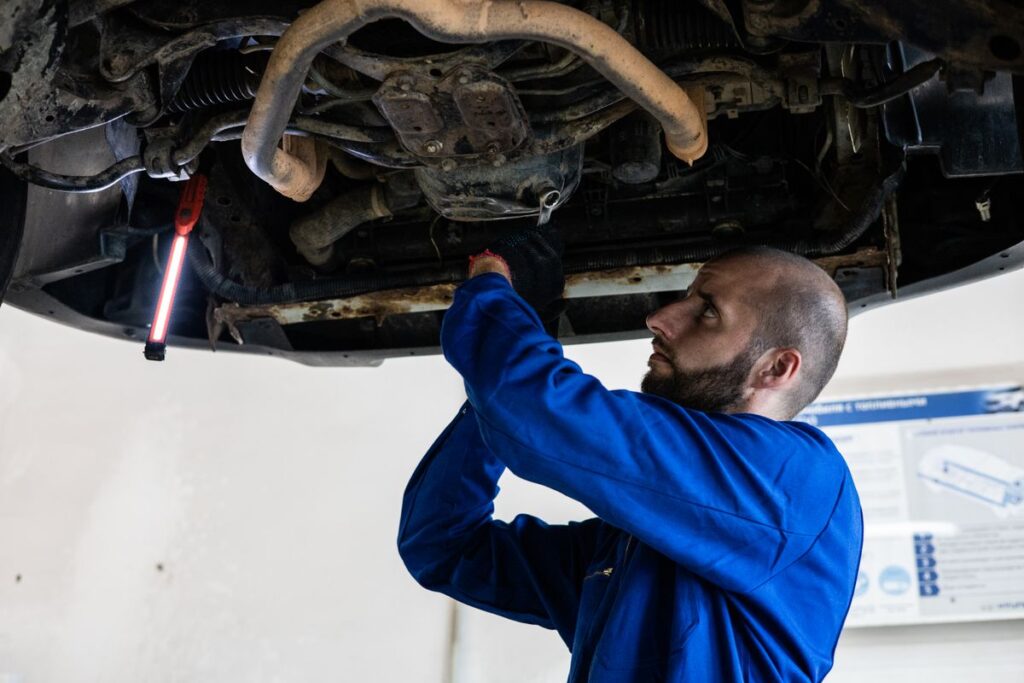
A proper check looks at the whole system, not just the hole you can hear. We inspect the muffler, pipes, hangers and clamps, and tell you whether a section can be repaired or the muffler needs replacing. Our exhaust and muffler repair in Grand Rapids covers foreign and domestic vehicles.
Frequently Asked Questions
Can you drive with a hole in your muffler?
For a short time, usually yes, if the hole is in the rear muffler and you smell no exhaust inside the car. It will get louder as the hole grows, so plan a repair soon.
Can a muffler with a hole be patched?
A small hole in solid metal can be patched with exhaust tape, paste or a clamp to get you by. If the metal around the hole is thin or flaking, the patch won’t hold and the muffler needs replacing.
Is it illegal to drive with a hole in your muffler in Michigan?
MCL 257.707 requires a muffler “in good working order and in constant operation to prevent excessive or unusual noise and annoying smoke.” A muffler with a hole in it may not meet that standard, so read the statute and get it repaired.
Why does my muffler keep rusting out?
Short trips leave water from combustion sitting inside the muffler, where it rusts the case from the inside. Road salt attacks the outside at the same time, which is why Michigan mufflers often fail in late winter.
Need exhaust repair in Grand Rapids? Call 456 AutoFix at 616-279-3832, Monday to Friday 8am to 5pm, or book through our contact page.
Can’t make it during the day? Use our after-hours drop-off. We’re at 456 Carrier St NE in Creston.