
A healthy exhaust is quiet and easy to forget. Once it starts roaring, rattling or leaving a smell in the cabin, it needs attention. At 456 AutoFix in Creston, we handle exhaust repair in Grand Rapids for foreign and domestic vehicles, from muffler and pipe work to catalytic converter and oxygen sensor replacement.
Quick answer
What does exhaust repair involve?
Exhaust repair means finding the leak or failed part, then repairing or replacing only what’s needed, from a gasket or hanger to a muffler or catalytic converter. A loud exhaust is a warning, but an exhaust smell inside the car is urgent because of carbon monoxide. For exhaust repair in Grand Rapids, call 456 AutoFix at 616-279-3832.
Your exhaust carries hot, toxic gas from the engine to the back of the car, cleaning and quieting it on the way. A problem in any section can affect noise, fuel economy, the check engine light and your safety.

Signs you need exhaust repair in Grand Rapids
These are the common signs and how quickly to act on each.
| What you notice | Likely source | How urgent |
|---|---|---|
| Exhaust smell inside the car | A leak ahead of the tailpipe letting gas into the cabin | Now Drive with windows open straight to a shop |
| Ticking on a cold start that fades as it warms | Manifold gasket leak or a cracked manifold | Soon |
| Deep roar that gets louder with speed | Rotted muffler, failed flex pipe or a hole in a pipe | Soon |
| Rattle or buzz under the car | Loose heat shield or a broken hanger | Moderate Check before something drags |
| Check engine light, sluggish power | Catalytic converter or oxygen sensor fault | Have it diagnosed |
| Pipe hanging low or scraping | Broken hangers or a separated joint | Now |
A sudden, very loud roar on a car that was quiet yesterday can also mean a stolen catalytic converter. We cover that below.
Carbon monoxide: when an exhaust problem can’t wait
Exhaust gas contains carbon monoxide, which you can’t see and may not smell. According to the Virginia Department of Health’s carbon monoxide guidance, car exhaust is a common source of CO. The department recommends checking your car’s exhaust system every year.
- If you smell exhaust in the cabin, open the windows and get the car checked right away.
- Headache, dizziness, nausea or confusion while driving are warning signs. Get to fresh air and seek medical help.
- Never let the car idle in a closed garage, and never warm it up in a garage attached to your house, even with the door open.
- After a snowstorm, clear snow away from the tailpipe before you start the engine.

Your exhaust system, part by part
Here is the system from the engine back, so our findings make sense when we explain them.
| Part | What it does | Common failure signs |
|---|---|---|
| Exhaust manifold and gasket | Collects gas from each cylinder | Ticking on cold start, cracks, broken studs, burnt smell under the hood |
| Flex pipe | Lets the engine move without cracking the pipes | Rumble or hiss that rises with speed, frayed braid |
| Catalytic converter | Turns harmful gases into less harmful ones | Check engine light, rattle inside, rotten egg smell, poor power |
| Oxygen (O2) sensors | Tell the computer how the engine and converter are working | Check engine light, worse fuel economy |
| Resonator | Tunes out drone at certain speeds | Droning at highway speed, rust holes |
| Muffler | Quiets the exhaust | Loud exhaust, rattle from broken baffles, rust holes |
| Pipes and tailpipe | Carry gas between parts and out the back | Rust holes, separated joints, soot marks |
| Hangers and isolators | Hold the system up and absorb vibration | Clunks, rattles, low-hanging exhaust |

Why West Michigan exhausts rust out
Exhaust parts here get attacked from two directions. From the outside in, road salt and slush cling to the pipes and muffler all winter, and every freeze-thaw cycle works the corrosion deeper. Seams, clamps and welds usually go first.
From the inside out, the culprit is water. Burning fuel makes water vapor, and on short trips the exhaust never gets hot enough to drive it out. That moisture condenses in the muffler and rear pipes, turns acidic and quietly eats the metal from within.
Short drives in cold weather are the hardest combination, and a longer highway drive now and then helps dry the system out. Rinsing the underside during salt season helps too, and our Michigan winter car maintenance guide covers the rest.
Catalytic converters, theft and Michigan’s rules
Catalytic converters contain small amounts of precious metals, which is why thieves cut them off parked cars. If your car suddenly sounds like a race car on start-up, look underneath for a cut pipe. Report it to the police and your insurer, and we can replace the missing section.
Michigan doesn’t require emissions testing for passenger vehicles, so no inspection will force a converter repair. A failing converter still matters, because it can cost you power and fuel economy and keep the check engine light on. Converter and oxygen sensor codes such as P0420 are covered on our check engine light diagnosis in Grand Rapids page.

Exhaust leak repair options: patch, section or full replacement
Not every leak needs a whole new system. The right repair depends on how much sound metal is left around the problem.
| Option | When it fits | Trade-offs |
|---|---|---|
| Patch, clamp or weld repair | A small hole or cracked joint where the surrounding metal is still sound | Keeps good parts in place. Won’t hold on thin, flaking pipe |
| Section replacement | One part has failed, like a muffler, flex pipe or converter | Fixes the failure without replacing healthy sections |
| Larger or full replacement | Rust has spread through several sections and joints | More parts up front, but avoids repairing one leak after another |
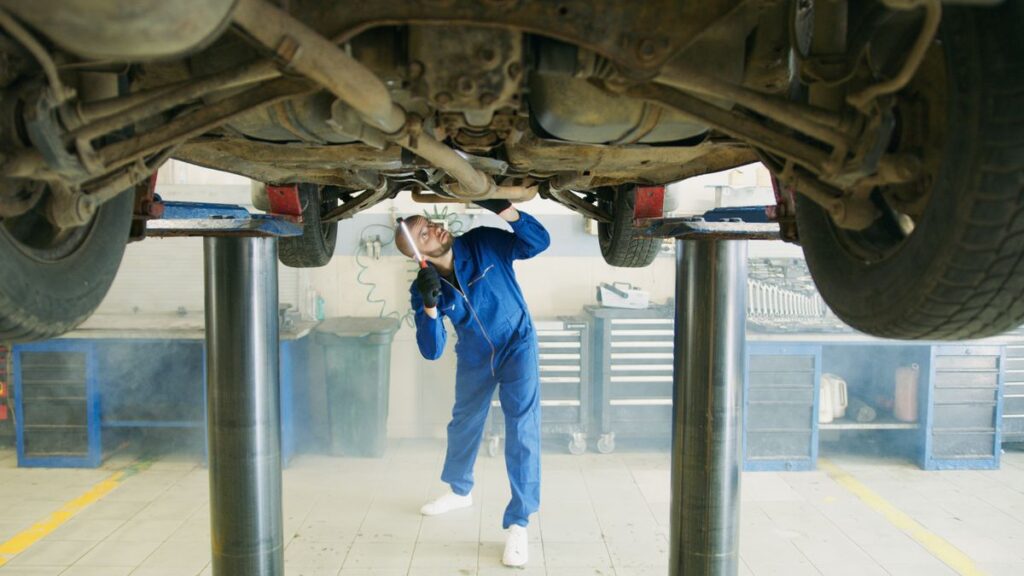
We inspect the whole system on a lift, then tell you what can be repaired and what really needs replacing. Hardware-store putty and wrap may buy a few days, but they rarely last on a rusted pipe.
Audi and European exhaust systems
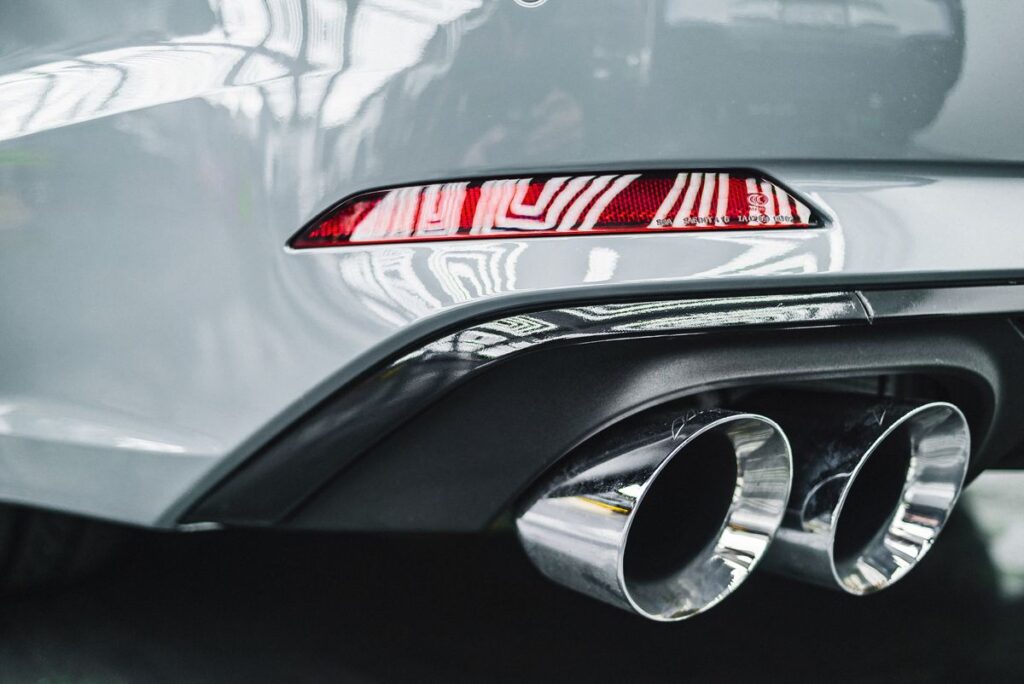
Many European cars, Audi included, use more complex exhaust layouts. You may find more than one catalytic converter, several oxygen sensors and pipes routed tightly around a turbocharger. Accurate diagnosis before ordering parts matters here.
Hendrick Hoffman, our owner and head mechanic, is Audi factory trained and has spent eight years focused on Audi and foreign cars. See our Audi repair service in Grand Rapids, or our page on foreign and European car repair in Grand Rapids. Domestic cars and trucks are just as welcome.
Why bring your exhaust repair to our Grand Rapids shop
- Hendrick has worked in automotive service since 2005 and is a Universal Technical Institute graduate. Meet our certified Grand Rapids mechanic.
- We explain what we found before any work goes ahead.
- We’re in Creston, near several main highways, and work on foreign and domestic vehicles.
An exhaust inspection fits well with brakes and suspension checks, since it’s all done from under the car. See everything we handle on our auto repair services in Grand Rapids page, and find our CARFAX and BBB ratings on the 456 AutoFix homepage.
Related guides
Frequently Asked Questions
Is it safe to drive with an exhaust leak?
A small leak at the back of the car is mostly a noise problem, but it should be fixed soon. If you smell exhaust inside the car, keep the windows open and get it checked right away, because carbon monoxide can build up in the cabin.
Can a rusted exhaust pipe be welded instead of replaced?
Sometimes. Where the metal around a hole or crack is still sound, a repair can make sense. If the pipe is thin and flaking, replacing that section is the lasting fix.
Does Michigan require emissions testing?
No. Michigan doesn’t require emissions testing for passenger vehicles. A failing catalytic converter or oxygen sensor is still worth fixing, because it affects how the engine runs.
Need exhaust or muffler repair in Grand Rapids? Call 456 AutoFix at 616-279-3832, Monday to Friday 8am to 5pm, or book through our contact page.
Can’t make it during the day? Use our after-hours drop-off. We’re at 456 Carrier St NE in Creston.