
As an Amazon Associate, 456 AutoFix earns from qualifying purchases. Product links below go to Amazon, where you can confirm the right part for your vehicle.
The small block Chevy has powered everything from Bel Airs to square-body pickups, and most carbureted versions still feed fuel the old way: a diaphragm pump bolted to the side of the block, driven by a pushrod off the camshaft. The best fuel pump for small block chevy engines depends on what the engine makes and how it is used, not on the brand sticker.
This guide covers mechanical versus electric pumps, how much flow a typical 350 actually needs, and six pumps that suit different builds. Factory-style in-tank modules for later trucks are covered in our guide to choosing a fuel pump brand.
Quick answer
Which fuel pump suits a small block Chevy?
For a carbureted street 350, a block-mounted mechanical pump rated around 80 to 110 GPH, such as the Edelbrock 1721 or Holley 12-327-11, is usually enough and needs no regulator. Bigger or race engines may want a higher-flow pump with a regulator, and an electric pump suits builds without a pump boss.
Our Quick Picks
Three starting points: a stock-style street pump, a higher-flow mechanical for modified engines and a frame-mounted electric pump. Three more options follow in the reviews.

Edelbrock 1721
A straightforward block-mounted pump that runs a carb without a regulator.

Holley 12-327-11
More volume than a stock pump while still running without a regulator.

Holley 12-801-1 RED
A frame-mounted pump for builds without a mechanical pump.
Mechanical or Electric on a Small Block?
A mechanical pump bolts to the passenger side of the block, low and forward. A steel pushrod rides on an eccentric on the cam gear and moves the pump arm, so the pump only works while the engine turns. That makes it simple and self-limiting: no wiring, no relay and no risk of pumping fuel onto the ground after a crash.
An electric pump mounts on the frame rail, ideally close to the tank and below it, because these pumps push fuel far better than they pull it. It needs its own fused circuit and a relay, and many builders wire it through an oil pressure safety switch so it shuts off if the engine stalls.
How Much Flow Does a 350 Need?
Pump makers quote free flow in gallons per hour (GPH), measured with no restriction. A mild street 350 uses only a fraction of what an 80 GPH pump can move, so bigger is not automatically better. Extra flow helps once the engine is built for high rpm or the car runs at the strip.
Pressure matters more than most people expect. Many four-barrel carburetors are happiest around 6 to 7 psi, and a pump with a higher shutoff pressure can push the needle off its seat and flood the bowl. That is why some pumps in this guide say no regulator is required, while the higher-output ones tell you to fit one.
Best Fuel Pump for Small Block Chevy: Six Pumps Reviewed
Five block-mounted mechanical pumps and one frame-mounted electric pump follow, roughly from mild street use to racing. Confirm that each listing names small block Chevy fitment before you order.
1. Edelbrock 1721 Performer Series: 6 PSI Street Mechanical Fuel Pump
- 6 psi output for street use
- No regulator required
- 3/8 in. NPT inlet and outlet
- Gasoline or blended fuels
The Edelbrock 1721 is a block-mounted mechanical pump from the company’s Performer Series, the street-focused line that also covers intakes and carburetors. It bolts to the standard pump boss on a small block Chevy and is driven by the factory pushrod and cam eccentric, so the installation follows the same steps as a stock replacement.
Edelbrock lists an output of 6 psi, which sits in the range most street four-barrel carburetors are set up for, and says no regulator is needed. That keeps the plumbing simple: one feed line from the tank and one to the carburetor. The inlet and outlet are tapped for 3/8 inch NPT fittings, and the listing notes a valve design aimed at better flow quantity and quality. Edelbrock also states that the pump is designed for gasoline or blended fuels, which covers the E10 sold at most stations.
This is a sensible pick for a stock or mildly built 350, especially where the old pump has started leaking or dropping pressure. It is not meant for alcohol fuel or for high-horsepower engines that need more volume than a street pump delivers. If your carburetor or fuel log is set up for a lower pressure, check that 6 psi suits it before you fit the pump.
2. Holley 12-327-11: 110 GPH Mechanical Fuel Pump with Rotatable Body
- 110 GPH free flow
- 6.5 to 8 psi shutoff pressure
- No regulator required
- 3/8 in. NPT, rotatable body
Holley’s 12-327-11 is a mechanical pump for small block Chevy engines that steps up the volume while keeping pressure in a carburetor-friendly range. Holley rates it at 110 GPH free flow, with shutoff pressure pre-set between 6.5 and 8 psi, and states that a fuel pressure regulator is not required.
The construction is described as heavy duty for continuous high rpm operation, which suits engines with a bigger cam, a larger carburetor or a car that sees long highway stretches. The fuel body casting can be rotated to suit different plumbing, a handy detail when headers, a power steering bracket or a frame rail crowd the area where the lines usually run. Both ports are tapped for 3/8 inch NPT, so it pairs naturally with a 3/8 inch feed line.
Owners of stock engines can use it too, though the extra volume will not be noticed on a mild 350. The upper end of its pressure range is worth checking against your carburetor’s needle and seat, since some carburetors start to flood near 8 psi. Holley’s catalog lists it as a small block Chevy pump, but the Amazon bullet points do not name the engine, so confirm the listing shows small block fitment before ordering.
View Holley 12-327-11 on Amazon

3. Holley 12-834: 80 GPH Mechanical Fuel Pump with 1/4 in. NPT Ports
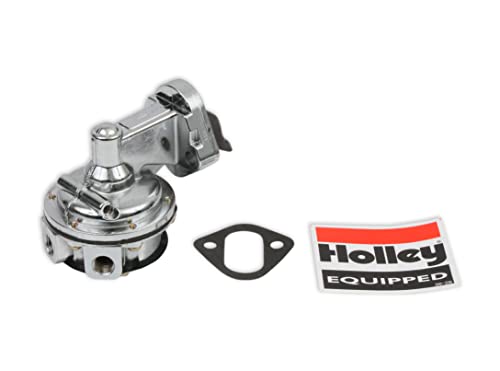
- 80 GPH free flow
- 7.5 psi shutoff pressure
- No regulator required
- 1/4 in. NPT inlet and outlet
The Holley 12-834 is a street performance mechanical pump with a more modest flow figure than the 110 GPH units. Holley lists 80 GPH free flow and a shutoff pressure pre-set at 7.5 psi, and says no fuel pressure regulator is required.
Its main difference from the 12-327-11 is the port size. The inlet and outlet are tapped for 1/4 inch NPT, which suits engines that still run smaller original-style fuel plumbing instead of a 3/8 inch line. Like other Holley mechanical pumps, the fuel body casting can be rotated to line up with existing hoses, and the build is described as heavy duty for continuous high rpm operation. For a stock 305 or 350 in a daily driver, pickup or survivor car, 80 GPH is plenty of fuel.
The 7.5 psi shutoff is a little higher than some stock carburetors prefer, so check what your carburetor maker recommends and watch for flooding or a rich idle after installation. Owners planning a bigger carburetor or a move to 3/8 inch line will be better served by a pump with 3/8 inch ports. The API listing does not spell out the engine family, so confirm small block Chevy fitment on the listing before you buy.
4. Holley 12-327-13: 130+ GPH Mechanical Fuel Pump for Small Block Chevy

- 130+ GPH free flow
- 7.5 to 9 psi shutoff pressure
- Regulator required (Holley 12-704 recommended)
- 3/8 in. NPT, rotatable body
For small blocks that make well beyond stock power, Holley’s 12-327-13 raises the free flow figure to 130 GPH or more. Shutoff pressure is pre-set between 7.5 and 9 psi, and here Holley is clear that a fuel pressure regulator is required, recommending its 12-704 regulator.
The listing describes redesigned high flow valves intended to keep fuel delivery steady, along with heavy duty construction for continuous high rpm use. As with the 12-327-11, the fuel body can be rotated to suit different line routing, and the ports are tapped for 3/8 inch NPT. Those features make it a fit for a stroker, a high-compression street engine or a car that spends weekends at the drag strip.
The regulator is not optional. Without one, 9 psi can overpower the needle and seat in many carburetors and cause flooding, a rich idle or fuel spilling from the vents. Budget for the regulator, a pressure gauge and the right fittings when planning the swap. On a mild 350, this much volume adds complexity without a real benefit, and one of the pumps above will be simpler to live with.
View Holley 12-327-13 on Amazon

5. Edelbrock 1711 Victor Series: 13-14 PSI Racing Pump for Gas or Alcohol

- 13 to 14 psi maximum pressure
- Gasoline and alcohol fuels
- 6-valve body, alcohol-proof diaphragm
- Designed for small block vehicles
The Edelbrock 1711 belongs to the Victor Series, Edelbrock’s racing line, and it is a very different tool from the street pumps above. Edelbrock lists a maximum pressure of 13 to 14 psi and says the pump is designed for both gasoline and alcohol fuels, using a 6-valve body and a large alcohol-proof diaphragm.
Alcohol fuel needs far more volume than gasoline for the same power, which is why racing pumps like this one move so much fuel at such high pressure. The listing also mentions aircraft-type allen bolts on the body and states that the pump is designed for small block vehicles. It mounts in the usual pump location and runs off the cam eccentric like any other block-mounted pump.
That pressure is far above what a street carburetor can handle on its own, so plan on a regulator set to your carburetor maker’s figure and a gauge to confirm it. This pump suits drag cars, circle track engines and alcohol-fueled builds rather than cruisers or daily drivers. Owners running ordinary pump gas on a street 350 will find it more pump than they need and should look at the Performer or Holley street models instead.
View Edelbrock 1711 Victor on Amazon
6. Holley 12-801-1 RED: 97 GPH Electric Fuel Pump for Carbureted Engines
- 97 GPH free flow
- 7 psi maximum pressure
- 2 amp motor draw
- Relay kit 12-753 and 7.5 amp fuse recommended
Holley’s RED electric pump is the frame-mounted alternative for small block owners who cannot or would rather not use a block-mounted pump. Holley rates the 12-801-1 at 97 GPH free flow with a maximum pressure of 7 psi, a figure that suits most street carburetors without extra hardware.
The listing describes a lower housing casting designed for better flow and constant fuel flow without pulsation, aimed at street and strip use. The motor draws 2 amps, and Holley recommends its 12-753 relay kit and a 7.5 amp fuse, so plan the wiring rather than tapping into an existing circuit. Mount it low and near the tank, because electric pumps push fuel much better than they pull it. Many builders also add an oil pressure safety switch so the pump stops if the engine stalls.
This pump suits engines with a blocked-off pump boss, swaps where headers or brackets get in the way, and cars with long fuel lines that suffer from slow hot restarts. It is a gasoline pump for carbureted engines, not for fuel injection, which needs much higher pressure. Holley also states that it is not designed for use on aircraft of any type.
View Holley 12-801-1 RED on Amazon
The Six Pumps Side by Side
If you are still weighing the best fuel pump for Small Block Chevy builds, this summary uses the figures from each listing, with both ends shown where a range is given.
| Pump | Flow and pressure | Regulator | Suits |
|---|---|---|---|
| Edelbrock 1721 | 6 psi | Not required | Stock to mild street 350s |
| Holley 12-327-11 | 110 GPH, 6.5 to 8 psi | Not required | Modified street engines |
| Holley 12-834 | 80 GPH, 7.5 psi | Not required | Engines with 1/4 inch lines |
| Holley 12-327-13 | 130+ GPH, 7.5 to 9 psi | Required | Strong street and strip builds |
| Edelbrock 1711 | 13 to 14 psi | Plan on one with a carb | Racing on gasoline or alcohol |
| Holley 12-801-1 | 97 GPH, 7 psi max | Not required | Frame mount or pusher setups |
Fuel-injected small blocks are a different job. The throttle-body 350 trucks of the late 1980s and early 1990s, and the Vortec 5.7 that followed, use in-tank electric pumps rather than a block-mounted one. If you are converting to an LS engine instead, our page on the best fuel pump for LS swap builds covers the higher pressure those engines need.

Winter Storage, Ethanol and Spring Start-Up
Plenty of small block cars in West Michigan sit from November to April. Most pump gasoline in the U.S. contains up to 10 percent ethanol, and the fueleconomy.gov guide to ethanol blends notes that E15 is approved only for 2001 and newer vehicles, which leaves out nearly every carbureted small block. Stick to E10 or ethanol-free fuel in an older car.
Fuel left sitting all winter can leave varnish in the carburetor and dry out rubber parts. Store the car with a full tank treated with a stabilizer from our guide to the best fuel stabilizer, and run the engine long enough to pull treated fuel through the pump and carburetor.

In spring, a mechanical pump may need a few short cranking bursts to refill the bowl. Check the pump body, fittings and weep hole for wet spots before the first drive. Fuel at the weep hole means the diaphragm has failed and the pump needs replacing.
Is the Pump Really the Problem?
A stumble when you open the throttle can come from a weak pump, but it is just as often a clogged filter, a stuck accelerator pump in the carburetor, a vacuum leak or worn ignition parts. Our page on why a car hesitates when accelerating walks through those overlaps. A cheap fuel pressure gauge at the carburetor inlet settles the question quickly.

Small block trucks with throttle-body or Vortec injection store codes when fuel pressure runs low, and a check engine light that stays on while the engine runs fine can be an early sign. Our check engine light diagnostic in Grand Rapids reads those codes and the live data, so you know where the fault is before buying parts.
More Buying Guides
Frequently Asked Questions
Is a mechanical or electric fuel pump better for a 350?
For most carbureted street 350s, a mechanical pump is the simpler choice because it needs no wiring and shuts off with the engine. An electric pump suits builds without a pump boss, cars with long fuel runs, or owners who want a pusher pump near the tank.
Do I need a fuel pressure regulator on a small block Chevy?
Not with pumps whose listing says no regulator is required, like the Edelbrock 1721 or Holley 12-327-11. Higher-output pumps such as the Holley 12-327-13 call for one, and so does any pump whose shutoff pressure is above what your carburetor is set up for.
Why does my new mechanical fuel pump not pump?
The usual causes are a pushrod that dropped out of place during installation, an arm sitting on the wrong side of the pushrod, or an air leak on the inlet hose. Holding the pushrod up with heavy grease or a bolt through the block while you fit the pump helps.
Does a Vortec 350 use a mechanical fuel pump?
No. The Vortec 5.7 and the earlier throttle-body 350 trucks use an electric pump inside the fuel tank. Their replacement is a module or in-tank pump matched to the truck’s year and tank size, not one of the block-mounted pumps above.
Hard starts, a stumble off the line or a fuel smell from the engine bay? Call 456 AutoFix at 616-279-3832, Monday through Friday from 8am to 5pm, or book a diagnostic visit through our contact page.
Classic owners who can’t get away during the day can leave the car with our after-hours drop-off at 456 Carrier St NE, Grand Rapids, MI 49505. Tell us whether the trouble shows up cold, hot or only under load, and we’ll start there.