
As an Amazon Associate, 456 AutoFix earns from qualifying purchases. Product links below go to Amazon, where you can confirm the right part for your vehicle.
Picking the best coolant tester starts with a question most listings skip: what are you trying to find out? A tool that reads freeze protection can’t find a leaking hose, and a pressure kit can’t tell you whether the mix will survive a January cold snap.
This guide sorts coolant testers by the job they do, then reviews six that cover those jobs. If you’re still choosing the fluid itself, start with our guide to picking the best coolant brand for your engine.
Quick answer
Which coolant tester should a home mechanic buy?
For freeze protection, a refractometer with automatic temperature compensation, such as the Triplett RFT55, reads more consistently than a float tester. To chase a coolant leak, add a pressure tester kit like the Mishimoto MMTL-CPT-28. Test strips such as Phoenix 8001-B show when tired coolant needs replacing.
Our Quick Picks
Three quick picks for the three most common checks: freeze protection, leak hunting and coolant condition. All six testers are reviewed below.

Triplett RFT55
Reads freeze protection from two or three drops of coolant.

Mishimoto MMTL-CPT-28
Pressure test plus vacuum refill in one case.

Phoenix Systems 8001-B
Shows when coolant is worn out, whatever its color.
What Does a Coolant Tester Do?
“Coolant tester” is a loose label for four different tools. Each one answers a single question about the cooling system, and none of them answers all four:
- Freeze-point testers (refractometers and float hydrometers) tell you how much glycol is in the mix, which sets freeze and boil protection.
- Test strips show the chemical condition of the coolant, so you can see when the additives are spent even though the color still looks fine.
- Pressure testers pump the cold system up to its cap rating so a leak shows itself as a drip or a falling gauge.
- Combustion leak testers sample the air above the coolant for exhaust gas, the classic sign of a head gasket or cracked head problem.
The best coolant tester kit for a home garage usually pairs a freeze-point tool with strips, then adds a pressure tester once the reservoir starts dropping.
How Do Coolant Testers Work?
A refractometer bends light through two or three drops of coolant on a glass prism. The more glycol in the sample, the further the light bends, and you read the freeze point where a shaded line crosses the scale. Ethylene and propylene glycol bend light differently, so the scale has to match your coolant base.
Maker notes matter here. ATD, for example, says its 3705 coolant refractometer works with ethylene or propylene glycol but is not for OAT coolants or DEF. Read the instructions for any refractometer before trusting it on an extended-life coolant.
Float hydrometers are cheaper, but their readings shift with coolant temperature and vary more than a refractometer’s. Strips change color and are matched to a chart, while pressure and combustion testers work on the sealed system rather than a sample.
Best Coolant Tester Picks in Detail
The best coolant tester for your garage depends on the problem you’re solving, not on how many pieces come in the case. These six cover freeze protection, coolant condition, leaks and combustion gas.
1. Triplett RFT55: Glycol and Battery Refractometer with ATC
- Freeze point for ethylene and propylene glycol in °F
- Battery acid specific gravity scale
- Automatic temperature compensation
- Pipette, screwdriver, cloth and case included
The Triplett RFT55 is a handheld optical refractometer for checking how much protection your coolant mix gives. According to the listing, it reads the freeze point of both propylene and ethylene glycol in Fahrenheit, and it carries a separate scale for battery acid specific gravity. That makes it useful for more than the radiator if you still maintain flooded batteries.
A test takes only two or three drops of coolant on the prism. Automatic temperature compensation corrects for the air around you, so a reading taken in a cold garage should line up with one taken in a warm shop. You calibrate it with distilled water and the small screwdriver in the kit, and the case, cleaning cloth and pipette keep everything together in a drawer.
This style of tool suits owners who check the mix every fall, top off with water during the summer, or want to confirm the ratio after a flush and refill. It does not measure additive condition, pH or leaks, so pair it with strips or a pressure tester for those jobs. As with any refractometer, read the coolant base on the jug first, because each glycol has its own scale, and check the instructions if you run an extended-life coolant.
2. ATD Tools 3705: Coolant Refractometer with Steel Body and ATC

- Freeze point for ethylene or propylene glycol
- Battery acid gravity scale
- Automatic temperature compensation
- Steel body with adjustable viewfinder
The ATD Tools 3705 is a refractometer built with a steel body for life in a busy tool drawer. It checks the freezing point of coolant and also measures battery acid gravity, so one tool covers two routine winter checks. The listing points to automatic temperature compensation, large graphics and a high-contrast lens that make the shaded line easier to read under shop lighting.
An adjustable viewfinder lets you bring the scale into focus for your eyesight, and ATD’s own product page lists a storage case, fluid dropper, cleaning cloth and mini screwdriver in the box. The maker also says it works with ethylene or propylene glycol antifreeze, but that it is not for use with OAT coolants or DEF. That is an important limit, because many newer vehicles leave the factory with an organic acid coolant.
This refractometer suits owners of older vehicles on conventional green coolant, or anyone looking after farm machinery, trailers and other equipment with glycol systems that are not OAT. If your coolant jug says OAT, or you are unsure what is in the system, the Triplett above or a test strip is the safer first check. Read the maker’s coolant notes before you rely on any freeze point reading for winter protection.

3. Phoenix Systems 8001-B: 100 Coolant Condition Test Strips
- 100 strips in one pack
- Works with all coolant colors and types
- 60-second visual read
- For coolant as diluted in the vehicle
Phoenix Systems 8001-B strips answer a different question from a refractometer: is the coolant still doing its job, or has it worn out? The pack holds 100 strips, and the listing says they work with every coolant color, including conventional, long life, extended life, Dex-Cool and low-tox formulas. That broad coverage helps when you buy a used car and have no idea what went into it.
Each test is a 60-second visual check. You dip a strip in a sample from the reservoir or radiator, wait, and compare the pad to the color chart. Phoenix stresses that you should test coolant as it sits in the vehicle, usually diluted around 50/50, and not straight concentrate from the jug, which would give a misleading result.
Strips suit owners who want a simple go or no-go answer before deciding on a flush, and they are easy to keep in a glovebox. They are consumables, so the pack runs out eventually, and color matching takes good light and honest timing. They also do not find leaks or measure the exact freeze point, so many people keep a pack alongside a refractometer and use both on the same sample.
View Phoenix Systems 8001-B on Amazon
4. Mishimoto MMTL-CPT-28: 28-Piece Pressure Tester and Vacuum Refill Kit
- 17 adapters and 3 test caps
- 0 to 35 psi gauge range
- Vacuum purge refill tool
- Molded storage case
The Mishimoto MMTL-CPT-28 is a cooling system pressure tester that also includes a vacuum refill tool. The 28-piece kit comes with 17 adapters and three test caps meant to cover most import and domestic vehicles, all stored in a molded case. Mishimoto lists an operating range of 0 to 35 psi, which covers the cap ratings found on typical passenger car systems.
In use, you fit the correct adapter to the cold filler neck, pump the system to the pressure printed on your cap and watch the gauge. A dropping needle points to a leak, and the pressure often pushes coolant out of a weak hose, seam or gasket where you can see it. The test caps let you check the radiator cap itself, which is a common and easily missed cause of coolant loss.
The vacuum purge tool pulls air out of the system so fresh coolant fills it without trapped pockets, cutting down on the bleeding many engines need after a repair. That half of the kit relies on compressed air, so plan for a compressor. This kit suits owners chasing a slow loss or refilling after a hose, radiator or water pump job, and it is more than you need for a simple freeze point check.
View Mishimoto MMTL-CPT-28 on Amazon

5. Astro Tools 78585: Radiator Pressure Tester with Vacuum Refill Tool
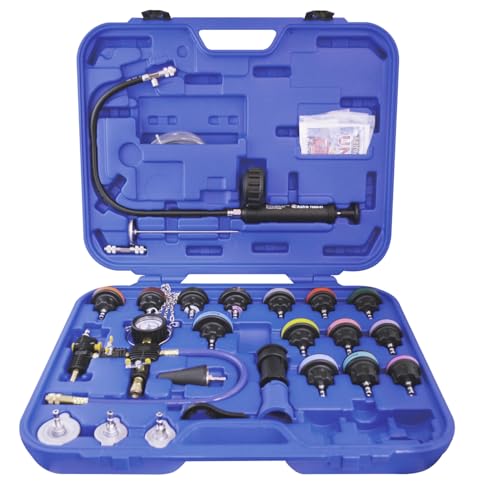
- For domestic and import vehicles
- Color-coded radiator test caps
- Vacuum purge and refill connection
- Blow-molded carry case
The Astro Tools 78585 is another universal radiator pressure tester paired with a vacuum type refill tool. The listing describes it as suitable for both domestic and import vehicles, and it keeps the gauge, pump, adapters and refill tool in a blow-molded case. That makes it a reasonable fit for a household with several different cars sharing one garage.
Astro uses color-coded radiator test caps, which help you pick the right adapter quickly instead of trying each one on the filler neck. The vacuum purge and refill connection is designed to fit nearly all types of radiator openings, so the same kit handles both leak testing and refilling after a cooling system repair. As with any pressure tester, work on a cold engine and stop at the rating stamped on your cap.
This kit suits owners who want a pressure tester and refill tool from an established tool maker without needing every specialty adapter. The listing does not state a gauge range or an adapter count, so compare the included adapters with your vehicles before buying, especially for trucks, older models or machinery with unusual filler necks. Like the Mishimoto, the refill side generally needs shop air, so a compressor is part of the setup.
View Astro Tools 78585 on Amazon
6. Block Tester BT-500: Combustion Leak Test Kit with 16-Test Fluid
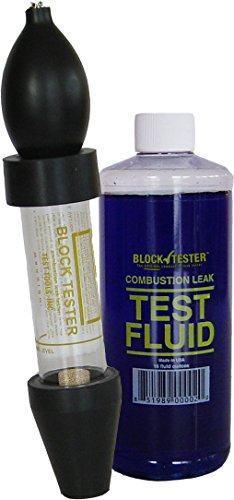
- Fluid turns blue to yellow with combustion gas
- Fluid for 16 tests included
- Single-chamber tester design
- Gas, diesel, propane and natural gas engines
The Block Tester BT-500 checks for something the other tools here cannot see: exhaust gas in the cooling system. The kit draws air from above the coolant through a test fluid that turns from blue to yellow when combustion gas is present. A positive result points to a blown head gasket, a cracked head or block, pulled studs or a warped sealing surface.
The listing says the kit includes everything needed to start, with enough fluid for 16 tests, and uses a large single-chamber design intended to give a clear result from less fluid. It works with virtually any liquid-cooled engine with a closed cooling system, including gasoline, diesel, propane and natural gas engines. The maker states it is made in the USA and backs it with a limited lifetime warranty.
This tester suits anyone whose engine is losing coolant with no outside drip, overheating under load, or showing bubbles in the reservoir. Keep the coolant level low enough in the neck that liquid never reaches the test fluid, or the result can be wrong. A yellow reading is a strong reason to get a full diagnosis before trying a sealer, because some internal leaks need a repair rather than a bottle.
View Block Tester BT-500 on Amazon
Which Tester Answers Which Symptom?
Start from what the car is doing, because the best coolant tester for a winter check is the wrong tool for a leak.
| Symptom or job | Tester to reach for | What the result tells you |
|---|---|---|
| Getting ready for winter | Refractometer | Freeze point of the current mix |
| Coolant is old or of unknown history | Test strips | Whether the additive package is worn out |
| Reservoir keeps dropping, no puddle obvious | Pressure tester | Where the system leaks under pressure |
| Bubbles in the reservoir or overheating on hills | Combustion leak tester | Whether exhaust gas is reaching the coolant |
| Just flushed and refilled | Refractometer plus vacuum refill tool | Correct mix and no trapped air |
After a flush, a refractometer confirms you didn’t leave the mix too weak with leftover water in the block. Our guide to the best radiator flush for a clean cooling system walks through the drain and refill side of that job.

In West Michigan, the freeze-point check is worth doing every fall. Coolant topped up with plain water over the summer can lose protection with no change in color, and a frozen mix can crack a block or heater core.
How to Use a Coolant Pressure Tester
For a slow coolant loss, the best coolant tester is a pressure kit, and it is simple to use if you respect the heat. Follow the kit’s instructions and the pressure printed on your cap:
- Work cold: never open a hot radiator or reservoir. Let the engine sit until the upper hose is cool to the touch.
- Fit the right adapter: match the adapter to the filler neck so it seals without forcing it.
- Pump to the cap rating, no higher: overshooting can split an old hose or a plastic tank.
- Watch and look: a falling needle means a leak. Check hoses, radiator seams and the water pump weep hole.
- Test the cap too: most kits include cap adapters, because a weak cap lets coolant boil off without any visible drip.

A radiator coolant pressure tester and vacuum refill kit adds a venturi tool that pulls the system into a vacuum, then draws fresh coolant in with fewer air pockets. It typically needs an air compressor, so check your setup first.
When the Readings Point to the Shop
Some results are a job for a lift and a full diagnosis. If a combustion leak tester changes color, or the pressure gauge falls with no outside leak, coolant may be going into the engine. A milky substance under the oil cap or steady white smoke from the exhaust backs that up.
Trapped air or a leaking core can also leave you with lukewarm cabin heat, which our car heater repair in Grand Rapids covers.

Not sure where to start? If the car is due for an oil change in Creston, mention the coolant loss when you drop it off. Low coolant and a milky oil cap are things we would want to know about before the new oil goes in.
More Buying Guides
Frequently Asked Questions
How do you use a coolant tester?
With the engine cold, take a sample from the radiator or reservoir. Put two or three drops on a refractometer prism and read the freeze point, or dip a strip and match the color within the stated time. Always use the scale or chart for your coolant type.
Can a coolant tester detect a blown head gasket?
A freeze-point tester or strip can’t. A combustion leak tester can, because its fluid changes color when exhaust gas reaches the coolant. A positive result still needs a proper diagnosis before any repair is planned.
Do I need the vacuum refill tool in a pressure tester kit?
Only if you refill cooling systems after repairs and own an air compressor. The vacuum tool removes air pockets that cause overheating and poor heat, but the pressure gauge and adapters are the parts that find leaks.
Is there a coolant pressure tester for heavy equipment?
Car kits work on any machine whose filler neck matches one of the included adapters and whose cap rating sits inside the gauge range. Compare the adapter list and the cap pressure before buying for a tractor or heavy truck.
Losing coolant and can’t find where it’s going? Ring 456 AutoFix on 616-279-3832 between 8am and 5pm on weekdays, or request a cooling system check online.
Working through the day? Our after-hours drop-off lets you leave the keys outside opening time at 456 Carrier St NE, Grand Rapids.