
As an Amazon Associate, 456 AutoFix earns from qualifying purchases. Product links below go to Amazon, where you can confirm the details before you buy.
A laptop at 9 percent, a camera battery that needs a wall plug and a long drive ahead: that is when a 12V inverter earns its spot in the console. The best power inverter for car use is the one sized for what you actually plug in, without overloading the accessory socket or flattening the battery.
This guide explains how to size one, when it should clamp to the battery instead of the lighter socket, and six units that cover light charging up to small appliances.
Quick answer
What size power inverter should you keep in your car?
For phones, tablets and laptops, a 150W to 300W plug-in unit such as the BESTEK 300W is plenty. The DEWALT 140W suits quiet, light charging. For tools or small appliances, choose a unit that clamps to the battery, like the Energizer 1100W, and run the engine while you use it.
Our Quick Picks
Three quick picks for the most common needs: a compact plug-in for laptops, a silent unit for light charging and a battery-clamped model for tools. All six inverters are reviewed below.

BESTEK 300W
A compact socket inverter for laptops and phones.

DEWALT DXAEPI140
A fan-free inverter with USB-C charging.

Energizer 1100W
Battery-connected power for tools and appliances.
How to Size a Good Power Inverter for Your Car
Start with the label on the device you want to run. Add up the watts of everything you will use at the same time, then leave about 20 percent of headroom. A laptop charger usually draws well under 100 watts, while a hair dryer or coffee maker can pull over 1,000.
Two wattage numbers appear on every listing. Continuous watts is what the inverter can hold for long periods, and peak or surge watts is a brief burst for motors and compressors that need extra current to start. Size by the continuous number.
- The socket limit: most 12V accessory sockets sit on a fuse of roughly 10 to 20 amps, which caps a plug-in unit at well below its rated output on many cars. Check your owner’s manual for the fuse rating.
- Current draw: on the 12V side, an inverter pulls roughly 1 amp for every 10 watts it delivers, once losses are counted.
- Wave type: modified sine wave units handle most chargers and tools. Pure sine wave output is smoother and suits CPAP machines, some audio gear and devices that buzz or run warm on modified power.
- Protection: look for low-voltage shutoff, overload and overheat protection, and an ETL or UL listing.
Power Inverter for Car Battery or Lighter Socket?
A plug-in inverter is the simple choice. It goes in the cup holder, comes out when you park and needs no tools. The trade-off is power, since the socket wiring and fuse were designed for accessories, not appliances.
Larger inverters connect straight to the battery with clamps or ring terminals and heavy cables. That route bypasses the small socket fuse, so the cable length, gauge and an inline fuse matter. Keep the inverter close to the battery, attach red to positive first, and never route bare cables where they can rub on metal.
If a socket keeps losing power after you use an inverter, read our guide to why a car fuse keeps blowing before you install a bigger fuse. A larger fuse than the circuit was built for can overheat the wiring.
Best Power Inverter for Car Use: Six Units Reviewed
The list moves from compact plug-in units to models that clamp to the battery. Outputs, ports and protections come from each Amazon listing, so confirm the current listing before you order.
1. BESTEK 300W Power Inverter: Two AC Outlets and Dual 4.8A USB in an Aluminum Housing
- 300W continuous, 700W instantaneous
- Two 110V AC outlets and two USB ports
- Built-in 40A fuse and multiple protections
- Aluminum housing with temperature-controlled fan
The BESTEK 300W is a compact inverter that plugs into the 12V accessory socket and turns it into two household outlets plus two USB ports. The listing rates it at 300 watts continuous and 700 watts instantaneous, accepts an input range of about 11 to 17 volts and describes the body as roughly the size of a phone.
Two AC outlets let you charge a laptop and a camera battery pack at the same time, while the USB ports, listed at 4.8 amps, handle phones and tablets. The housing is aluminum, and BESTEK says the cooling fan stays quiet at light loads and speeds up as output passes about 70 watts or the unit warms. Protection covers overheating, under and over voltage, and short circuits, with a built-in fuse, and the listing states ETL certification.
In practice, the socket in most cars cannot supply the full 300 watts, so treat it as a laptop and electronics charger rather than an appliance runner. It does not include battery clamps, which keeps it simple but limits its ceiling. If you want more power later, a unit that connects to the battery is the next step up.
2. FOVAL 150W Car Power Inverter: One AC Outlet and Dual USB in a Credit Card Size Body
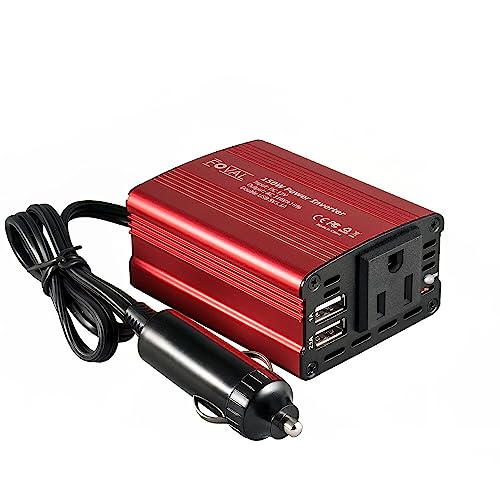
- 150W continuous output
- One 110V AC outlet and two USB ports
- About 3.2 x 2.5 x 1.5 inches, 8 oz
- Built-in fuse and overload protection
The FOVAL 150W is one of the smallest plug-in inverters you can buy, sized close to a credit card at about 3.2 by 2.5 by 1.5 inches and around 8 ounces according to the listing. It plugs into the cigarette lighter socket and provides one 110V AC outlet alongside two USB ports that share 3.1 amps.
That 150-watt rating lines up well with what a typical accessory socket can deliver, so you are less likely to hit the car’s fuse limit than with larger plug-in units. It covers laptop chargers, camera batteries, handheld game consoles, string lights and similar small loads. FOVAL lists a built-in fuse with protection against overheating, under and over voltage, short circuits and overloads, and the shell is metal with a small cooling fan.
The single outlet is the main limitation, so a household that wants to run two AC chargers at once will need a power strip or a larger unit. There is no battery clamp option, which rules out anything heavier than light electronics. For a commuter who just wants a laptop plug in the console, the small size is the selling point, and it stores easily in a glove box between trips.

3. DEWALT DXAEPI140 Power Inverter: 140W with 25W USB-C and Fan-Free Silent Design
- 140W continuous household power
- 25W USB-C and 15W USB-A ports
- Fan-free, silent running design
- Low-voltage automatic shut-off
The DEWALT DXAEPI140 is a 140-watt plug-in inverter built around quiet operation. The listing describes a fan-free design, so there is no cooling fan whirring next to you on a long drive or while you work from the driver’s seat, which is the main difference from most units in this size class.
Alongside the household outlet, it has a 25-watt USB-C port and a 15-watt USB-A port, so a phone or tablet can charge over USB while a laptop uses the AC plug. DEWALT includes a low-voltage regulator with automatic shut-off to help prevent battery drain, which is useful if the socket in your vehicle stays powered with the key off. An installation kit is listed for mounting the unit permanently, a handy option in a work truck or van where it should stay in one place.
The modest 140-watt rating keeps it within the range most accessory sockets can supply, but it also means this is a charging tool rather than a way to run power tools or kitchen appliances. Larger laptops with high-wattage chargers may sit near its limit. If your loads are phones, tablets and a laptop, the silence and USB-C port make it an easy unit to live with.
View DEWALT DXAEPI140 on Amazon
4. Cobra PURE SINE 400W Inverter: Pure Sine Output with Two GFCI Outlets and Battery Cables

- 400W continuous, 800W peak pure sine
- Two GFCI-protected AC outlets
- 12 AWG battery cables and 12V cable included
- Five protections including low-voltage cutoff
The Cobra PURE SINE 400W is the pick here for devices that prefer clean, smooth power. The listing rates it at 400 watts continuous and 800 watts peak with pure sine wave output, which Cobra positions for medical devices, sensitive electronics, laptops and entertainment gear.
Both AC outlets are GFCI protected, an uncommon feature at this size. The box includes 16-inch 12 AWG cables for a direct battery connection plus a 12V cable for the accessory socket, so you can use it plugged in for light loads and clamp it to the battery when you need the full rating. Cobra lists five protections: over temperature, reverse polarity, over voltage, a low-voltage alarm and low-voltage cutoff. The listing also notes compatibility with Cobra’s remote controller, which adds USB-A and USB-C ports within reach, so check whether your listing includes it.
Pure sine wave output costs more than modified sine at the same wattage, so it makes most sense if you run a CPAP, studio audio gear or a device whose maker asks for it. For simple phone and laptop charging, a modified sine plug-in unit does the job. As with any battery-connected inverter, keep the engine running for long sessions.
View Cobra PURE SINE 400W on Amazon

5. STANLEY PI500S Power Inverter: 500W via Battery Clamps or 120W via the 12V Port

- 500W continuous with battery clamps
- 120W through the 12V DC plug
- Dual 120V AC outlets and dual 3.1A USB
- Low-battery warning and overload protection
The STANLEY PI500S is built around a practical idea: two ways to connect, each with an honest rating. Plugged into the 12V port it supplies 120 watts, which matches what a typical accessory socket can handle, and clamped to the vehicle battery it supplies 500 watts continuous, according to the listing.
That split makes it a flexible single unit: on a normal drive, plug it into the socket for a laptop or phone. When you need more, such as a small power tool, a work light or a blender at a tailgate, open the hood and attach the clamps. It has dual 120V AC outlets and dual 3.1-amp USB ports, and the lightweight body has a carry-friendly shape. STANLEY lists a built-in battery protection warning that signals when the vehicle battery is getting low, plus overload protection meant to help avoid blown fuses.
Using the clamps means working around the battery, so wear eye protection, connect positive first and keep the cables away from moving belts. Run the engine for higher loads to avoid draining the battery. For drivers who want a single inverter that can do light charging most days and heavier jobs occasionally, the PI500S covers both.
6. Energizer 1100W Power Inverter: Modified Sine with Battery Cables, Dual AC and Dual USB
- 1,100W continuous, modified sine wave
- Two 110V AC outlets and two 2.4A USB ports
- Battery cables and installation kit included
- ETL listed under UL Standard 458
The Energizer 1100W steps well past plug-in territory. It converts 12V battery power into 1,100 watts of continuous modified sine wave output, and it connects directly to the battery with the included cables rather than through the accessory socket, according to the listing.
That much power covers corded drills and saws, work lights or a small coffee maker, depending on each device’s label. It has two 110V AC outlets and two 2.4-amp USB ports, so you can charge a phone while a tool runs. Energizer states the unit is ETL listed under UL Standard 458, the safety standard for inverters used in vehicles and boats, and markets it for cars, trucks and RVs, worksites and emergency backup. The installation kit helps you set it up where a suitable battery is within reach.
Running 1,100 watts draws roughly 100 amps from a 12V battery, so the engine must be running and the battery and alternator need to be healthy. Keep the inverter close to the battery, use the supplied cables and add an inline fuse if you mount it permanently. Modified sine output suits most tools and chargers, but it is not the choice for sensitive medical devices.
View Energizer 1100W on Amazon
Comparing the Six Inverters at a Glance
When you shortlist the best power inverter for car trips, compare continuous watts as each listing states them. For the two plug-in units rated above 150 watts, your car’s socket fuse may set the real ceiling.
| Inverter | Continuous output | Connection | Suits |
|---|---|---|---|
| BESTEK 300W | 300W | Lighter socket | Laptops and phones on road trips |
| FOVAL 150W | 150W | Lighter socket | A small unit for the cup holder |
| DEWALT DXAEPI140 | 140W | Lighter socket or mounted | Silent charging with USB-C |
| Cobra PURE SINE 400W | 400W pure sine | Battery cables or 12V cable | Sensitive electronics and medical devices |
| STANLEY PI500S | 500W clamped, 120W plugged in | Battery clamps or socket | Drivers who want both options |
| Energizer 1100W | 1,100W modified sine | Battery cables | Tools and small appliances |

Keeping the Battery Healthy Through a Michigan Winter
An inverter only moves energy out of the battery. With the engine off, a 100-watt load pulls roughly 8 to 10 amps, and a typical starting battery can drop below a reliable cranking level in an hour or two. Cold mornings in Grand Rapids already cut the power a battery can deliver, so a long session with the key off is a good way to need a jump.
Run the engine for anything heavier than phone and laptop charging, and unplug the inverter when you park. Some cars keep the accessory socket live with the key off, which is a common reason a car battery dies overnight. A jump starter rated for cold weather is a sensible partner for any inverter in the trunk.

Idling to keep a large inverter going has its own risk. The EPA’s page on carbon monoxide and indoor air warns against idling a car inside a garage, because the gas has no color or smell. Always run the engine outdoors, and keep the tailpipe clear of snowbanks after a storm.
When Power Problems Point to the Car, Not the Inverter
Most inverter complaints come down to load. If a light load still trips the low-voltage alarm, the battery may be weak or the alternator may not be keeping up, which our guide to bad alternator symptoms helps you sort out.

Warm or melted socket plugs, flickering dash lights and repeat fuse failures point to a wiring fault that should be traced, not worked around. Our car electrical repair in Grand Rapids covers charging tests, parasitic draw checks and socket circuit repairs. Wire a permanent battery-fed inverter only if you are confident with fuses and cable sizing, or let a technician do it.
More Buying Guides
Frequently Asked Questions
Will a power inverter drain my car battery?
Yes, if you use it with the engine off for long. Small loads like phone charging take a while, but laptops and anything with a heater add up quickly. Run the engine for bigger loads and choose a unit with a low-voltage shutoff.
Which is the best car power inverter brand?
No single brand fits every job. BESTEK, Cobra, DEWALT, Energizer, FOVAL and STANLEY all list protections and certifications, so compare continuous output, connection type and wave type for what you plan to run.
Do I need a pure sine wave inverter?
Most phone and laptop chargers work on modified sine wave power. Choose pure sine wave for CPAP machines, some audio equipment and devices whose makers recommend it, or if a device hums or runs hot on a modified unit.
What is the best power inverter for a caravan?
A caravan or travel trailer usually runs off its own house battery, so it calls for a larger inverter wired to that battery rather than a plug-in car unit. Size it for the trailer’s loads and have the wiring and fusing checked by someone qualified.
Socket dead again, or a battery that cannot keep up? Call 456 AutoFix at 616-279-3832 between 8am and 5pm, Monday to Friday, or set up an appointment on our contact page.
Busy all day? Drop the car off after hours at our shop at 456 Carrier St NE in Creston, and we will check the charging system once it is in the bay.