
As an Amazon Associate, 456 AutoFix earns from qualifying purchases. Product links below go to Amazon, where you can confirm the right part for your vehicle.
A weekend at a campsite goes better when the laptop, camera batteries, string lights and a small fan all have somewhere to plug in. The best car power inverter for camping turns your vehicle’s 12V battery into ordinary household outlets without leaving you with a dead battery on Sunday morning.
Below: how to size an inverter, when the lighter socket is enough, and six pure sine wave units in detail. For inverters for everyday driving, start with our main guide to the best power inverter for car use.
Quick answer
What inverter should you bring car camping?
For phones, laptops and lights, a 300W pure sine wave inverter that plugs into the 12V socket covers most campsites. If you want to run a fan, a cooler or a CPAP all night, wire a 600W to 1000W pure sine unit to a deep-cycle battery so the starter battery stays ready.
Our Quick Picks
Three quick picks: a socket inverter for charging, a certified unit for overnight loads and a 1000W option for heavier gear. All six are reviewed below.

BESTEK 300W Pure Sine
Compact socket inverter with fast USB-C charging for phones and laptops.

Renogy P2 700W
Certified inverter for a deep-cycle setup that runs a fan or CPAP.

Ampeak 1000W Pure Sine
Three outlets and a clear readout of battery voltage and draw.
How Much Inverter Does a Campsite Really Need?
Start with a list of what you plan to plug in and the watts printed on each charger or label. Add up the items that will run at the same time, then leave some headroom. Phones, a laptop and LED lights rarely reach 150 watts together, while an electric cooler can pass that on its own.
- Continuous watts: the load the inverter can carry for hours. Size to this number, not the peak.
- Peak or surge watts: a short burst for gear with a motor or compressor that pulls extra current at start-up.
- Waveform: pure sine wave output suits laptops, CPAP machines, fans and battery chargers for tools, and it tends to run them quieter than modified sine.
- Low-voltage shutdown: cuts the output before the battery is drained too far to start the engine.
The U.S. Department of Energy explains that an inverter switches DC power back and forth to create AC, with filtering to shape a clean sine wave. That clean wave is why every unit in this list is a pure sine model.
Socket Plug or Battery Clamps at the Campsite?
Most vehicles protect the 12V accessory socket with a fuse of around 15 amps, which limits a plug-in inverter to roughly 150 watts in practice. That is fine for charging, but a bigger load will blow the fuse. If yours keeps going, our guide on why a car fuse keeps blowing walks through the usual causes.
Anything above that needs short, heavy cables bolted or clamped to a battery. For a weekend camper, that is often a second deep-cycle battery in the cargo area or truck bed, kept separate from the starter battery. Check your owner’s manual before wiring anything to the car’s electrical system, and keep the inverter where it can breathe, away from sleeping bags and gear.
Best Car Power Inverter for Camping: Six Units Compared
All six are pure sine wave inverters listed on Amazon US, ordered from small plug-in units to larger battery-wired ones.
1. BESTEK 300W Pure Sine Wave Inverter: Two AC Outlets with USB-C PD and QC Ports
- 300W continuous, 700W peak, pure sine
- Two AC outlets plus USB-C PD and QC USB-A
- 24-inch cable with a 12V plug, 11-17V input
- Built-in 40A fuse and a load-sensing fan
The BESTEK 300W is a compact pure sine wave inverter that plugs into a vehicle’s 12V accessory socket through a 24-inch cable. BESTEK lists 300 watts of continuous output and 700 watts of peak power, with an input range of 11 to 17 volts. On the front are two AC outlets, a USB-C port with Power Delivery and a Quick Charge USB-A port, so a phone, a tablet and a laptop can charge at the same time.
For camping, that layout covers the everyday jobs: topping up camera batteries, charging a laptop for evening work, or running a string of lights and a small speaker. Pure sine output means the same clean waveform as a wall outlet, which suits laptop chargers and other electronics that dislike rougher power. A built-in 40-amp fuse and protection against short circuits, overheating, low voltage and high voltage are listed, with LED indicators to show a fault.
The cooling fan changes speed with load and temperature, which keeps noise down when you only charge a phone. A car socket is usually fused well below 300 watts, so keep the load modest there. It is a charging tool, not a way to run a cooler all night.
View BESTEK 300W Pure Sine on Amazon
2. BESTEK 500W Pure Sine Wave Inverter: Socket Plug and Battery Clamps Included
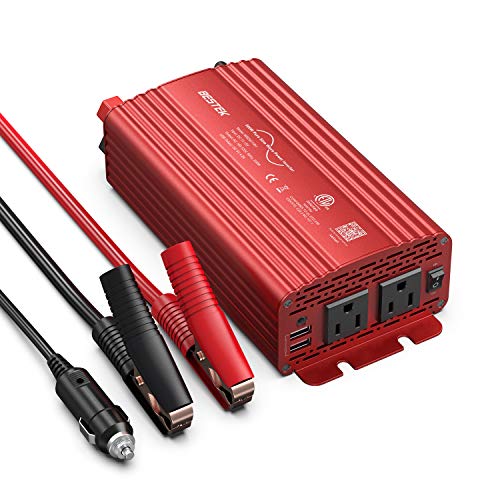
- 500W continuous pure sine output
- Lighter-plug cable and battery clamp cable
- Two AC outlets and dual USB, 4.2A total
- Two replaceable 40A fuses, ETL listed
The BESTEK 500W steps up from the 300W model with a larger pure sine output and, importantly for camping, two ways to connect. The box includes a 12V lighter-plug cable for light loads and a cable with battery clamps for running closer to the full rating. It has two AC outlets and two USB ports that share 4.2 amps, and the listing notes it is ETL listed.
BESTEK is direct about the socket limit: plugged into the lighter outlet, keep the load under about 150 watts, since that is what most car fuses allow. Clamped to the battery, the inverter can deliver up to 500 watts, enough for a laptop, a small fan and lights together, or for recharging cordless tool batteries at a work site or a campsite.
The aluminum housing has vents and a built-in fan, and two 40-amp fuses sit on the back where you can replace them. Protection covers over-voltage, under-voltage, overheating, overload, reverse polarity and short circuits, and the under-voltage cutoff is there to avoid draining the battery dry. If the load goes past 500 watts, it shuts down and needs to be switched off and on to reset. Note that the on-off switch only controls the three-prong outlets.
View BESTEK 500W Pure Sine on Amazon

3. GIANDEL 600W Pure Sine Wave Inverter: Dual AC Outlets with 15 ft Wired Remote

- 600W continuous pure sine output
- 15 ft wired remote for on and off
- ETL listed to the UL 458 standard
- Two 40A fuses and a heat-triggered fan
The GIANDEL 600W is a battery-wired pure sine inverter built for small off-grid setups, camper vans, trucks and cars. It delivers 600 watts of continuous power through two AC outlets and comes with a 15-foot wired remote. That remote is handy at camp, because the inverter can sit near the battery under a seat or in a storage bin while you switch it on and off from inside.
GIANDEL describes it as suitable for fans, small pumps, laptops, tablets and a satellite internet kit, as long as the real power stays under 600 watts. The listing is also honest about a limit: it cannot start a refrigerator or freezer, even a small one, because of the compressor’s start-up demand. A power light and a red indicator warn when it is time to check the battery.
The inverter is ETL listed to the UL 458 standard, with protection for high voltage, low voltage, overheating, overload, reverse polarity and short circuits. Two 40-amp fuses blow if the battery cables are reversed. The aluminum housing has ribbed sides and vents, and the fan runs only when the unit gets hot, which keeps a quiet campsite quiet. GIANDEL lists an 18-month warranty.
View GIANDEL 600W Pure Sine on Amazon
4. Renogy P2 700W Pure Sine Wave Inverter: GFCI Outlets, USB and Hardwire Port
- 700W continuous, 1400W surge, pure sine
- GFCI outlets, 5V/2.1A USB, AC terminal block
- Two 3 ft 6AWG cables and a 19.8 ft remote
- UL 458 and CSA C22.2 107.1 certified
The Renogy P2 700W is a pure sine wave inverter aimed at RVs, trucks and off-grid solar setups, and it fits a camping rig built around a deep-cycle battery. Renogy lists 700 watts of continuous power, a 1,400-watt surge for start-up loads and conversion efficiency above 90 percent. The outlets are ground-fault protected, which adds a layer of safety around damp ground and wet gear.
Connection options are flexible. There are two AC outlets, a 5V/2.1A USB port and an AC terminal block for hardwiring the output into a camper’s circuit. The kit includes two 3-foot 6AWG battery cables and a 19.8-foot wired remote, so the inverter can live near the battery while the switch stays within reach of the bed or the driver’s seat.
It is certified to UL 458 and the matching CSA standard, and LED indicators flag under-voltage, over-voltage, over-temperature, overload and short circuits. Cooling fans and a metal housing are built for life in a vehicle. Renogy notes that the power source should be a deep-cycle battery, so this is not a unit to run off the starter battery for a whole night.

5. Ampeak 1000W Pure Sine Wave Inverter: 3 AC Outlets, Dual USB and LCD Display
- 1000W continuous, 2000W surge, pure sine
- Three AC outlets and dual 2.4A USB ports
- LCD shows voltage, current and power
- ETL certified with soft start and spark protection
The Ampeak 1000W is a pure sine wave inverter with room for heavier camp gear. It is listed at 1,000 watts of continuous output with a 2,000-watt surge, and it has three AC outlets plus two 2.4-amp USB ports. The front LCD shows input and output voltage, current and power, which makes it easier to see how hard you are working the battery before it reaches the cutoff point.
Ampeak lists an output of 115 volts, plus or minus 5, and the inverter is ETL certified. A soft start and what the brand calls a 17-point protection system are listed, along with a spark protection circuit that cuts output if the connections are wrong or shorted. That matters at a dark campsite, where it is easy to fumble a cable.
The fan is designed to switch on only when the inside reaches about 50°C (122°F), so it stays quiet during light use. With a 1,000-watt rating, this unit suits a deep-cycle battery bank with heavy cables rather than a starter battery or the lighter socket. For a camper who runs an electric cooler, a blender or tool chargers, it gives headroom the smaller units can’t.
View Ampeak 1000W Pure Sine on Amazon
6. Renogy P2 1000W Pure Sine Wave Inverter: GFCI Outlet, 4AWG Cables and Wired Remote

- 1000W continuous, 2000W surge, pure sine
- GFCI protection, USB port, AC terminal block
- Two 3 ft 4AWG cables and 16.4 ft remote
- UL 458 and CSA C22.2 107.1 certified
The Renogy P2 1000W is the larger sibling of the 700W model, built for a camper or truck with a proper house battery. It is listed at 1,000 watts of continuous output with a 2,000-watt surge and conversion efficiency above 90 percent. Like the smaller unit, it has ground-fault protection, two AC outlets, a 5V/2.1A USB port and an AC terminal block for hardwiring.
The difference is in the supporting parts. The kit includes two 3-foot 4AWG battery cables, heavier than the 6AWG cables on the 700W, to carry the higher current, along with a 16.4-foot wired remote. That makes it a sensible core for a built-out van or truck-bed camper, where the inverter is mounted once and stays connected to a deep-cycle bank.
Renogy lists certification to UL 458 and the matching CSA standard, with LED indicators for under-voltage, over-voltage, over-temperature, overload and short circuits. The metal housing and high-speed fans are meant to handle bumps and heat inside a vehicle. Renogy says the input should be a deep-cycle battery rated for deep discharge. For tent camping with a phone and a laptop, it is more inverter than you need.
View Renogy P2 1000W on Amazon
Sizing the Best Car Power Inverter for Camping Loads
Treat the table as a starting point and check the wattage on your own gear. The battery, not the inverter, sets how long anything runs.
| Camp load | Inverter size | Connection | Power source |
|---|---|---|---|
| Phones, camera batteries, LED lights | 150W to 300W | 12V socket | Starter battery, engine running |
| Laptop, small fan, Starlink-type kit | 300W to 500W | Socket for light loads, clamps above about 150W | Starter battery for short use |
| CPAP or fan all night | 500W to 700W | Battery cables | Separate deep-cycle battery |
| Electric cooler, blender, tool chargers | 700W to 1000W | Battery cables, heavy gauge | Deep-cycle battery bank |

Gear with heating elements, such as kettles, hair dryers and hot plates, draws far more than any of these setups can sustain from a car battery. Leave those at home or use a camp stove instead.
Best Power Inverter for Car Camping in Michigan: Protecting the Battery
Spring and fall nights at West Michigan campgrounds can drop close to freezing, and a cold battery has less cranking power to start with. Pull it down overnight running a fan or an electric blanket and it may not turn the engine over at breakfast. A few habits help:
- Arrive with a full battery: an older or weak battery fails first at camp, so test it before the trip.
- Run big loads on a second battery: keep the starter battery for starting.
- Never idle near the tent: if you run the engine to recharge, do it in open air with the exhaust pointed away from tents and windows, and never in a garage or enclosed space, because of carbon monoxide.
- Switch it off when idle: an inverter draws a little power even with nothing plugged in.

Heading somewhere remote with more electronics? Our guide to the best battery for Starlink Mini covers portable power for a satellite kit, and a car battery tester tells you whether the starter battery is up to the trip before you pack.
When the Dead Battery Isn’t the Inverter’s Fault
Even the best car power inverter for camping can drain a battery, but so can a fault in the car. If your battery goes flat at home, with no inverter attached, something is drawing power after the car is shut off. Our article on why a car battery dies overnight explains the usual suspects, and a battery that never seems to recharge on the drive can point to bad alternator symptoms.

Hardwiring a second battery adds circuits that need proper fusing. To have the charging system checked before camping season, or a drain traced, our car electrical repair in Grand Rapids covers battery, charging and wiring faults.
More Buying Guides
Frequently Asked Questions
What size inverter do I need for car camping?
Add up the watts of everything you will run at once and pick an inverter rated above that for continuous output. Charging phones, laptops and lights fits a 300W unit, while a cooler or an all-night fan calls for 600W or more on a deep-cycle battery.
Can I run an inverter overnight from my car battery?
Small loads for a short time are usually fine, but a starter battery is not built for deep discharge. For overnight use, run the inverter from a separate deep-cycle battery and rely on the low-voltage shutdown as a backstop, not a plan.
Do I need a pure sine wave inverter for a CPAP?
Pure sine wave output is the safer choice for a CPAP or any other medical device. Check your machine’s manual for its wattage and power requirements, and ask about a DC cord, which avoids the inverter altogether.
Should the engine run while I use the inverter at camp?
Running the engine keeps the battery charged, but only do it outdoors with the exhaust away from tents, windows and other campers. Never idle in a garage or enclosed space, and check campground rules on idling.
Battery or charging trouble before your next trip out of Grand Rapids? Reach 456 AutoFix at 616-279-3832 on weekdays between 8am and 5pm, or set up an electrical check on our contact page.
Packing up during work hours? Our after-hours drop-off lets you leave the vehicle at 456 Carrier St NE whenever it suits you.