
As an Amazon Associate, 456 AutoFix earns from qualifying purchases. Product links below go to Amazon, where you can confirm the right part for your vehicle.
It feels like rolling over rumble strips on a smooth road: a brief, buzzing vibration at steady cruising speed that fades when you press the gas or lift off. That is the classic sign of torque converter shudder, and the best transmission additive for torque converter shudder is a friction modifier made for the converter clutch, not a thick slip or leak treatment.
This guide explains what causes the shake, how the treatments differ, five products sold for it and the signs that a bottle will not help. For additives that target slipping, leaks or general wear, see our main transmission additive buying guide.
Quick answer
What stops a torque converter from shuddering?
When the cause is worn-out fluid, a concentrated friction modifier usually settles it. Lubegard Instant Shudder Fixx is the standard first try, and Lubegard ATF Protectant keeps the fluid’s friction stable afterward. Lubegard’s HFM Supplement suits units that need highly friction modified fluid. Mechanical faults still need a proper diagnosis.
Our Quick Picks
Three quick picks: a fast-acting shudder concentrate, a protectant that keeps the fluid's friction stable afterward, and a supplement for transmissions that need highly friction modified fluid. All five products are reviewed below.

Lubegard Instant Shudder Fixx
A single-purpose concentrate made only for converter lock-up shudder.
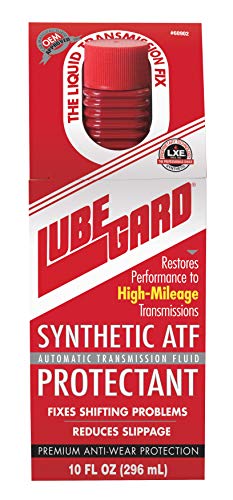
Lubegard ATF Protectant
A protectant that keeps friction stable after the shudder is gone.

Lubegard HFM ATF Supplement
A supplement that raises a base fluid's friction modification.
What Converter Shudder Is and Why It Starts
Most modern automatic transmissions have a clutch inside the torque converter. At steady speeds the computer applies that clutch so the engine and transmission turn together, which saves fuel and cuts heat. To make the change smooth, the clutch is allowed to slip a tiny, controlled amount as it locks and unlocks.
That controlled slip depends on the friction modifiers in the automatic transmission fluid (ATF). As fluid ages, heat and oxidation use those modifiers up, and the clutch starts to grab and release many times a second instead of sliding smoothly. You feel that stick-slip action as a shudder, often between about 30 and 55 mph and most often under light throttle.
Because the root cause is often fluid chemistry, a bottle can genuinely help here. A converter clutch lining that is worn through, a sticking control solenoid or a valve body fault is another matter, and no additive will repair those parts.
How to Choose a Shudder Treatment
Start with the fluid your transmission is meant to use. Your owner’s manual or the dipstick names the spec, such as Dexron, Mercon, ATF+4 or a maker’s own CVT fluid, and the additive has to suit it. The treatments on this page fall into four groups:
- Concentrated shudder fixes: a small tube of strong friction modifier that works quickly on lock-up shudder in a conventional automatic.
- ATF protectants: a larger dose that adds friction modifiers plus heat and oxidation protection, meant to keep the fluid stable for the rest of its life.
- Highly friction modified supplements: used to bring a general-purpose fluid closer to the friction level that some carmakers’ fluids require, which matters for certain shudder-prone units.
- Fluid conditioners: broader formulas that refresh the whole fluid and list shudder among several benefits.
Check the exclusions before you buy. The maker’s page for Lubegard Instant Shudder Fixx says it is not for CVT, dual-clutch (DCT) or older Ford Type F applications, and none of the products on this page is listed for CVTs, so CVT owners should start with the CVT treatments in the main guide linked above. Avoid thick stop-slip formulas for this job, because raising fluid viscosity is not what a shuddering converter clutch needs.
Best Transmission Additive for Torque Converter Shudder: Five Treatments Reviewed
Each product below is sold for converter shudder or clutch chatter in an automatic transmission, listed from the targeted fixes to the broader treatments.
1. Lubegard 19610 Instant Shudder Fixx: 2 oz Concentrated Friction Modifier for Lock-Up Shudder
- 2 oz application tube, part 19610
- Concentrated friction modifier for converter lock-up shudder
- Works with conventional or synthetic ATF
- Not for CVT, DCT or Ford Type F applications
Lubegard’s Instant Shudder Fixx, part 19610, is the product most transmission forums point to first when a converter starts to shake. It is a concentrated friction modifier packed in a 2 oz tube, and the listing describes it as formulated specifically for eliminating torque converter lock-up shudder. The maker also says it provides up to four times less wear than regular ATF.
The small size is the point. Instead of changing the whole character of the fluid, it adds a strong dose of the friction modifiers that old ATF has lost, so the converter clutch can slide smoothly again as it applies. Lubegard states it works in conventional or synthetic automatic transmission fluid, and the maker suggests following it with its ATF Protectant or Platinum Protectant for longer-term benefit.
It suits a conventional automatic that buzzes at steady speeds and smooths out under harder throttle, especially one with fluid that is due for a change. It is not for CVT, dual-clutch or older Ford Type F applications, so owners of those transmissions need a product made for their unit. If the shudder returns quickly after treatment, the converter clutch or its controls probably need a closer look rather than another tube.
View Lubegard Instant Shudder Fixx on Amazon
2. Lubegard 60902 Automatic Transmission Fluid Protectant: 10 oz Synthetic Additive for Chatter and Shudder
- 10 oz bottle, part 60902
- Listed to eliminate clutch chatter and converter shudder
- Helps reduce elevated operating temperatures
- Softens and shortens harsh shifts
Lubegard’s Automatic Transmission Fluid Protectant, sold as the red 60902 bottle, is a broader treatment than the shudder tube. The 10 oz bottle is listed to eliminate clutch chatter and torque converter shudder while also reducing wear throughout the transmission. The listing adds that it helps prevent overheating and softens harsh shifts, making them quicker in duration.
Where Instant Shudder Fixx gives a quick hit of friction modifier, this protectant is meant to stay in the fluid and keep its frictional behavior consistent as the miles add up. That makes it a natural partner for the tube, and Lubegard itself recommends the pairing. On its product page the maker gives a treat rate of 1 oz per quart of total transmission capacity, so check your capacity before deciding how much to add.
It suits drivers who want to treat fresh fluid after a service or keep a once-shuddering transmission from drifting back into trouble. It also helps where shudder is mild and shows up only on hot days or long trips. Like the tube, it is not for CVT, dual-clutch or older Ford Type F applications. Keep the total fluid level at or below the full mark, and remember that it cannot rebuild a worn clutch lining.
View Lubegard ATF Protectant on Amazon

3. Lubegard 61910 Highly Friction Modified ATF Supplement: 10 oz Anti-Shudder Additive with LXE
- 10 oz bottle, part 61910
- Converts Dex/Merc ATF to a highly friction modified fluid
- Anti-shudder with converter clutches
- Recommended for Ford AODE and 4R70W shudder
Lubegard’s Highly Friction Modified ATF Supplement, the black 61910 bottle, solves a narrower problem. Some transmissions are designed around fluids with a high level of friction modification, and a general-purpose fluid can leave their converter clutches grabbing. The listing says this 10 oz supplement converts conventional Dex/Merc fluid into a highly friction modified ATF and low-viscosity fluids into several carmakers’ newer specs.
The anti-shudder claim is specific: the listing calls it anti-shudder with converter clutches and anti-chatter in clutch packs, and it recommends allowing penetration overnight for maximum benefit. It also names the Ford AODE and 4R70W transmissions with shudder problems as applications. The rest of the formula covers smoother shifting, fluid life and protection against foaming and oxidation, and the maker gives a treat rate of 1 oz per quart of total capacity.
It suits owners and technicians who know their transmission wants a highly friction modified fluid, or who have a unit filled with a universal ATF that has started to shudder. It is a more technical choice than the red protectant, so read Lubegard’s conversion chart before using it. It shares the usual exclusions: not for CVT, dual-clutch or older Ford Type F transmissions, and not a cure for worn parts.
View Lubegard HFM ATF Supplement on Amazon
4. WIT Take the Shake Away WM465SHK: 2 fl oz Torque Converter Shudder Treatment

- 2 fl oz bottle, part WM465SHK
- Targets vibration during converter clutch engagement
- Does not increase fluid viscosity
- Not for CVT, DCT or Ford Type F; made in USA
Take the Shake Away comes from Whatever It Takes Transmission Parts, a transmission parts company, and it is built around the same small-dose idea as the Lubegard tube. The 2 fl oz bottle, part number WM465SHK, is listed to help reduce the vibration associated with torque converter clutch engagement and to support smoother lock-up. The listing specifically mentions low-speed converter shudder.
Beyond the shudder claim, the maker says it improves lubrication for transmission clutches and friction bands and helps reduce wear without increasing fluid viscosity. That last point matters, because a converter clutch that shudders needs the right friction behavior, not thicker fluid. The listing also states that it will not harm seals or gasket materials or clog transmission filters, and that it is made in the USA.
It suits drivers who want a second option alongside the better-known tube, or who prefer a single small bottle for a car that has just started to buzz at light throttle. Compatibility follows the familiar pattern: automatic transmission fluids except CVT, dual-clutch and Ford Type F. It is a newer listing with less long-term owner feedback than the established products here, so treat it as a first step and get a diagnosis if the shudder persists.
View Take the Shake Away Torque Converter Treatment on Amazon

5. Lucas Oil 10441 Automatic Transmission Fluid Conditioner: 20 oz Treatment for Noise and Shudder

- 20 oz bottle, part 10441
- Listed to reduce noise and shudder
- Mixes with conventional and synthetic ATF
- Not recommended for CVT transmissions
Lucas Oil’s Automatic Transmission Fluid Conditioner, part 10441, is a broader treatment than the friction modifiers above, and it should not be confused with the thicker Lucas Transmission Fix aimed at slipping. The 20 oz bottle is listed to improve shifting and reduce noise and shudder. Lucas says it is compatible with all conventional and synthetic automatic transmission fluids and extends fluid life.
The listing also states that it is for use in both new and older transmissions, which makes it a reasonable choice for a general refresh when a car shows several small symptoms at once. A transmission that shifts a little harshly, makes some extra noise and has started a light shudder at cruising speed is the kind of case it is pitched at. It is a conditioner for the whole fluid rather than a concentrated shot of friction modifier.
That broad approach is both its strength and its limit. For a pure lock-up shudder, a dedicated product such as Instant Shudder Fixx is more targeted, while this bottle suits drivers who want one treatment for overall fluid condition. Lucas does not recommend it for CVT transmissions. Check your fluid capacity and the directions on the bottle so the level stays at or below the full mark, and have a shudder that keeps getting worse diagnosed.
View Lucas Oil Transmission Fluid Conditioner on Amazon
Shudder, Misfire or Something Else?
Several problems feel like converter shudder from the driver’s seat. When the vibration shows up is the quickest way to sort them.
| What you feel | Likely cause | Next step |
|---|---|---|
| Buzz at steady 30 to 55 mph, gone when you press harder or lift off | Converter clutch shudder from tired fluid | Friction modifier, then a fluid service |
| Shake under load with a flashing or steady check engine light | Engine misfire | Scan for codes before treating the transmission |
| Thump or shake when shifting into drive or reverse | Worn engine or transmission mounts | Inspect the mounts |
| Vibration that grows with road speed in any gear | Tire balance, wheel bearing or driveshaft | Check tires and the driveline |
| Shudder that returns soon after a fresh treatment | Worn converter clutch or control fault | Professional transmission diagnosis |

The misfire row deserves extra attention. A weak coil or a fouled injector can produce a shake under light throttle that feels a lot like a converter clutch, and the check engine light may only flicker. If you suspect fuel delivery, our fuel system cleaner guide covers the injector side.
Using a Shudder Fix the Right Way
A few habits make a friction modifier more likely to work:
- Check the fluid first: on vehicles with a dipstick, read the level with the engine running and warm, following the manual’s procedure. Dark, burnt-smelling fluid needs a fluid service.
- Match the treat rate: follow the label for your fluid capacity and keep the total at or below the full mark.
- Drive it gently: cover several miles of steady driving so the treated fluid reaches the converter clutch.
- Judge the result: cruise through the speed range where the shudder used to appear, on a warm transmission.
Wear eye protection and gloves when you pour ATF products, wipe up spills and keep the funnel clean, because dirt in a transmission does real damage. Sealed transmissions with no dipstick need a fill and check procedure that is better left to a shop.

West Michigan driving is tough on ATF. Stop-and-go traffic through a humid summer, towing a boat to the lake or short trips in January all add heat cycles and moisture, so treat your manual’s severe-service fluid interval as the normal one. Owners keeping a high-mileage car on the road should also look at our high mileage oil picks for the engine side, and the oil additive buying guide explains which engine treatments are worth a look.
When the Shake Needs a Diagnosis
Even the best transmission additive for torque converter shudder is only a good bet when the shudder is mild, appears at lock-up speeds and comes with no warning lights. Stop treating and get it checked if the vibration gets worse, the engine flares in RPM between shifts, the transmission slips or a check engine light comes on. Converter clutch faults often store their own trouble codes.

Our check engine light diagnostic in Grand Rapids reads the stored codes and live data so you know whether the problem sits in the engine, the sensors or the transmission controls. Regular visits for an oil change at our Creston shop are also a good moment to keep track of how the car drives over time. If the trouble is slipping rather than shaking, our guide to the transmission additive for slipping covers that problem.
More Buying Guides
Frequently Asked Questions
What is the best transmission additive for torque converter shudder?
For a conventional automatic, a concentrated friction modifier such as Lubegard Instant Shudder Fixx is the usual first choice, often followed by Lubegard ATF Protectant for longer-term stability. CVT owners need a product made for CVT fluid, because the classic shudder fixes exclude those units.
Can an additive fix torque converter shudder for good?
It can when depleted friction modifiers in old fluid are the cause. The fix lasts longer when the fluid is also changed on schedule. A worn converter clutch or a faulty solenoid will bring the shudder back, and those need repair.
Can I use a shudder fix in a CVT or dual-clutch transmission?
Not the classic ones. None of the products reviewed here is listed for CVTs, and the Lubegard ATF additives and Take the Shake Away also exclude DCT units. Use only a product whose label lists your transmission type, and check your owner’s manual first.
Is it safe to drive with torque converter shudder?
A mild shudder with no warning lights is usually safe for short-term driving while you deal with it. Left alone, the extra heat and wear can shorten the life of the converter and the fluid. Slipping, flaring RPM or a warning light means it is time for a diagnosis.
Still feeling that buzz after a treatment? Ring our Grand Rapids shop at 616-279-3832 between 8am and 5pm on weekdays, or request a visit through our contact page.
If your workday overlaps our hours, the after-hours drop-off at 456 Carrier St NE means the car can be waiting for us when we open.