As an Amazon Associate, 456 AutoFix earns from qualifying purchases. Product links below go to Amazon, where you can confirm the right part for your vehicle.
A second battery for a fridge, lights or a winch is only useful if the start battery still cranks the engine the next morning. The best battery isolator for your build lets the alternator charge both batteries while driving, then separates them when the engine stops so accessories drain only the auxiliary one.
Below are the isolator types, then six units across relay and diode designs. Planning the whole setup? Our dual battery kit guide covers trays, cables and complete packages.
Quick answer
Which battery isolator should you buy for a two-battery setup?
For most trucks and campers with lead-acid or AGM batteries, a sealed automatic relay sized to your alternator does the job: the Blue Sea SI-ACR handles alternators up to 120A. If solar also charges the second battery, a dual-sensing unit like the REDARC SBI12D suits. The KeyLine 140A VSR is a simpler option.
Our Quick Picks
Three quick picks: a sealed charging relay for most trucks, a dual-sensing isolator for solar setups and a simple VSR for a basic second battery. All six units are reviewed below.
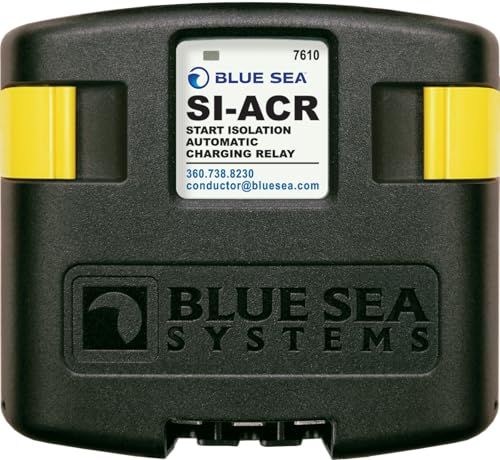
Blue Sea SI-ACR 120A Charging Relay
A sealed relay that combines batteries while charging and splits them at rest.

REDARC SBI12D Dual Sensing Isolator
Lets a solar panel or charger top up the start battery once the second is full.

KeyLine 140A VSR Isolator
A compact, sealed VSR for a basic start-plus-auxiliary layout.
What Is a Battery Isolator, and Which Type Do You Need?
A battery isolator sits between the start battery and an auxiliary battery. With the engine running it lets charge reach both; with the engine off it keeps camping loads or an inverter from draining the battery the starter needs.
- Voltage sensitive relay (VSR): a heavy relay that closes when it sees charging voltage, often around 13.2 to 13.3 volts, and opens when voltage falls.
- Automatic charging relay (ACR): a VSR with extra logic, such as dual sensing and start isolation during cranking.
- Diode isolator: no moving contacts. Current flows one way to each battery, but the diodes drop some voltage unless the alternator compensates.
- Manual or remote relays: larger relays with a switch so you can force the batteries together or lock them apart.
Battery Isolator vs Relay, ACR or Combiner: Reading the Specs
People often weigh a battery isolator vs relay as if they were rivals. In practice a VSR, an ACR and a battery combiner are all relay-based isolators; the names differ by maker and by the logic around the contacts. Only a diode unit never connects the two batteries directly.
The best battery isolator for you starts with a continuous amp rating that meets or exceeds your alternator’s output. Then check the cut-in and cut-out voltages, whether the unit is sealed against water and dust, and whether the listing allows lithium batteries. Several low-cost VSRs say plainly that they are not for lithium.
Diode isolators lose a little voltage across each path. Victron’s Argodiode battery isolator page explains that its units charge two or more batteries from one alternator without tying them together, and uses Schottky diodes to keep that drop low.
Best Battery Isolator Units: Six Reviewed in Detail
Our best battery isolator list covers two automatic charging relays, a dual-sensing isolator, two VSRs and a diode isolator. Ratings and voltages are as each listing or maker states.
1. Blue Sea Systems SI-ACR: 120A Automatic Charging Relay with Start Isolation
- Supports alternators up to 120 amps
- 12/24 volt auto-ranging input
- Dual sensing with start isolation during cranking
- Hermetically sealed, ignition-protected contacts
The Blue Sea Systems SI-ACR is an automatic charging relay, the marine name for a relay-type battery isolator with extra control logic. It connects the start and auxiliary batteries when it senses charging voltage, then separates them once the engine stops and voltage falls, so camping or work loads draw only from the second battery. The listing rates it for alternators up to 120 amps.
Several features set it apart from a basic VSR. Input voltage is auto-ranging between 12 and 24 volts, and the relay senses both batteries, so either side can trigger combining. Start isolation briefly separates house loads from the engine circuit during cranking, which the listing says protects sensitive electronics. The contacts are hermetically sealed and ignition protected, rated for installation aboard gasoline-powered boats.
In a truck or van, those sealed contacts are useful under a hood that sees salt spray and pressure washing. Mount it close to the batteries, fuse both positive cables and use wire sized for your alternator. The 120 amp limit means it is not the right choice for very high-output alternators, and like any relay it depends on the charging system reaching its combining voltage, so a smart alternator may need a different approach.
View Blue Sea SI-ACR 120A Charging Relay on Amazon
2. REDARC Smart Start SBI12D: 12V 100A Dual Sensing Battery Isolator
- 100A continuous, 400A maximum inrush
- Turns on at 13.2V, off at 12.7V
- Dual sensing for solar or AC charger input
- Silver contacts and LED status indication
The REDARC Smart Start SBI12D is a microprocessor-controlled, solenoid-type isolator for 12 volt dual battery systems. REDARC rates it at 100 amps continuous with a maximum inrush of 400 amps. It connects the batteries at 13.2 volts and separates them at 12.7 volts, with a 5 second turn-on delay and a 10 second turn-off delay so brief voltage swings do not make it chatter.
Dual sensing is the reason to choose it. If a solar panel or an AC battery charger feeds the auxiliary battery, the SBI12D lets that source also charge the start battery once the auxiliary side reaches 13.2 volts. That suits a camper or overland vehicle that sits for days with solar on the roof. REDARC lists silver contacts for longer life, surge protection, fault detection with an LED indicator and standby current under 5 milliamps.
Plan for extra parts. Fuse kits are sold separately, and REDARC says the product may need additional items to complete installation and recommends a qualified auto electrician or technician. At 100 amps it suits typical stock alternators rather than high-output units. The maker does not state lithium or smart alternator compatibility on its page, so check with REDARC if either applies to your vehicle.
View REDARC SBI12D Dual Sensing Isolator on Amazon
3. KeyLine Chargers 140A VSR: 12V Dual Battery Isolator with Mounting Plate
- Cuts in at 13.3V, cuts out at 12.8V
- 140 amp rating for 12 volt systems
- IP65 rated for water, dust and vibration
- Compact 2.6 x 2.6 x 2 in body with mounting plate
The KeyLine Chargers 140 amp unit is a voltage sensitive relay for 12 volt dual battery setups. It closes at 13.3 volts and opens at 12.8 volts, so the start battery gets charge first and is cut off from accessories once voltage drops after shutdown. Because it is a relay, the listing notes it avoids the voltage loss of a diode-style isolator.
The body measures 2.6 by 2.6 by 2 inches according to the listing, small enough to fit beside a battery tray or on an inner fender. It carries an IP65 rating against water, dust and vibration, which helps on vehicles that see off-road trails, boat ramps or winter slush. A mounting plate and hardware come in the box along with directions written for first-time installers.
Installation wires are not included in this version. You will need cables sized for your alternator output and run length, plus a fuse or breaker near each battery positive; KeyLine sells separate kits with wiring if you prefer one package. This is a good battery isolator for a simple second battery running lights or a cooler, but it does not list adjustable voltages, so trucks with smart alternators or lithium batteries may need a different device.
View KeyLine 140A VSR Isolator on Amazon
4. Victron Energy Argodiode 80-2AC: 80A Two-Battery Diode Isolator

- Charges two batteries from one alternator
- 80 amp rating, batteries never connected together
- Schottky diodes for low voltage drop
- Alternator energize input and compensation diode
The Victron Energy Argodiode 80-2AC is a diode battery isolator rather than a relay. It lets one alternator charge two batteries at the same time without ever connecting the batteries to each other, so draining the accessory battery cannot pull down the starter battery. The listing rates this model at 80 amps for two batteries, and Victron sells larger versions for three batteries or higher current.
Diodes always lose some voltage, and Victron addresses that in two ways. It uses Schottky diodes for a low voltage drop, and every model has a compensation diode that can raise the alternator’s output slightly to make up for the loss. The AC models add a current-limited energize input that powers the alternator’s B+ terminal when the engine run switch is closed, which some alternators need to start charging.
With no moving contacts, there is nothing to click, wear or stick. The trade-off is that the alternator’s voltage regulation has to work with the isolator, and wiring the compensation diode is a job for someone comfortable reading a charging circuit. At 80 amps it suits smaller alternators. Check that your alternator type is compatible before ordering, especially on modern vehicles with computer-controlled charging.
View Victron Argodiode 80-2AC Isolator on Amazon

5. Blue Sea Systems ML-ACR: 500A Automatic Charging Relay with Manual Control

- 500 amp relay for large battery banks
- Automatic charge combining with start isolation
- Manual control with lock-off for servicing
- Remote Contura switch (PN 2146) included
The Blue Sea Systems ML-ACR is the heavy end of the relay isolator range. The listing gives it a 500 amp rating for 12 volt systems, and it automatically manages charging for two large battery banks, combining them while charging and isolating them during discharge. It also lists start and engine isolation, keeping the house bank separate while the engine cranks.
What sets it apart from most isolators is manual control. A switch on the unit works with or without power, so you can close or open the relay by hand when needed. A lock-off position holds the relay open while you service the system. The package includes Blue Sea’s ML-Series remote Contura switch, part number 2146, so the relay can be controlled from the cab or helm.
This suits a truck with a high-output alternator, a winch on the auxiliary battery, or a large house bank in a camper. It is bigger than a compact VSR and needs heavy cable, proper fusing and a remote switch run through the cab, so many owners leave the wiring to a shop. For a basic second battery running lights, it is more relay than the job needs.
View Blue Sea ML-ACR 500A Relay on Amazon
6. Nilight 140A Smart Dual Battery Isolator: 12V VSR with LED Voltage Display

- Cuts in at 13.3V, cuts out at 12.8V
- Live LED voltage display
- IP66 waterproof housing with silicone seal
- Mounting hardware and ring terminal included
The Nilight 140 amp smart dual battery isolator is a 12 volt voltage sensitive relay with one useful extra: an LED display that shows voltage in real time. Like most VSRs it cuts in at 13.3 volts and cuts out at 12.8 volts, so the main battery charges first and the auxiliary battery joins once there is surplus charge from the alternator.
The housing is sealed with silicone and carries an IP66 waterproof rating, which the listing says suits dusty, wet and rough conditions off-road or on a boat. The display lets you check battery status without a meter, which is handy for spotting a weak auxiliary battery on a camping trip or noticing that the alternator is not reaching cut-in voltage. Mounting screws, nuts, spring washers and a ring terminal are included.
Two limits are worth knowing. The listing states plainly that this isolator is not compatible with lithium batteries, so it is for lead-acid and AGM setups only. Cables and fuses are not included, so budget for wire sized to your alternator and a fuse near each battery. Mount the display where you can actually see it, and keep it out of direct splash from the wheel well.
View Nilight 140A VSR with Voltage Display on Amazon
Best Dual Battery Isolator for Your Setup
Pick by how the second battery gets charged and how big the charging system is, then by battery chemistry.
| Your setup | Isolator type | Listed rating | Pick |
|---|---|---|---|
| Truck or van, alternator up to 120A, AGM or flooded batteries | Automatic charging relay | 120A | Blue Sea SI-ACR |
| Auxiliary battery also charged by solar or a shore charger | Dual-sensing isolator | 100A continuous | REDARC SBI12D |
| Simple second battery for lights or a fridge | VSR | 140A | KeyLine or Nilight |
| Boat or rig where batteries must never connect | Diode isolator | 80A, two batteries | Victron Argodiode 80-2AC |
| High-output alternator, big house bank, winch | Heavy relay with manual control | 500A | Blue Sea ML-ACR |
Even the best battery isolator has two limits. Many newer trucks have smart or variable-voltage alternators that drop charging voltage once the start battery is full, so a relay set to cut in around 13.2 volts may stay open. Lithium auxiliary batteries also usually want a controlled charge profile. In both cases our battery isolator vs DC to DC charger comparison explains when a charger is the better tool.

Wiring, Fuses and West Michigan Winters
An isolator is only as safe as its cable. Put a fuse or circuit breaker close to each battery positive, size the cable for the full current and length of the run, and disconnect the negative terminals before you start. If a fuse on the new circuit pops repeatedly, our guide to why a car fuse keeps blowing walks through the usual short and overload causes.
Under a Grand Rapids hood, road salt slush and freeze-thaw moisture reach every terminal. A sealed relay mounted high, away from splash, outlasts an open unit bolted low on the fender. For storage, our battery disconnect switch roundup covers master switches that cut all power.

Cold also cuts a weak start battery’s cranking power, so make sure both batteries are healthy and of a similar type; our car battery brands guide compares the main lines if one needs replacing.
When the Wiring Job Belongs at a Shop
Mounting the relay is easy; routing heavy cable, choosing fuse sizes and tying into an ignition signal is where installs go wrong. REDARC itself recommends a qualified auto electrician for its isolators.

Bring the vehicle in if the start battery still drains overnight, the relay clicks on and off, a cable gets warm or a warning light appears after the install. Our car electrical repair in Grand Rapids service handles body and engine electronics, including finding out why a battery keeps going flat.
More Buying Guides
Frequently Asked Questions
Is a battery isolator or VSR better?
A VSR is one kind of battery isolator, the relay kind. Compared with a diode isolator, a VSR has almost no voltage drop but connects the two batteries while charging. A diode unit keeps them apart at all times and needs an alternator that can make up for its small drop.
What is the difference between a battery isolator vs ACR?
An ACR, or automatic charging relay, is a relay isolator with added control features. Blue Sea’s SI-ACR, for example, lists dual sensing and start isolation, which briefly separates the batteries while the engine cranks. A basic isolator may lack those functions.
Should I get a battery isolator or combiner?
Most combiners are voltage sensitive relays sold under another name, so they do the same job. Compare amp rating, cut-in voltage, sealing and lithium support rather than the label on the box.
What is the best battery isolator kit for a first install?
Look for a 12 V unit rated at or above your alternator output that comes with mounting hardware and clear directions. The KeyLine 140A VSR includes a mounting plate but no cables, so plan to buy fused cable sized for your run.
Not sure your truck’s charging system can feed a second battery, or did the new isolator leave the start battery flat? Describe the build to us at 616-279-3832 on a weekday from 8 in the morning until 5, or send us the details through the contact page.
Need the truck back by morning? Our after-hours drop-off at 456 Carrier St NE takes it overnight; tape a list of everything wired to the second battery to the dash.