
As an Amazon Associate, 456 AutoFix earns from qualifying purchases. Product links below go to Amazon, where you can confirm the right part for your vehicle.
A second battery lets you run a fridge, lights or a winch without draining the one that starts the engine. The best dual battery kit for you depends on what you drive, what the second battery powers and which battery chemistry you plan to use.
Below are the kit types and six kits for trucks, boats and side-by-sides. Still choosing the batteries? See our roundup of car battery brands worth considering is a good place to start.
Quick answer
Which dual battery kit should you buy?
For most trucks with two lead-acid or AGM batteries, a 140 amp voltage sensitive relay kit such as the KeyLine 140A covers the job. Boats suit the Blue Sea Add-A-Battery switch and relay kit. A large lithium house battery calls for a lithium-capable, higher-current kit like the VEVOR 300A.
Our Quick Picks
Three starting points: a truck VSR kit, a marine switch and relay kit, and a high-current kit for lithium. All six kits are reviewed below.

KeyLine 140A Dual Battery Isolator Kit
Compact automatic relay with the cables and terminals to finish a basic install.

Blue Sea Add-A-Battery 120A Kit
A selector switch and automatic relay that keep start and house banks apart.
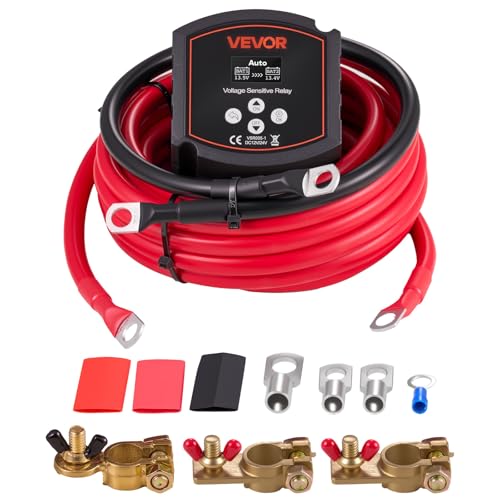
VEVOR 300A Lithium Dual Battery Isolator Kit
Adjustable voltage settings and a manual combine mode for bigger auxiliary banks.
How a Two-Battery Setup Shares One Alternator
While the engine runs, both batteries should charge. When it stops, the auxiliary battery should be cut off so accessories cannot pull the starting battery down. Kits differ in how they make that connection:
- Voltage sensitive relay (VSR): links the batteries at charging voltage and separates them when voltage falls. Most “dual battery isolator kits” work this way.
- Manual or ignition-switched solenoid: you decide when the batteries connect, often with a dash switch.
- Marine switch plus charging relay: a battery switch for start and house banks, paired with an automatic relay.
- DC to DC charger: a charger rather than a relay, used for lithium house batteries and vehicles whose alternator voltage varies. We compare the two approaches in our battery isolator vs DC to DC charger guide.
Linking two batteries puts them in parallel. Battery University’s guide to parallel configurations notes that capacity adds while voltage stays the same, and that a shorted cell drains the others and can become a fire hazard. That is why every kit worth installing has a fuse in the circuit.
What to Check on a Dual Battery Wiring Kit Listing
Listings look alike at a glance. Five points separate one kit from the next:
- Current rating: 140 amps suits most truck accessory loads; inverters and large banks may need 250 or 300 amps.
- Cable gauge and length: the cable must be thick enough for the current and long enough to reach a bed or cargo-area battery.
- Battery chemistry: some listings support lithium, and some say plainly they do not.
- Cut-in and cut-out voltage: fixed values suit a conventional alternator; adjustable ones help on newer systems.
- Fusing: check whether fuses and holders come in the box or must be bought separately.
Best Dual Battery Kit Picks, Reviewed One by One
Each kit is described from the maker’s listing. Check your battery types and cable route before ordering.
1. KeyLine Chargers 140A Dual Battery Isolator Kit: VSR with 20 ft Cable and Brass Terminals
- 140 amp voltage sensitive relay
- Cuts in at 13.3V, out at 12.8V
- IP65 rated, 2.6 x 2.6 x 2 in body
- 20 ft red cable, 2 ft ground, brass terminals
KeyLine Chargers built this kit around a 140 amp voltage sensitive relay, the automatic switch that sits between a starting battery and an auxiliary battery. According to the listing, it connects the two once system voltage reaches 13.3 volts and separates them when it falls to 12.8 volts. In practice that means both batteries charge while the engine runs, and the starting battery is left alone once you shut down and the accessories keep drawing.
The relay body measures about 2.6 by 2.6 by 2 inches, small enough to tuck beside the battery tray, and KeyLine rates it IP65 against water and dust. In the box you get a 20 foot red power cable, a 2 foot black ground cable, two positive and one negative brass marine-style terminals, tinned copper lugs, heat shrink, cable ties and instructions. That is enough to reach a battery in a bed box or behind a rear seat on many pickups.
The listing does not state a cable gauge or lithium support, so check both with KeyLine if you plan a long run or a lithium house battery. Fuses are not listed in the package, so budget for a pair sized for the cable. KeyLine backs the kit with a 12-month warranty.
View KeyLine 140A Dual Battery Isolator Kit on Amazon
2. VEVOR 300A Dual Battery Isolator Kit: 2 AWG Cable, LCD Voltmeter and Lithium Support
- 300 amp relay for large battery banks
- Adjustable start-stop voltage for lithium or lead-acid
- Manual mode and 3-60 second delay
- 20 ft 2 AWG red and 2 ft 2 AWG ground cable
VEVOR’s 300 amp kit is aimed at larger auxiliary banks, the kind that feed an inverter, a compressor fridge or a camper’s lighting. The listing says its start and stop voltages can be adjusted, which is what lets it work with lithium as well as lead-acid batteries. A small display shows the voltage of both batteries in real time across a 4.5 to 20 volt range, so you can see at a glance whether the auxiliary side is actually charging.
Two features stand out against simpler relays. A manual mode lets you combine the batteries on demand, so a full auxiliary battery can help a weak starting battery without jumper cables. An adjustable delay of 3 to 60 seconds keeps the relay from clicking on and off when voltage hovers near the switching point. VEVOR also lists overvoltage and undervoltage protection.
The kit includes a 20 foot run of 2 AWG red cable, a 2 foot 2 AWG ground, copper connectors, lugs, heat shrink and zip ties. Heavy cable is harder to route and crimp, so plan the path and use a proper crimper. Fuses are not in the package, and on a truck with a variable-voltage alternator a DC to DC charger may still suit lithium better.
View VEVOR 300A Lithium Dual Battery Isolator Kit on Amazon

3. Nilight 140A Dual Battery Setup Isolator Kit: IP66 VSR with 6 AWG Cables

- 140 amp automatic voltage sensitive relay
- Cuts in at 13.3V, out at 12.8V
- IP66 rated housing with silicone seal
- 6 AWG red and black cables, terminals and clamps
Nilight’s kit uses the same basic approach as most truck dual battery systems: a 140 amp voltage sensitive relay that joins the batteries at 13.3 volts and separates them at 12.8 volts. With the engine running and the starting battery charged, the relay brings the auxiliary battery online so one alternator feeds both. Turn the key off and the auxiliary battery runs your lights, fridge or radio on its own.
The housing carries an IP66 rating and a silicone seal, which matters on a truck that sees slush, pressure washing and salt spray. The package is thorough, with 6 AWG red and black battery cables with connectors, two positive and one negative marine terminals, three 5/16 inch battery clamps, screws, nuts, washers, heat shrink, ring terminals and cable ties. Nilight lists uses from camper vans and RVs to UTVs and boats.
Read the fine print before ordering. Nilight states plainly that the relay is not compatible with lithium batteries, and that it is for dual battery setups only, not single-battery vehicles. Cable length is not given on the listing, so measure your run first. For two lead-acid or AGM batteries, it is a complete, sealed package.
View Nilight 140A Dual Battery Isolator Kit on Amazon
4. Blue Sea Systems Add-A-Battery Kit 120A: Dual Circuit Plus Switch and SI-ACR Relay
- Dual Circuit Plus battery switch
- SI-ACR automatic charging relay
- Emergency parallel for engine starting
- Tin-plated copper studs, 120 A continuous
Blue Sea Systems designed the Add-A-Battery kit for boats, and it pairs two parts that work together. The Dual Circuit Plus switch manages the starting and house banks as separate circuits, while the SI-ACR automatic charging relay senses charging voltage, combines the batteries while the engine charges and isolates them at rest. The result is a house bank for electronics and a starting battery kept in reserve.
The switch also has an emergency parallel position. If the starting battery is flat, you can combine it with the house bank to start the engine. Blue Sea says one on and off operation controls both banks, which cuts the chance of leaving a switch in the wrong position at the dock. Studs are tin-plated copper to resist corrosion, and the kit carries a 120 amp continuous rating that Blue Sea lists for inboards and larger outboards.
For a small outboard, the 65 amp Mini Add-A-Battery is the smaller sibling. The listing describes the switch and relay rather than cables or fuses, so plan to buy marine-grade cable and circuit protection sized for your run. Follow the instructions for the order in which the switch, relay and batteries connect.
View Blue Sea Add-A-Battery 120A Kit on Amazon

5. Painless Performance 40103 Dual Battery Control System: 250A Waterproof Solenoid and 3-Position Switch

- 250 amp waterproof dual battery controller
- Three-position switch with indicator lights
- Isolate, ignition-on or always-connected modes
- Solenoid, pre-terminated wire, fuse holder and fuse
Painless Performance takes a manual route. Instead of a relay that reacts to voltage, the 40103 uses a 250 amp waterproof solenoid controlled by a three-position switch you mount within reach. Position one isolates the auxiliary battery with no light showing. Position two connects it only while the ignition is on, shown by a green light, and position three keeps it connected at all times with a red light.
That middle position behaves much like an automatic kit for daily driving, since the batteries link when the key is on and separate when it is off. The always-on position helps when winching or self-jumping, because you can deliberately combine both batteries. Painless includes the solenoid, the toggle switch, pre-terminated wire and connectors, a fuse holder, a fuse and mounting hardware, which saves sourcing small parts.
The trade-off is that the system does what you tell it. Leave the switch in position three overnight with a fridge running and both batteries drain together. The listing does not mention lithium charging, and battery cables between the two batteries are a separate purchase. For an off-road truck where you want to choose when the batteries share power, it is a sound option.
View Painless 40103 Dual Battery Control System on Amazon
6. Drieaco UTV Dual Battery Isolator Connect and Monitor Kit for Honda Pioneer 1000/700/500

- Listed for Honda Pioneer 1000, 700 and 500
- Replaces part number UTV-SBI-CM
- Cuts in at 13.4V, out at 12.9V
- 36 mm dual voltmeter and 6 gauge cables included
Side-by-side owners often add a second battery for a winch, a light bar or a stereo, and this Drieaco kit is listed specifically for the Honda Pioneer 1000, 700 and 500. It is sold as a replacement for part number UTV-SBI-CM, a connect and monitor kit, so it suits owners who know that setup and want a matching kit. Check that your Pioneer model and year match the listing before ordering.
The isolator connects the batteries at 13.4 volts and separates them at 12.9 volts, so the machine’s main battery stays ready to start while the auxiliary battery handles accessories. A 36 mm dual-display blue LED voltmeter shows both batteries at once, and it runs through a relay with its own wired socket so it is not left drawing power. That makes it easy to spot a battery that is starting to fade before a trip.
The kit includes the UTV-SBI-18 isolator, the voltmeter relay and socket, the voltmeter, three 6 gauge battery cables with lugs, 8 feet of duplex wire, mounting hardware and instructions. The second battery and a tray for it are not part of the kit. Owners of other machines should look at a general VSR kit instead.
View Drieaco Honda Pioneer Dual Battery Kit on Amazon
Matching the Kit to Your Rig
The best dual battery kit for your rig depends more on the vehicle and the second battery than on the relay itself.
| Setup | Kit type | Kit from this list | Watch for |
|---|---|---|---|
| Pickup with two lead-acid or AGM batteries | 140A VSR kit | KeyLine 140A or Nilight 140A | Nilight rules out lithium |
| Lithium house battery or inverter loads | High-current, lithium-capable VSR | VEVOR 300A | Variable-voltage alternators may suit a DC to DC charger better |
| Boat with start and house banks | Switch plus automatic charging relay | Blue Sea Add-A-Battery 120A | Cable and fuses sized for your run |
| Owner who wants manual control | Switched solenoid | Painless 40103 | Batteries stay linked if left in the always-on position |
| Honda Pioneer side-by-side | Model-specific UTV kit | Drieaco Pioneer kit | Confirm your Pioneer model first |

On many newer trucks the alternator output drops once the battery is full, to save fuel. A VSR may then rarely see its cut-in voltage, and the second battery stays undercharged. If that sounds like your truck, read about alternators that work with lithium batteries and consider a DC to DC charger instead of a relay.
Dual Battery Kit Installation: A DIY Reality Check
A DIY dual battery kit is within reach if you can crimp heavy cable safely. Jobs that go wrong usually skip one of these steps:
- Disconnect first: remove the negative cable from the starting battery before any wiring, and wear eye protection and gloves.
- Fuse both ends: put a fuse rated for the cable close to each battery positive, so a chafed cable cannot short unprotected.
- Mount the second battery solidly: lead-acid batteries vent gas, so follow the battery maker’s mounting guidance.
- Crimp, seal and route with care: use proper lugs, heat shrink and grommets wherever cable passes through metal.

West Michigan winters add one more job. Road salt and slush find their way under the hood and into bed-mounted battery boxes, so coat terminals and lugs and check them each spring. If you want a way to cut power to the auxiliary bank for storage, a battery disconnect switch pairs well with any of these kits.
When the Second Battery Is Not the Problem
A kit cannot fix a weak alternator or a hidden drain. If the starting battery still goes flat with the relay installed, or a kit fuse keeps failing, the cause is somewhere else in the wiring. Our article on why a car fuse keeps blowing walks through the usual suspects.

Even the best dual battery kit cannot hide a short or a parasitic draw, and tracing one takes a meter and patience. Our car electrical repair service in Grand Rapids tests the charging system, checks the wiring and finds what is pulling the batteries down.
More Buying Guides
Frequently Asked Questions
What is the best dual battery kit for a truck?
For a truck with two lead-acid or AGM batteries and a conventional alternator, a 140 amp VSR kit like the KeyLine 140A is a sensible fit. Choose a lithium-capable kit or a DC to DC charger if the second battery is lithium.
Is a marine dual battery kit different from a truck kit?
Marine kits such as the Blue Sea Add-A-Battery pair a battery selector switch with an automatic charging relay and use corrosion-resistant studs. Truck kits usually rely on the relay alone, with no selector switch.
Can I mix an old battery and a new one in a dual setup?
It works, but the batteries are only isolated with the engine off. While charging they are linked, so a weak or failing battery can drag the other down. Test both before installing a kit.
Which dual battery kit fits a Honda Pioneer 1000?
The Drieaco connect and monitor kit is listed for the Honda Pioneer 1000, 700 and 500 as a replacement for part UTV-SBI-CM. Check your model and year against the listing before ordering.
Auxiliary battery dying or a kit fuse popping on your truck in Grand Rapids? Ring 456 AutoFix at 616-279-3832 on a weekday between 8am and 5pm, or request a charging system check through our contact page.
Working the same hours we do? Our after-hours drop-off lets you leave the truck and keys at 456 Carrier St NE once your own shift is done.