
As an Amazon Associate, 456 AutoFix earns from qualifying purchases. Product links below go to Amazon, where you can confirm the right part for your vehicle.
Plenty of West Michigan driveways hold a RAV4 next to a Civic, or an Outback beside an Altima. Buying a separate scanner for each brand rarely makes sense, so the best scan tool for Japanese cars is usually one multi-make unit whose listing names the makes you own and the systems you need to reach.
Below we explain what a “Japanese” scanner really means for US-market cars, then review five tools from a phone-sized engine reader up to a wireless tablet. For a wider look at home diagnostics on any brand, see our guide to OBD2 scanners for DIY mechanics.
Quick answer
Which scanner suits a garage full of Japanese cars?
For a mixed Toyota, Honda and Nissan household, the LAUNCH CRP123 Advanced reads engine, ABS, airbag and transmission codes and lists those makes by name. Choose the VDIAGTOOL VD80BT Lite if you want wireless active tests. On a tight budget, the TOPDON AL600 covers brake and airbag codes.
Our Quick Picks
Three tools that cover the main ways owners of Japanese cars diagnose at home:

LAUNCH CRP123 Advanced
A touchscreen handheld that names the main Japanese makes in its coverage list.

VDIAGTOOL VD80BT Lite
An 8 inch tablet that commands parts and reaches every module the car offers.
TOPDON AL600
A handheld code reader that reaches the brake and airbag modules on newer cars.
OBD2, JOBD and Maker Software: Sorting Out the Labels
A Japanese car sold new in the US follows the same diagnostic rules as a Ford or a Chevy. According to the California Air Resources Board OBD II fact sheet, every 1996 and newer gasoline car and truck must carry OBD II, and nearly all US vehicles are certified to California’s version wherever they are sold. The emission label under the hood says “OBD II” if you want to confirm it.
JOBD is the Japanese domestic market standard. It matters if you own a right-hand-drive import brought over from Japan, not a Camry bought at a Michigan dealer. None of the five tools below states JOBD support, so an imported Skyline or Kei truck calls for a scanner whose listing says so.
The real split for US cars is between generic and maker-level access. Generic OBD2 covers engine and emissions faults. Toyota’s VSC, Honda’s VSA, Nissan’s VDC, airbag modules and body controllers store their codes in each maker’s own format, which only a tool with that maker’s software can read.
Choosing by the Cars Parked in Your Driveway
Start with the cars you own and the jobs you plan to do, then match the tool.
- One brand only: a single-make edition goes deeper. Our guides for Toyota and Lexus scanners, Honda and Acura scanners, Nissan scanners and Subaru scanners cover those.
- Two or more makes: look for a multi-make tool whose listing names your brands, or at least states Asian coverage and the years it starts.
- Brake and airbag lights: the listing should say ABS and SRS, not only “OBD2 functions”.
- Service work: oil reset, steering angle calibration, battery registration and brake service modes save trips after routine jobs.
- Active tests: commanding a fan, pump or window from the tool helps separate a bad part from a wiring fault.
Best Scan Tool for Japanese Cars: Five Multi-Make Tools Reviewed
All five read standard OBD2 on 1996 and newer cars, and the first four go further into brake, airbag or body systems. The features described for each scanner are taken from its Amazon listing.
1. LAUNCH CRP123 Advanced: 4-System OBD2 Scanner with 8 Reset Services
- Engine, ABS, SRS and transmission diagnostics
- 8 resets incl. ABS bleed, SAS, BMS, throttle
- Lists Toyota, Honda, Nissan, Subaru, Lexus
- 5 in touchscreen, 64GB, Wi-Fi updates
The LAUNCH CRP123 Advanced is a handheld scanner built around four systems: engine, ABS, transmission and SRS airbags. It runs Android 8.1 on a 5 inch touchscreen, with 64GB of storage, a 6000mAh battery and a Type-C charging port. Its coverage list names Toyota, Honda, Nissan, Subaru and Lexus alongside American and European brands, for 12V vehicles from 1996 on, which makes it a natural fit for a driveway with more than one Japanese make.
Eight service functions are built in: ABS bleeding, oil light reset, steering angle calibration, brake reset, battery matching, DPF regeneration, throttle adaptation and injector coding. AutoVIN and AutoScan identify the car without manual menus, and the tool can show four live data streams at once along with a battery voltage test. That covers most of the post-repair resets a home mechanic meets after brake pads, a new battery or an alignment.
Updates come over 2.4GHz or 5GHz Wi-Fi with no subscription, and the menus are available in 11 languages. LAUNCH notes that CAN FD and DoIP need a separate adapter, and that coverage varies by model and year. It does not list bidirectional active tests or body modules, so owners who want to command parts or reach every controller may prefer a full-system tool.
View LAUNCH CRP123 Advanced on Amazon
2. VDIAGTOOL VD80BT Lite: Wireless Bidirectional Scan Tool with 28+ Services
- Full-system scan with 4,000+ active tests
- 28+ services, coding and PMI calibration
- Wireless adapter with up to 66 ft range
- 8 in tablet, CAN FD, DoIP and FCA support
The VDIAGTOOL VD80BT Lite is an 8 inch tablet scanner that talks to the car through a wireless adapter with a listed range of up to 66 feet. It runs a full-system scan, covering engine, transmission, ABS, SRS, steering and other modules, and VDIAGTOOL states it works with OBD2 vehicles from 1996 on across more than 100 brands, covering most US, EU and Asian cars. It also supports CAN FD, DoIP and the FCA secure gateway.
The main reason to choose it is bidirectional control. The listing names more than 4,000 active tests, such as running fuel pumps, windows, A/C clutches and relays from the screen. It lists 28 maintenance services, including oil and service light resets, battery registration, TPMS calibration, brake reset after pads and steering angle relearn. Coding is listed for several makes including Mitsubishi, PMI calibration for Ford, Lincoln and Mazda, plus guided diagnostics and PDF health reports.
Software updates are free for two years rather than for life, which matters if you keep tools a long time. It is a lot of capability for someone who only wants to read a check engine light, and the maker asks buyers to confirm function coverage for their exact vehicle before ordering.
View VDIAGTOOL VD80BT Lite on Amazon
3. LAUNCH Creader VII+ V2.0: Engine, ABS, SRS and Transmission Code Reader with 3 Resets

- Engine, transmission, ABS and SRS codes
- Oil, SAS and ETS throttle resets
- All 10 OBD2 test modes, DTC library
- 4 in color screen, 10 languages
The LAUNCH Creader VII+ V2.0 is a compact handheld with a 4 inch color screen and button navigation instead of a touchscreen. It reads and clears codes in the engine, transmission, ABS and SRS modules, shows live data in text or graph form, and pulls ECU information. LAUNCH says it covers more than 10,000 vehicles and names Nissan and Toyota among the brands, along with Ford, GM, Chrysler, BMW and Mercedes-Benz.
Three reset functions are listed: oil life reset, steering angle sensor reset and electronic throttle reset. The tool also runs all ten OBD2 test modes, including oxygen sensor and EVAP tests, which help when a car is not ready for an emissions check. A built-in code library explains fault definitions, and the listing highlights that it can read transmission temperature. Diagnostic reports save automatically and can be printed from a computer.
Updates are free for life but go through a TF card or USB cable rather than Wi-Fi, which takes a few extra steps. With only three resets and no active tests, it suits owners who mainly want to read warning lights across several systems. LAUNCH asks buyers to confirm vehicle coverage through the listing’s question section or by email before ordering.
View LAUNCH Creader VII+ V2.0 on Amazon
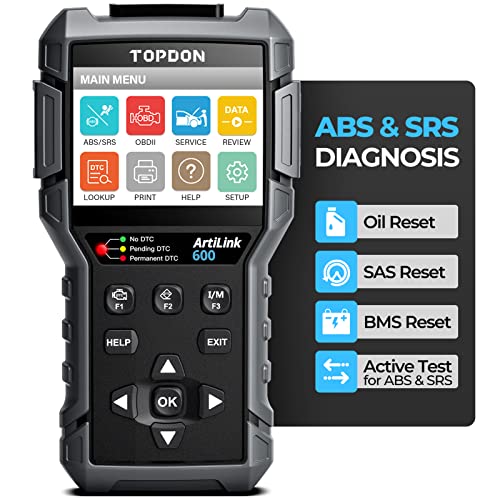
4. TOPDON AL600: ABS and SRS Code Reader with Oil, SAS and BMS Resets
- Engine, ABS and SRS diagnostics
- Oil, SAS and battery (BMS) resets
- Red-yellow-green LED code status
- Menus in 7 languages incl. Japanese
The TOPDON AL600 is a handheld code reader that goes past engine codes into the ABS and SRS airbag modules. The listing says it can test individual ABS and SRS components as well as read and erase codes, which helps narrow down a warning light on the dash. Shortcut keys handle code reading, erasing and I/M readiness, and red, yellow and green LEDs show overall status at a glance.
Three service functions are listed: oil reset, steering angle sensor reset for straight driving after an alignment, and battery management system reset after a new battery. A built-in code lookup library and a help key explain what each code means. Menus and code definitions come in seven languages, Japanese among them. Software updates are free and install through a computer connection using TOPDON’s website.
Coverage limits matter for Japanese cars here. TOPDON lists most US-based cars from 1996, EU-based cars after 2000 and Asian-based cars after 2008, so an older Corolla or Accord may get only basic engine functions. For a newer Japanese car where the brake or airbag light is the concern, it is a straightforward choice. It does not offer active tests or full-system access to body modules.
5. VDIAGTOOL VD10: Plug-In OBD2 Engine Code Reader with I/M Readiness
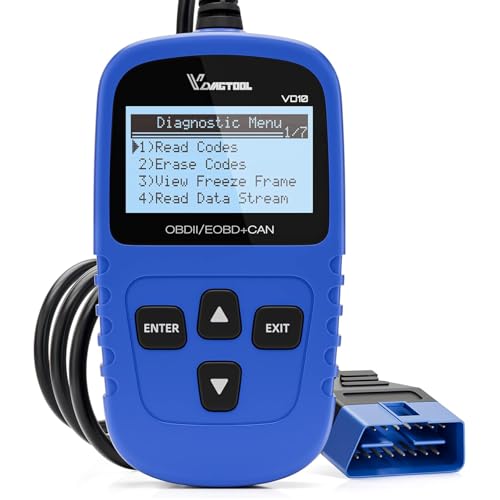
- Reads generic and maker engine codes
- Live data, freeze frame, I/M readiness
- Supports all five OBD2 protocols
- Powered from the port, no batteries
The VDIAGTOOL VD10 is a basic plug-in reader for the check engine light. It powers up from the OBD2 port, so there are no batteries to replace, and shows results on a backlit two-line LCD screen. It reads generic and manufacturer-specific engine codes, including pending codes, and displays definitions from a built-in library of more than 3,000 codes. It can then clear the codes and turn off the warning light once a repair is done.
Live data covers readings such as engine speed, intake air temperature, fuel trims and misfire data, and the tool retrieves the freeze frame stored with each code. An I/M readiness check shows whether the emissions monitors have finished, useful before an inspection or after a battery change. It also reads vehicle information like the VIN, calibration IDs and CVNs, which can help confirm a matching computer when you look at a used car.
The listing names all five OBD2 protocols and gives coverage as post-1996 US-based, post-2006 EU-based and post-2009 Asian-based 12V cars and light trucks, so check an older Japanese car with the seller. It does not read ABS, airbag or body codes and has no resets beyond clearing engine codes. It suits a glovebox check rather than deeper work.
How the Five Tools Line Up
The tablet and handhelds reach more modules, while the two plug-in readers stay simple.
| Scanner | Format | Systems | Suits |
|---|---|---|---|
| LAUNCH CRP123 Advanced | 5 in touchscreen handheld | Engine, ABS, SRS, transmission | Mixed Japanese driveways that need brake and airbag codes |
| VDIAGTOOL VD80BT Lite | 8 in tablet, wireless adapter | Full system, active tests, coding | Owners who want module tests and deeper service work |
| LAUNCH Creader VII+ V2.0 | 4 in screen handheld | Engine, ABS, SRS, transmission | Button-driven code reading with three resets |
| TOPDON AL600 | Handheld with LED status lights | Engine, ABS, SRS | Newer Japanese cars on a budget |
| VDIAGTOOL VD10 | 2-line plug-in reader | Engine and emissions only | A glovebox check before a shop visit |
Winter Batteries, Readiness Monitors and Grand Rapids Driving
A battery that gives out on a January morning is common here, and swapping it has a side effect many owners miss. The CARB fact sheet explains that a dead, disconnected or replaced battery can leave the readiness indicators marked incomplete. That is normal, and about a week of regular driving usually sets them again.
Every tool in this list shows I/M readiness, so you can see which monitors still need to run after a battery job. Several also list battery registration or BMS reset, which some newer cars expect after a new battery goes in. Check your owner’s manual, since the need varies by make and model.
Short trips in deep cold can also keep some monitors from finishing. If a scan shows one stuck incomplete for weeks of normal driving, that is worth a closer look rather than another code clear.

Codes That Belong With a Technician
Even the best scan tool for Japanese cars names a fault, not the part behind it. A lean code on a Rogue could trace to a vacuum leak, a dirty airflow sensor or low fuel pressure. If the light stays on while the car drives normally, our article on a check engine light that is on but the car runs fine covers the usual suspects.
Maker-specific codes follow the same logic on any brand, as our breakdown of common Audi fault codes and their causes shows. CARB warns that a blinking check engine light can signal a fault that damages the catalytic converter. Treat that, a brake warning or an airbag light as a reason to stop clearing codes.
When a code returns after a repair, or you want the parts behind it tested properly, book our check engine light diagnostic in Grand Rapids. We work on foreign and domestic vehicles, and Japanese makes are part of that daily mix.
More Buying Guides
Frequently Asked Questions
Do Japanese cars need a special scanner?
Not for engine codes on cars sold new in the US. They use standard OBD2 from 1996 on, so any OBD2 reader works for the check engine light. You need maker-level software for ABS, airbag and body modules, and a JOBD tool only for imports built for the Japanese market.
Can one scanner read airbag codes on both a Toyota and a Honda?
Yes, if its listing covers SRS on both makes. The LAUNCH CRP123 Advanced names Toyota and Honda and lists SRS, and the Creader VII+ V2.0 and TOPDON AL600 also list airbag codes. Coverage varies by model and year, so confirm yours with the seller first.
Why does my older Japanese car not work with some scanners?
Some listings limit Asian-brand coverage by year. The TOPDON AL600 lists Asian-based cars after 2008 and the VDIAGTOOL VD10 lists them after 2009. For an older Japanese car, ask the seller to confirm coverage with your VIN.
Will a new battery affect my emissions readiness?
It can. A disconnected or replaced battery often resets the readiness monitors to incomplete. Normal driving for about a week usually completes them, and a scanner with I/M readiness shows which ones are still waiting.
Pulled a code from your Toyota, Honda or Subaru and want a second opinion? Call 456 AutoFix at 616-279-3832, Monday to Friday 8am to 5pm, or request a diagnostic appointment on our contact page.
Bring the car to 456 Carrier St NE in Creston, or drop it off after hours and write the code number on the key envelope so we know where to start.