
As an Amazon Associate, 456 AutoFix earns from qualifying purchases. Product links below go to Amazon, where you can confirm the right part for your vehicle.
Shop for a smart charger that can sit on a garage shelf all winter and two European names keep turning up. The ctek vs bosch choice is less about which logo is better and more about what you want the charger to do besides keep a battery full.
This page looks at both brands first, then lines up one charger from each in the same small-amp class: the CTEK 4.3 Test & Charge and the Bosch C40-Li, with the bigger Bosch C80-Li added for heavier jobs. Want a longer list of options? Our roundup of chargers for cold-weather storage reviews a wider field.
Quick answer
Should you buy a CTEK or a Bosch battery charger?
Pick by the job. The CTEK 4.3 Test & Charge is a 12V lead-acid charger that also tests the battery and alternator, handy when a car keeps going flat. The Bosch C40-Li adds 6V batteries and a 12V lithium mode at up to 5A, and the bigger C80-Li reaches 20A in fast mode.
Our Quick Picks
One small-amp smart charger from each brand, plus the larger Bosch C80-Li for owners who need more current, with a full write-up of all three further down.

CTEK 4.3 Test & Charge
Charges and maintains a battery, then tests it and the alternator.

Bosch C40-Li
One charger for lead-acid and lithium batteries across several vehicles.
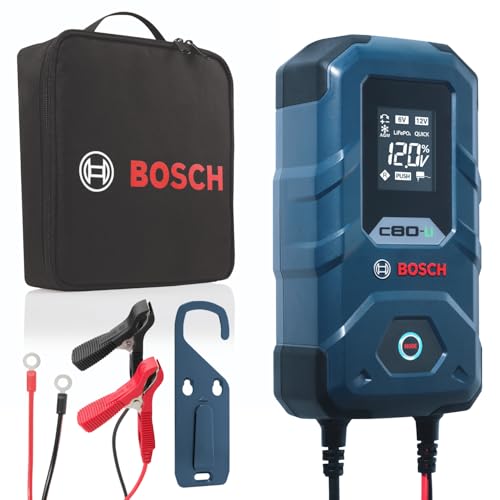
Bosch C80-Li
The larger Li model, adding fast charging and a power supply mode.
A Charger Specialist and a Parts Giant
CTEK is a Swedish company that builds battery chargers and related accessories, and its range on Amazon US is wide. It runs from the small US 0.8 maintainer through the MXS 5.0, the cold-climate MUS 4.3 Polar and the app-linked CS ONE, up to the PRO25SE for workshop use. The Test & Charge belongs to the 4.3 amp family and is the version that adds diagnostics.
Bosch is far better known for spark plugs, wiper blades and brake pads than for chargers. The battery chargers it currently lists on Amazon US are the C40-Li and the larger C80-Li, which its listing says can push up to 20 amps in a fast mode and act as a power supply while a battery is swapped. If you remember the Bosch C3 and C7 from European forums, these two newer models are what turns up in a US search today.
How each brand fills a battery
Most smart chargers follow the pattern Battery University lays out for lead-acid charging: a constant-current bulk stage, a topping stage at lower current, then a float stage that offsets self-discharge. CTEK splits that into 8 steps, with a recovery step at the start and pulse maintenance at the end. Bosch describes maintenance and regeneration functions but publishes no step count on its listing.
The bigger split is battery chemistry. The Bosch has a dedicated lithium mode for 12V LiFePO4 batteries and also charges 6V lead-acid. The CTEK listing centers on 12V lead-acid types, flooded through AGM. Lithium cells need their own charge profile, so the right mode matters more than the badge on the case.
CTEK vs Bosch Specs Side by Side
Every figure below comes from the three Amazon US listings. Where a listing says nothing, the table says so instead of guessing.
| Point | CTEK 4.3 Test & Charge | Bosch C40-Li | Bosch C80-Li |
|---|---|---|---|
| Charge current | 4.3A class (per model name) | Up to 5A | Up to 20A in fast mode |
| Battery voltage | 12V | 6V and 12V | 6V and 12V |
| Battery types | All lead-acid types | Lead-acid, AGM, EFB, gel, SLI, 12V LiFePO4 | Same as C40-Li |
| Battery and alternator test | Yes, 3 test programs | Not listed | Not listed |
| Maintenance | Float/pulse, batteries up to 160Ah | Maintenance and regeneration functions | Maintenance charging, power supply mode |
| Protection | Spark-free, reverse polarity | Overheating, short circuit, reverse polarity, IP65 | Overheating, short circuit, reverse polarity, IP65 |
| Mode memory after power loss | Not stated | Yes | Yes |
| Temperature compensation | Not stated | Not stated | Not stated |
| Warranty on listing | Not stated | Not stated | Not stated |
On paper the ctek vs bosch pair split cleanly. The CTEK gives up voltage range and clear lithium support in exchange for a built-in test function, while the Bosch gives up testing for wider battery coverage and a splash-rated housing. The C80-Li keeps that Bosch profile and trades size for more current.
CTEK vs Bosch: Three Chargers Up Close
None of these three models has appeared in our earlier charger guides, so each is a fresh pick for this ctek vs bosch matchup. Check your battery type and voltage against each listing before you order.
CTEK 4.3 Test & Charge: 12V Charger with Battery and Alternator Testing
- 12V charger in CTEK's 4.3 amp class
- 3 test programs for battery and alternator
- 8 step charging with float/pulse maintenance
- Spark-free, reverse polarity protection
The Test & Charge is CTEK’s 12 volt charger in its 4.3 amp family, and it adds a diagnostic side to the usual charging work. Its listing describes three test programs that check the battery’s condition and how well the vehicle’s charging system is performing. The maker pitches it for every lead-acid battery type and lists float and pulse maintenance for batteries up to 160Ah, which covers most cars, small trucks and motorcycles.
Charging runs through CTEK’s 8 step routine, which recovers, charges and then holds the battery while the vehicle sits unused. You choose a program and a mode, connect the clamps and let it work through the steps on its own. CTEK lists spark-free operation and reverse polarity protection, and says the voltage and current it delivers are clean, with no surges or spikes reaching the vehicle’s electronics.
The test programs are the reason to pick this one over a plain maintainer. When a car keeps going flat, a quick check can hint whether the battery is worn or the alternator is falling short, before you buy either part. It is a 12 volt unit, so it won’t serve a 6 volt classic. One bullet also mentions LiFePO4, so confirm lithium support with CTEK before you connect it to a lithium battery.
View CTEK 4.3 Test & Charge on Amazon

Bosch C40-Li: 5A 6V/12V Charger for Lead-Acid and Lithium Batteries
- Up to 5A, 6V and 12V batteries
- Lead-acid, AGM, EFB, gel, SLI and 12V LiFePO4
- Remembers the last mode after a power cut
- Maintenance and regeneration functions
The C40-Li is the smaller of the two Li chargers Bosch currently lists on Amazon US, with the C80-Li above it. It charges 6 volt and 12 volt lead-acid batteries, including AGM, EFB, gel and SLI types, as well as 12 volt lithium-ion (LiFePO4) batteries. The listing names scooters, motorcycles, cars, trucks, SUVs, vans and motorboats, so one unit can look after most of a household’s batteries.
Motorcycle and lithium modes charge at up to 5 amps, and an integrated microprocessor runs the process. If mains power drops for a moment, the charger keeps the mode you selected and carries on in it, which helps where the garage outlet shares a circuit with other tools. The safety bullet lists overheating, short circuit and reversed polarity protection plus an IP65 dust and splash rating, though it names the C80-Li, so confirm on the box.
Maintenance and regeneration functions are meant for batteries that sit through an off-season, when slow discharge would otherwise shorten their life. It suits an owner with a mix of 6 volt, 12 volt and lithium batteries who wants one charger for all of them. It has no battery or alternator test, so it cannot tell you why a car keeps draining. The listing states no warranty term or temperature range.
Bosch C80-Li: Up to 20A 6V/12V Charger with Power Supply Mode
- Up to 20A in fast charging mode
- 6V lead-acid plus 12V lead-acid and LiFePO4
- Power supply mode for battery service
- IP65, overheating and reverse polarity protection
The C80-Li sits above the C40-Li in the same Bosch Li line and keeps its sibling’s battery coverage. Its listing names 12 volt LiFePO4, lead-acid, AGM, EFB, gel and SLI batteries, plus 6 volt lead-acid, in motorcycles, cars, trucks, SUVs, vans and motorboats. The product title quotes a 15 amp rating, and a separate fast charging mode lifts the current to as much as 20 amps.
That extra current shortens the wait on a large, deeply drained battery, such as the starting battery in a pickup or a boat. A power supply mode is the other addition: it feeds the vehicle while its battery is being serviced or replaced, so radio presets and other stored settings survive the swap. Like the smaller model, it returns to the selected mode after a brief mains dropout.
Bosch lists overheating, short circuit and reversed polarity protection with an IP65 rating against dust and splashing water, and a maintenance charge for batteries in seasonal use. Choose it over the C40-Li if you look after bigger batteries or change batteries yourself. It still has no battery or alternator test, and the listing gives no warranty term or temperature compensation.
Where CTEK and Bosch Differ Day to Day
Finding out why a battery keeps dying
A charger that brings a flat battery back to full only treats the symptom. The Test & Charge runs checks on the battery’s condition and on the output of the charging system, so you get a hint whether the battery or the alternator is to blame. If the results point at the alternator, our guide to bad alternator symptoms lists the other signs worth watching for.
Cars, bikes and lithium packs
A garage holding a 6V antique tractor, a lithium motorcycle battery and a family SUV is where the Bosch earns its shelf space. One C40-Li can handle all three, as long as you choose the right mode each time. The CTEK would cover only the 12V lead-acid batteries in that mix.

Leaving it connected for months
All three are built to stay hooked up through a storage season. Both Bosch models keep their last mode after a short power cut, so a tripped breaker or a storm flicker won’t drop it back into the wrong program. CTEK calls its approach connect and forget, with pulse maintenance topping the battery up between rests.
Warranty and temperature compensation
None of the three listings gives a warranty term, and none says the charger adjusts its voltage for temperature. That second gap matters more than it sounds, because Battery University puts the charge temperature coefficient of a lead-acid cell at about minus 3 millivolts per degree Celsius. If you charge in an unheated space, ask the seller or the maker about both points before you buy.
CTEK vs Bosch by Owner Type
Match the charger to the vehicles in your garage and to the question you most need answered.
| Your situation | Better fit | Why |
|---|---|---|
| Car keeps going flat for no clear reason | CTEK Test & Charge | Tests both the battery and the alternator |
| Lithium motorcycle or powersport battery | Bosch C40-Li | Has a 12V LiFePO4 mode |
| 6V classic car or tractor | Bosch C40-Li | Charges 6V and 12V lead-acid |
| One daily driver with an AGM battery | Any of the three | All three cover AGM |
| Garage outlet on a shared circuit | Bosch C40-Li | Resumes its last mode after a power cut |
| Large truck or boat battery, or a battery swap at home | Bosch C80-Li | 20A fast mode and a power supply mode |
Want to see CTEK’s cold-climate model against a bigger rival? Our NOCO Genius 10 vs CTEK MUS 4.3 comparison covers the Polar version in depth. For how CTEK stacks up against its best-known competitor at brand level, read our NOCO vs CTEK breakdown.
Keeping Batteries Healthy Through a West Michigan Winter
Grand Rapids winters are hard on any battery that sits. A lead-acid battery left partly charged can sulfate, and Battery University’s page on charging at high and low temperatures notes that freezing a lead-acid battery causes permanent damage. Keeping a maintainer connected holds the charge high and guards against both problems.

Lithium batteries bring a rule of their own. The same page says lithium-ion should not be charged below freezing, so a lithium bike battery kept in an unheated garage should come indoors before you plug in the Bosch’s lithium mode. Mount either charger on a wall or shelf, clear of the slush and road salt that drip off a parked car.
Start the season with a fully charged battery, clean terminals and a snug connection. Glance at the status lights every few weeks, and stop charging at once if the case is cracked, swollen or leaking. For cold-start trouble beyond the battery, see our guide to a car not starting in cold weather.
When a Charger Won’t Solve It
No charger can stop a parasitic drain or make up for a weak alternator. If the battery is flat after a night or two without a charger attached, our article on why a car battery dies overnight walks through the usual causes. A battery that fails the CTEK’s check right after a full charge is usually close to the end of its life.
When a test points at the charging system, or a drain is hard to track down, bring the car to us. We handle car electrical repair in Grand Rapids, checking the battery, alternator, cables and any module that stays awake after you lock up. Electrical systems are among the areas where Hendrick Hoffman holds both ASE and State of Michigan credentials, backed by work in automotive service since 2005.
More Buying Guides
Frequently Asked Questions
Is CTEK better than Bosch for battery chargers?
Neither wins across the board. The CTEK Test & Charge suits owners who want to check the battery and alternator as well as charge, while the Bosch C40-Li suits owners with 6V, 12V and lithium batteries to look after. Choose by the batteries you own.
Can the Bosch C40-Li charge a lithium battery?
Its listing says it charges 12V lithium-ion (LiFePO4) batteries at up to 5A in its lithium mode. Confirm that your battery is LiFePO4 and that its maker allows external charging, and don’t charge it below freezing.
Does the CTEK Test & Charge work on AGM batteries?
Yes. Its listing covers all lead-acid battery types, and an AGM battery is a sealed lead-acid design. Select the program that matches your battery before the charge starts.
What if the charger says my battery is fine but the car still dies?
Then the fault is likely in the vehicle, not the battery. A weak alternator or a parasitic drain will keep flattening a healthy battery, and a shop can measure charging output and trace the draw.
Charger shows a full battery but the engine still won’t turn over? Call 456 AutoFix at 616-279-3832, Monday to Friday 8am to 5pm, or ask for a charging system test on our contact page.
If your job runs right up to our closing time, the after-hours drop-off lets the car reach 456 Carrier St NE, Grand Rapids, whenever it suits you.