
As an Amazon Associate, 456 AutoFix earns from qualifying purchases. Product links below go to Amazon, where you can confirm the right part for your vehicle.
Most drivers blame winter when a battery dies, yet the damage often happened months earlier under a hot hood. The best car battery for heat matches your car’s group size, holds up to high under-hood temperatures and still has reserve left for the first cold morning.
Below we explain what heat does to a battery and which specs matter, then review six AGM batteries in common group sizes. For a wider look at who makes what, see our guide to car battery brands and how they compare.
Quick answer
Which car battery holds up in hot weather?
A sealed AGM battery in your car’s exact group size is the safest choice for heat. The Optima YellowTop D34 and Odyssey 34-PC1500T suit trucks and cars with heavy electrical loads, the Interstate MTX-24F fits many 24F applications, and the Weize Platinum Group 65 lists an operating range up to 158°F.
Our Quick Picks
Three quick picks: a dual-purpose Optima for heavy loads, an Odyssey built for long service life and an Interstate pure lead AGM in Group 24F. All six are reviewed below.

Optima YellowTop D34
A dual-purpose AGM that starts the engine and powers extra accessories.

Odyssey 34-PC1500T
A heavy AGM with deep-cycle ability and a full replacement period.

Interstate MTX-24F
A pure lead AGM for cars and SUVs that use the 24F size.
What Summer Heat Does Inside a Battery
Heat speeds up the chemical reaction inside a lead-acid battery. It also speeds up corrosion of the positive grids and drives water out of the electrolyte, and both losses are permanent.
Battery University’s page on how heat and loading affect battery life gives a rule of thumb: every 15°F rise in temperature cuts the life of a sealed lead-acid battery roughly in half. It also cites a Battery Council International study in which starter batteries averaged 59 months in the cooler North and only 47 months in the warmer South.
Here is the catch in a cold state. Heat weakens the battery quietly through July and August, but a warm engine starts easily, so nothing seems wrong. The lost capacity only shows on a frosty morning that asks for full cranking power.
Specs That Matter When It Gets Hot
No battery is immune to heat, so pick one that loses capacity slowly and fits the tray properly. Check these points first.
- Group size first: the group number on your old battery or in the owner’s manual sets the case size, terminal layout and polarity.
- AGM construction: absorbed glass mat batteries hold the electrolyte in fiberglass mats and are sealed, so there is no open water to boil off. Cars that came with AGM need AGM again.
- Reserve capacity: the minutes a battery can run the car’s loads with the alternator off. A higher figure gives more margin as heat slowly eats into capacity.
- Cold cranking amps: match or modestly exceed the factory figure.
- Freshness: check the date code on arrival, and keep the factory heat shield or sleeve when you swap batteries.
Flooded batteries can do well in heat when topped up and vented, but few owners check them. When you shop for the best car battery for heat, a sealed AGM design removes that chore, so every pick below is AGM.
Best Car Battery for Heat: Six AGM Batteries Reviewed
Each listing below names its group size, so start with the size your car uses. Treat this as a shortlist for the best car battery for heat in your vehicle, then confirm terminals and dimensions before you order.
1. Optima YellowTop D34: 750 CCA Dual Purpose AGM Battery with SpiralCell Design
- 750 cold cranking amps
- 120 minute reserve capacity
- 55 Ah C20 capacity
- Sealed SpiralCell AGM design
The YellowTop is Optima’s dual-purpose line, meaning it is built both to start an engine and to handle repeated deeper discharges from accessories. This D34 version is rated at 750 cold cranking amps with a 120 minute reserve capacity and a C20 capacity of 55 amp hours. It weighs 42.9 pounds, measures 10 by 6 7/8 by 7 13/16 inches and uses SAE top posts, which suit vehicles with standard post clamps.
Inside, Optima winds its plates into spiral cells made with 99.99 percent pure lead instead of stacking flat plates. The listing says this makes the battery fifteen times more resistant to vibration than a standard flooded battery and gives up to three times the life. For heat, the sealed AGM case matters most: there is no water to top up and nothing to boil away during a long, hot summer in a crowded engine bay.
This battery suits trucks, SUVs and older cars that run winches, plow lights, extra lighting or a large stereo. Group 34 is a common size in many Chrysler, Dodge and Jeep vehicles, but read the size on your current battery and measure the tray before you buy, since GM side-terminal trucks need the dual-terminal version instead. Drivers who only need starting power can choose the RedTop below instead.
View Optima YellowTop D34 on Amazon
2. Odyssey 34-PC1500T: 850 CCA Group 34 AGM Automotive Battery for Long Service Life
- 850 cold cranking amps
- 3 to 10 year service life claim
- 400 cycles at 80% depth of discharge
- Full recharge in 4 to 6 hours
Odyssey builds its Automotive and LTV batteries around thin plates of pure lead packed tightly in a sealed AGM case. The 34-PC1500T is a Group 34 battery rated at 850 cold cranking amps, with listed dimensions of 10.85 by 6.76 by 7.82 inches. The listing quotes a service life of three to ten years and a limited three and four year full replacement period rather than a pro-rated one.
Odyssey also claims 70 percent longer cycle life than conventional deep cycle batteries, up to 400 cycles at 80 percent depth of discharge, and a full recharge in four to six hours. That combination is useful where heat and heavy use meet. A battery that recovers quickly after a deep drain spends less time sitting partly charged, which is the condition that sulfates plates fastest on a hot day.
It suits drivers who plan to keep a truck or car for many years and want one battery to outlast several cheaper ones. It is heavy, and it is sold as a Group 34 with top posts, so confirm that your vehicle takes Group 34 and that the positive post sits on the correct side. It is more battery than a light commuter car needs.
View Odyssey 34-PC1500T on Amazon

3. Interstate MTX-24F: 710 CCA Group 24F Pure Lead AGM Battery for Start-Stop Vehicles
- 710 CCA and 70 amp hours
- Pure lead AGM construction
- Spill-proof VRLA design
- Built for start-stop vehicles
Interstate’s MTX line is its pure lead AGM range for start-stop vehicles and cars with many plug-in accessories. This Group 24F battery is rated at 710 cold cranking amps and 70 amp hours. Interstate says the design packs more lead into the case, and it expects about twice the service life of a conventional lead alloy AGM and three times that of a flooded battery.
The electrolyte is held in fiberglass mats, and the valve regulated case keeps it sealed and spill-proof. In hot weather that means no water loss to watch and less risk of acid creeping out to corrode the tray and cables. Start-stop systems also cycle the battery many times on every drive, and a battery built for that duty handles the extra strain of a hot commute better than a basic flooded unit.
Group 24F is common in many Toyota and Lexus models and in some other imports, but it is not interchangeable with Group 24, because the terminals are reversed. Interstate posts a compatibility guide on the listing, so check your own year, model and engine there before ordering. Cars that need a smaller or larger case should look at the other sizes here.
View Interstate MTX-24F on Amazon
4. Weize Platinum AGM Group 65: 750 CCA 70Ah Battery with 158°F Rated Operating Range
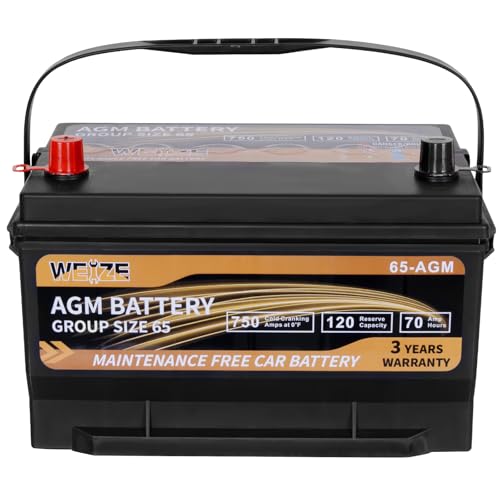
- 750 CCA, 70 Ah, 120 RC
- Operating range -22°F to 158°F
- Low self-discharge AGM
- Start-stop compatible
Weize’s Platinum AGM line covers most common group sizes, and this Group 65 version lists 70 amp hours, 750 cold cranking amps and 120 minutes of reserve capacity. The case measures 12.05 by 7.56 by 7.56 inches with tapered terminals, positive on the left. Unusually, the listing states an operating temperature range of -22°F to 158°F, which is a useful figure for anyone comparing batteries for heat.
Weize points to the glass fiber mats and separators as the reason AGM holds capacity better in hot climates, and to a lower self-discharge rate than flooded batteries. That second point matters if the vehicle sits in a hot garage for days between drives. The battery is listed as suited to start-stop and regenerative braking systems and to vehicles with heavy accessory loads, with a three year warranty.
Group 65 is a common size in many Ford and Lincoln trucks and SUVs, but measure your old battery and check the terminal layout before ordering, as Weize advises on the listing. It is a starting battery for vehicles, not a deep-cycle battery for solar, marine or RV house use. If your vehicle came with AGM, the listing also notes it should not be downgraded to flooded.
View Weize Platinum AGM Group 65 on Amazon

5. Deka 9A35/85 Intimidator: 640 CCA Group 35/85 AGM Battery with Right Positive Terminal
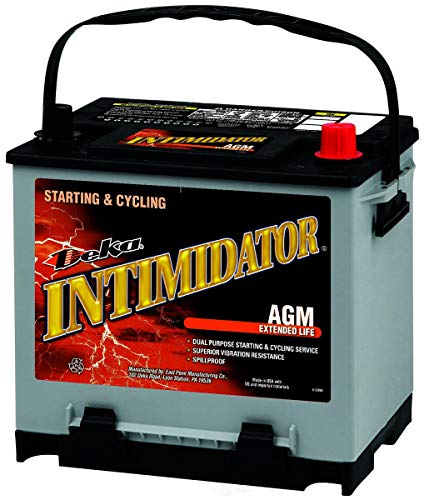
- 640 cold cranking amps
- Group size 35/85
- Right positive polarity
- Top post terminals
Deka is the battery brand of East Penn, and the Intimidator name covers its AGM car and truck batteries. The 9A35/85 is a dual-size battery listed for Group 35 and Group 85 applications, rated at 640 cold cranking amps with top post terminals and the positive on the right. Its listed dimensions are 9.5 by 6.75 by 7.75 inches, a compact case for smaller engine bays.
Compact cars often pack the battery close to the engine and exhaust with little air moving around it, which is exactly where heat shortens battery life. A sealed AGM case keeps the electrolyte in place and avoids the water loss a flooded battery suffers in that spot. The Amazon listing gives few other details, so expect a straightforward starting battery rather than one marketed for deep cycling.
Group 35 is used in many Japanese cars and crossovers from Honda, Nissan, Toyota and Subaru, among others. Even so, check the size printed on your current battery, and confirm that the positive post on your car sits on the right before you order. Reserve capacity is not stated on this listing, so drivers who run many accessories may prefer a model that lists it.
View Deka 9A35/85 Intimidator on Amazon
6. Optima RedTop 34/78: 800 CCA Sealed AGM Starting Battery with Dual Terminals

- 800 cold cranking amps
- 100 minute reserve capacity
- Dual SAE and GM posts
- SpiralCell pure lead design
The RedTop is Optima’s starting battery, built to deliver a strong burst of cranking power rather than repeated deep discharges. This 34/78 version is rated at 800 cold cranking amps, with a 100 minute reserve capacity and a C20 capacity of 50 amp hours. It measures 10.06 by 6.94 by 7.88 inches, weighs 38.8 pounds and carries both SAE top posts and GM side terminals.
It shares the SpiralCell design of the YellowTop D34, using 99.99 percent pure lead wound into sealed cells. Optima lists the same fifteen times vibration resistance and up to three times the life of a standard flooded battery. In a hot climate the sealed AGM case avoids water loss, and the spiral construction keeps the plates firmly packed, which helps on rough roads and in engines that shake at idle.
Optima describes the RedTop as ideal for basic electrical demands, so it suits a daily driver, a classic or a work truck without winches, plow lights or big audio. If your vehicle draws heavy accessory loads with the engine off, the YellowTop is the better match. Confirm that your truck or car uses Group 34 or 78 and has room for the case.
View Optima RedTop 34/78 on Amazon
How the Six Batteries Compare
The table lines up the group size, cranking figure and main strength of each battery, taken from the Amazon listings. Group size decides fit, so read across from the size on your current battery.
| Battery | Group size | Cold cranking amps | Suits |
|---|---|---|---|
| Optima YellowTop D34 | 34 (top post) | 750 | Heavy accessory loads, 120 min reserve |
| Odyssey 34-PC1500T | 34 | 850 | Long service life, deep cycling |
| Interstate MTX-24F | 24F | 710 | Start-stop cars in this size |
| Weize Platinum AGM 65 | 65 | 750 | Listed range up to 158°F |
| Deka 9A35/85 Intimidator | 35/85 | 640 | Compact cars and crossovers |
| Optima RedTop 34/78 | 34/78 (dual terminal) | 800 | Starting with light accessory use |
If two batteries share your group size, let your electrical load decide. A truck with a winch or plow light benefits from the deep-cycle ability of the YellowTop or Odyssey, while a commuter car is well served by a starting battery.

Hot Garages and Humid Summers in West Michigan
Grand Rapids is not the desert, but a battery does not feel the weather report. It feels the engine bay, which runs far hotter than the air on a humid July afternoon in stop-and-go traffic, and it feels a closed, unvented garage that bakes all day after the car is parked.
A few habits help the battery you already own. Keep the factory heat shield or sleeve in place, clean crust off the terminals and check that the hold-down is tight.

Cars that sit for weeks in summer lose charge faster in the heat, because self-discharge rises with temperature. A smart maintainer from our guide to car battery chargers for winter works just as well in July, holding the battery at full charge without overcharging it.
Test Before You Replace
A slow crank, a battery light or a dead car after a weekend parked does not always mean the battery is finished. A weak alternator, a loose ground or something left drawing power can flatten a good battery, and our article on a car battery that dies overnight explains how a parasitic drain is traced.

Many newer cars also need a new battery registered with the car’s computer, a step covered in our Audi battery replacement guide. If you would rather have the battery, alternator and wiring checked together, our shop handles car electrical repair in Grand Rapids and can confirm whether a heat-tired battery is really the cause.
More Buying Guides
Frequently Asked Questions
Is heat or cold harder on a car battery?
Heat does more lasting harm, because it speeds up grid corrosion and water loss inside the battery. Cold mostly exposes that damage by cutting the power a battery can deliver and raising the power the engine needs to start. A battery that struggles in January was often weakened the summer before.
Is an AGM battery better than a flooded one in hot weather?
For most drivers, yes. An AGM battery is sealed, so it cannot lose water to evaporation, and it resists vibration well. A flooded battery can also last in heat if its water level is checked, but few owners do that, and a car that came with AGM must keep using AGM.
Do I need more cold cranking amps for a hot climate?
No. Cold cranking amps measure starting power at 0°F, so a higher number does nothing against heat. Match the factory rating or go slightly above it, and give more weight to the right group size, reserve capacity and a sealed AGM design.
Should I keep the plastic heat shield around my battery?
Yes. The shield or sleeve slows the transfer of heat from the engine and exhaust to the battery case. Move it to the new battery when you replace the old one, and replace it if it is cracked or missing.
Did your car crank slowly after a hot week, or not at all on a cold morning? Call 456 AutoFix at 616-279-3832, Monday to Friday 8am to 5pm, or ask for a battery and charging check through our contact page.
Short on daytime hours? Park the car at 456 Carrier St NE, Grand Rapids, MI 49505 after we close, use our after-hours drop-off, and leave a note on when the slow starts happen.