
As an Amazon Associate, 456 AutoFix earns from qualifying purchases. Product links below go to Amazon, where you can check the refrigerant type and what comes in the box before you buy.
The A C Pro vs EZ Chill question usually comes up on the first muggy day of the year, when the vents blow cool but not cold and a recharge kit looks like an easy fix. Both names sit side by side on the shelf, both are made for R-134a systems, and the boxes look a lot alike. What most shoppers don’t realize is that the two lines are sold under one brand.
This guide explains how the two lines relate, then compares the reusable R-134a gauge and hose from each one: the A/C Pro ACP-400 and the EZ Chill gauge and hose, with the Arctic Freeze hose from a third sibling line added as another option. If you want the wider field of recharge kits for both refrigerants, our guide to choosing a car AC recharge kit covers that ground.
Quick answer
Should you buy the A/C Pro or the EZ Chill recharge hose?
Both are reusable low-side gauges for R-134a only, and Amazon sells both under the A/C Pro brand. Choose the A/C Pro ACP-400 if you want a 24-inch braided hose and an extra-large dial. Choose EZ Chill for a simpler tool with a 90-degree coupler, or the Arctic Freeze hose if you stock self-sealing cans. None of them works on R-1234yf.
Our Quick Picks
One reusable R-134a gauge and hose from each line, plus the Arctic Freeze tool from a third line in the same family, all sold under the A/C Pro brand on Amazon. Refrigerant is bought separately for every pick, and each is reviewed in full below.

A/C Pro ACP-400 Hose and Gauge
Long braided hose and a big dial for ports buried deep in the engine bay.
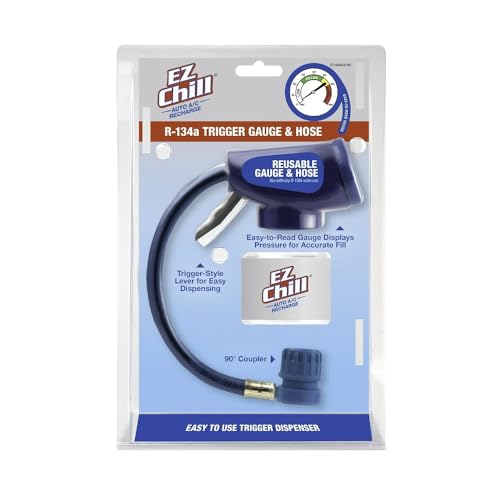
EZ Chill R-134a Gauge and Hose
A simpler gauge and hose with an angled coupler for cramped engine bays.

A/C Pro Arctic Freeze Gauge and Hose
A trigger gauge with an angled coupler, matched to self-sealing R-134a can tops.
One Brand, Two Product Lines
On Amazon US, the EZ Chill gauge carries “A/C Pro” in its brand field, and big-box retailers file EZ Chill products on the A/C Pro brand page too. So this is less a contest between rival companies and more a choice between two tiers from the same family. A/C Pro is the line with the bigger gauges, longer hoses and more product choices, while EZ Chill is the plainer, simpler line.
We compare the gauge and hose from each line rather than refrigerant cans, for two reasons. EZ Chill is listed on Amazon US only as a gauge and hose, with no can kit, and the only A/C Pro can kit we found there is the ACP100 four-pack, which our recharge kit guide already reviews. Comparing hose to hose keeps the match fair, and the hose is the part you keep for years anyway.
Start by confirming your refrigerant. Look for a sticker on the radiator support or under the hood that names R-134a or R-1234yf. All three tools here are made for R-134a only, which covers most cars from the mid-1990s up to the point where the maker switched that model over to R-1234yf.
The fittings are different on purpose. The EPA’s rules for servicing car A/C systems require each approved refrigerant to use its own unique fittings on the car, the cans and the charging equipment, and say an adapter should not be used to convert one. If your label says R-1234yf, skip all three and read our guide to recharge kits for R-1234yf cars instead.
A C Pro vs EZ Chill: The Hardware Side by Side
Every figure below comes from the three Amazon US listings. Where a listing leaves a detail out, the table says so rather than filling the gap with a guess.
| Point | A/C Pro ACP-400 | EZ Chill gauge and hose | Arctic Freeze gauge and hose |
|---|---|---|---|
| Refrigerant | R-134a only | R-134a only | R-134a only |
| Hose | 24-inch heavy-duty braided | Length not stated | Length not stated |
| Gauge | Extra-large dial-in gauge | Large pressure gauge | Size not stated |
| Coupler | Quick-connect, locks onto the port | 90-degree, for ports in tight spots | 90-degree, for tight ports |
| Dispenser | Rivet-hinged squeeze trigger | Trigger with thumb lever | Trigger dispenser |
| Can compatibility | Not stated; check the can label | Any R-134a automotive valve can | Self-sealing valve cans only |
| Refrigerant included | No | No | No |
The practical split is reach versus simplicity. The A/C Pro hose is longer and more heavily built, which matters when the port is buried. The EZ Chill tool keeps things basic, and its angled coupler can be easier to seat when the port points at something solid. Arctic Freeze shares that angled coupler but narrows the choice of refrigerant to self-sealing cans.
A C Pro vs EZ Chill Hoses: The Three Tools in Detail
Each listing below is a reusable R-134a gauge and hose with no refrigerant in the box. Plan on buying a can of plain R-134a to go with whichever one you pick, and read its label before you connect anything.
A/C Pro ACP-400: 24-Inch Braided R-134a Recharge Hose with XL Dial-In Gauge
- 24-inch heavy-duty braided hose
- Extra-large dial-in pressure gauge
- Quick-connect coupler for the low-side port
- Rivet-hinged squeeze trigger
The ACP-400 is A/C Pro’s stand-alone hose and gauge for R-134a systems, sold without any refrigerant. A/C Pro describes it as a professional-grade tool, and it is built to be kept and reused rather than thrown away with the empty can. It is the piece of an A/C Pro kit that does the measuring, so you pair it with whichever R-134a can you choose.
Reach is the first thing the listing points to. The 24-inch hose is heavy-duty and braided, which helps on engines where the low-side port sits behind an air box or low near the firewall. The extra-large dial-in gauge is meant to be read at a glance, the quick-connect coupler locks onto the service port, and a rivet-hinged trigger lets you meter refrigerant in short squeezes instead of one long blast.
This hose fits a driver who owns an R-134a car, expects to top it off again in a future summer, and wants the larger gauge and longer hose. The listing does not say which can tops it accepts, so read the can label before you buy refrigerant to go with it. It will not connect to an R-1234yf system, and a single low-side gauge cannot show what the high side is doing or find a leak.
View A/C Pro ACP-400 Hose and Gauge on Amazon

EZ Chill R-134a Gauge and Hose: Reusable Trigger Dispenser with 90-Degree Coupler
- Reusable R-134a gauge and hose
- Large pressure gauge
- Trigger dispenser with thumb lever
- 90-degree coupler for tight ports
EZ Chill is the plainer line, and this listing is one EZ Chill gauge and hose for R-134a systems. Amazon lists it under the A/C Pro brand name. As with the ACP-400, no refrigerant comes in the box, so you add a can of R-134a to the order unless you already have one on the garage shelf.
The listing describes a large gauge that shows the pressure reading and tells you when the system needs refrigerant. Dispensing is done with a trigger and a thumb lever, a layout that keeps the can steady in one hand while you squeeze. The coupler is angled at 90 degrees, which helps where the low-side port faces a hose, a bracket or the strut tower, and the listing says it works with any R-134a automotive can that has a valve top.
The basic routine on the listing is short: start the engine, switch the A/C on and find the low-pressure port before you connect. That makes this tool a sensible fit for someone who tops off one R-134a car every few years and wants a simple gauge. The listing gives no hose length, so look at the photos if your port is hard to reach. It does not fit R-1234yf cars, and it cannot diagnose a fault.
View EZ Chill R-134a Gauge and Hose on Amazon
A/C Pro Arctic Freeze Gauge and Hose: R-134a Trigger Dispenser for Self-Sealing Cans
- Reusable R-134a gauge and hose
- Trigger dispenser
- 90-degree coupler for tight ports
- Fits self-sealing valve can tops only
Arctic Freeze is a third line from the same A/C Pro family, and this listing is its reusable gauge and hose for R-134a systems. The box holds the tool alone, so a can of refrigerant goes on the order with it. In layout it sits close to the EZ Chill tool, which makes it a fair third option rather than a different class of product.
The listing calls out a trigger dispenser, a gauge that shows the pressure reading for an accurate fill, and a 90-degree coupler meant for low-side ports in awkward positions. The detail that sets it apart is the can top. The maker says it is designed for compliance and works only with R-134a cans that have self-sealing valve tops, so an older piercing-style can will not mate with it.
That makes Arctic Freeze a reasonable match for someone who already keeps self-sealing R-134a cans in the garage and likes an angled coupler. The listing gives no hose length and no gauge size, so compare its photos with the other two if reach or dial size matters to you. Like its siblings, it has no fitting for R-1234yf and cannot locate a leak.
View A/C Pro Arctic Freeze Gauge and Hose on Amazon
Which Hose Fits Your Car and Your Habits
The deciding factors are where your low-side port sits and how often you expect to use the tool. Neither one changes how much refrigerant your system needs.
| Your situation | Better fit | Why |
|---|---|---|
| Low-side port deep behind ducts or near the firewall | A/C Pro ACP-400 | 24-inch braided hose adds reach |
| Port faces a bracket, hose or strut tower | EZ Chill | 90-degree coupler seats at an angle |
| You want the easiest dial to read in sunlight | A/C Pro ACP-400 | Extra-large dial-in gauge |
| One quick top-off every few summers | EZ Chill | Simple tool that does the basic job |
| Your shelf already holds self-sealing R-134a cans | A/C Pro Arctic Freeze | Built around self-sealing can tops |
| Car uses R-1234yf | None of them | Different fittings by design |
| System empty or warm again within weeks | None of them | A leak needs finding first |
If you can’t decide, open the hood before you order. A port you can reach with your hand flat and the coupler straight on suits any of the three, so the choice comes down to the gauge you find easier to read.
Reading a Low-Side Gauge Without Overcharging
Connect to the right port, every time
All three tools attach only to the low-pressure port, usually on the larger aluminum line, with a cap often marked “L”. The R-134a high and low ports are different sizes, so a low-side coupler should not fit the high side; if it doesn’t click on easily, stop and check rather than forcing it. Wear safety glasses and gloves, because liquid refrigerant can freeze skin on contact and the belt and fan are close by.

Take readings with the compressor running
Run the engine with the A/C on its coldest setting and the fan on high, then confirm the compressor clutch is turning. Read the dial with the trigger released, since holding it shows can pressure instead of system pressure. Add refrigerant in short bursts, pause, and read again before the next one.
More refrigerant is not more cooling
An overcharged system can actually cool worse than one that is slightly low, and it puts extra load on the compressor. Follow the temperature guide printed on the can or gauge, stop once the needle reaches the target for the day’s air temperature, and save the rest of the can. Use plain refrigerant unless you have a reason for an additive, since sealers can complicate a later repair.
Humid Summers and Salty Winters in West Michigan
Grand Rapids summers are humid, and humid air makes an A/C system work harder to dry and cool the cabin. A system that felt fine in May can seem weak by July, which is when most people reach for a can. Keep in mind that vent temperature on a sticky afternoon is never as low as on a dry one, so judge the result on more than one day.
Winter matters too. Many cars run the compressor when you select defrost, because dry air clears a fogged windshield faster, so a weak A/C can show up as slow defogging in January. Road salt and slush also sit on the condenser at the front of the car, and corrosion there is a common source of slow leaks.
Before you recharge in spring, look through the grille at the condenser fins. Heavy crust, bent fins or oily patches are worth a closer look before you add refrigerant.
When a Recharge Can Is the Wrong Fix
A recharge only helps when the system is a little low. If the gauge reads near zero, the system is close to empty and has a leak that needs finding before any refrigerant goes in. A compressor that won’t engage, a fan that doesn’t run or warm air from one side only point to electrical or blend door faults, and our article on why a car AC is blowing warm air walks through those causes.
If you need to top off every summer, the refrigerant is going somewhere. A dye test can show where, and our guide to an AC leak detection kit for your car explains the options. When the leak is hard to reach or the fault isn’t refrigerant at all, our shop handles heating and air conditioning repair in Grand Rapids, starting with a full system check rather than another can.
More Buying Guides
Frequently Asked Questions
Are A/C Pro and EZ Chill made by the same company?
They are sold under the same brand. The EZ Chill gauge on Amazon US lists A/C Pro as its brand, and large retailers group EZ Chill products on the A/C Pro brand page. EZ Chill is the simpler line, and A/C Pro offers larger gauges, longer hoses and more product choices.
Can I use an EZ Chill hose with an A/C Pro can?
The EZ Chill listing says its hose works with any R-134a automotive can that has a valve top. The ACP-400 listing does not state which can tops it accepts. In either case, read the can label to confirm it is R-134a and matches the hose before you connect.
Will any of these hoses work on an R-1234yf car?
No. All three are built for R-134a, and the EPA requires each refrigerant to use its own unique fittings, with no adapters to convert one. If your under-hood label says R-1234yf, buy a kit made for that refrigerant.
How do I know when to stop adding refrigerant?
Stop when the gauge, read with the trigger released and the compressor running, reaches the target for the day’s air temperature on the can or gauge guide. Add in short bursts and check between them. Going past the target can reduce cooling and strain the compressor.
Topped off and still sweating at every red light? Call 456 AutoFix at 616-279-3832, Monday to Friday 8am to 5pm, or set up an A/C check through our contact page.
Working the same hours we are? Our after-hours drop-off lets you leave the car whenever suits you, and our Creston shop sits at 456 Carrier St NE.