As an Amazon Associate, 456 AutoFix earns from qualifying purchases. Product links below go to Amazon, where you can check the refrigerant type and contents of each kit before you buy.
The first hot, sticky week of a Grand Rapids summer is when most drivers discover their air conditioning has gone soft. The best car AC recharge kit is the one built for the refrigerant your car actually uses, with a gauge you can read and nothing in the can you didn’t ask for.
Below: how to confirm your refrigerant, what a kit should include, six options on Amazon US, and when a can only hides a bigger fault. If the air is already warm, read our walkthrough of why a car AC blows warm air before you spend anything.
Quick answer
Which recharge kit should you buy for a car that cools poorly?
Match the kit to the refrigerant on your under-hood label. Most older cars use R-134a and suit a trigger-gauge kit like the A/C Pro ACP100. Most newer light-duty vehicles use R-1234yf and need a kit with yf cans and a yf coupler, such as the ZeroR R1234YF kit. Skip stop leak unless you accept the trade-offs.
Our Quick Picks
Three quick picks by refrigerant type. All six products are reviewed below.

A/C Pro ACP100
Refrigerant and a reusable trigger gauge in one box for a straightforward top-off.

ZeroR R1234YF Recharge Kit
Complete yf kit with two cans and a long hose for hard-to-reach ports.

A/C Pro R-1234yf Gauge and Hose
A dedicated yf hose and gauge to pair with refrigerant cans you buy separately.
Read the Refrigerant Label Before You Shop
Pop the hood and look for a sticker near the radiator support or on the underside of the hood. It names the refrigerant, R-134a or R-1234yf, and often the charge amount. If the sticker is gone, check the owner’s manual.
The type matters because the two refrigerants use different service fittings on purpose. According to the EPA’s MVAC servicing requirements, each approved refrigerant has its own unique fittings to stop accidental mixing, and an adapter should not be used to convert one.
The EPA’s page on the MVAC refrigerant transition notes that R-134a has been the common refrigerant since the 1990s, that automakers began moving to R-1234yf in 2012, and that yf now fills the majority of light-duty vehicles. The same page states that hydrocarbon refrigerants are unacceptable for car A/C systems. That rules out the “natural gas” or “R-134a replacement” cans you will see online, some of which are labeled for non-automotive use.
Gauge, Refrigerant and Additives: What a Kit Should Include
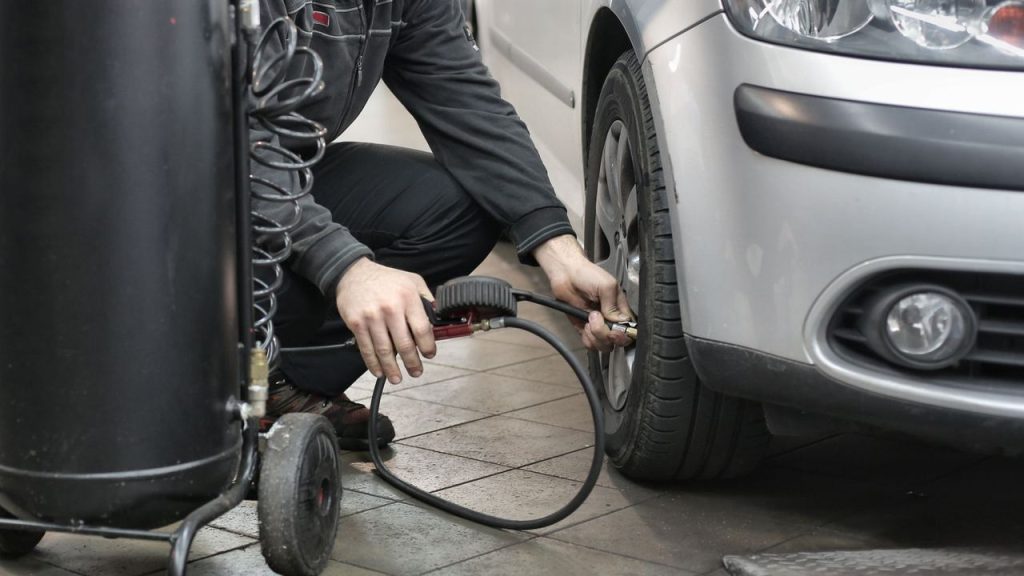
A DIY kit connects only to the low-pressure service port, usually on the larger aluminum line between the compressor and the evaporator. Its gauge shows low-side pressure only, enough to spot a low charge but not to diagnose a fault.
- Correct coupler: an R-134a quick connect or an R-1234yf quick connect, never a converted adapter.
- Readable gauge: a large dial with a temperature guide or color bands, read with the trigger released.
- Hose length: 24 inches reaches tucked-away ports.
- Can type: self-sealing cans let you stop, check the vents and store what is left.
- Additives: plain refrigerant, refrigerant with UV dye, or refrigerant with sealer. Know which one you are buying.
Best Car AC Recharge Kit Options, Reviewed One by One
The six products below cover both refrigerants. Confirm the refrigerant named on each listing matches your under-hood label before you order.
1. A/C Pro ACP100 Professional Formula: 20 oz Refrigerant Kit with Reusable Trigger Gauge
- 20 oz can per kit, pack of 4
- Reusable trigger dispenser with gauge
- Quick-connect adapter for the low-side port
- Formula aimed at colder, drier vent air
The ACP100 is A/C Pro’s long-running Professional Formula recharge kit, and this listing is a pack of four, each with a 20 oz can. Every kit includes a reusable trigger dispenser with a built-in gauge and an adapter that A/C Pro says gives a safe, quick hookup to the vehicle’s service port. The listing title doesn’t spell out the refrigerant, so read the can label and confirm it matches the R-134a sticker under your hood before you charge anything.
A/C Pro’s own ACP-100 instructions explain the routine: engine running, A/C on high with recirculation selected, coupler on the low-pressure port, and pressure read with the trigger released rather than squeezed. Charging stops once the needle sits in the green zone, and the maker warns against chasing the top of that zone.
A four-pack makes sense for a household with more than one R-134a vehicle, or for a car with a slow leak you plan to fix later. It is not a repair for a system that has lost all its charge, and it won’t work on a car that uses R-1234yf.
2. ZeroR R1234YF Recharge Kit: 2 x 8 oz HFO-1234yf Cans with 24-Inch Brass Can Tap Gauge
- Two 8 oz cans of R-1234yf
- 24-inch heavy-duty brass can tap and gauge
- Reverse-thread design for yf cans only
- Refrigerant measured by weight
If your label says R-1234yf, this ZeroR kit is our pick for the best car AC recharge kit in one box, since it packages the refrigerant and the tool together. It contains two 8 oz cans of HFO-1234yf refrigerant and a 24-inch can tap with a gauge. The cans and tap use a reverse-thread design, which ZeroR says keeps incompatible tools from connecting to a yf can.
The longer hose is the practical advantage, since many newer engines tuck the low-side port behind ducts or low on the firewall. The brass tap is built to be reused, so the remaining can can be saved for a later top-off. ZeroR measures each can by weight and notes that most systems take two to three cans, so this kit covers a typical partial recharge rather than a full fill.
Note that ZeroR also sells R-134a replacement kits that its listings describe as a hydrocarbon blend for non-MVAC use; this yf kit is a different product. It suits a yf car that has lost a little cooling. A yf system that is empty or loses its charge quickly needs leak repair first.
View ZeroR R1234YF Recharge Kit on Amazon
3. A/C Pro Certified R-1234yf Gauge and Hose: 24-Inch Reusable Recharge Hose with XL Gauge
- Extra-large gauge for R-1234yf systems
- 24-inch charging hose
- Push-on quick-connect coupler
- Trigger dispenser, reusable
This is the hose half of a recharge kit, built for R-1234yf systems: A/C Pro’s Certified line gauge and hose, with no refrigerant included. It pairs an extra-large dial with a 24-inch charging hose, a push-on quick-connect coupler for the yf low-side port and a trigger dispenser. The listing describes it as reusable, so it stays in the garage for the next season.
Buying the hose separately makes sense when you want to choose your own refrigerant, such as a plain can without additives, or when you own more than one yf vehicle. The trigger lets you meter refrigerant in short bursts and pause to read pressure, which is the habit that prevents overcharging.
It needs a separate R-1234yf can before it can do anything useful, so add one to the order if you don’t already have refrigerant. It will not attach to an R-134a port, by design. Owners of older R-134a cars should look at a 134a gauge instead, and anyone who wants high-side readings or a vacuum test needs a full manifold gauge set rather than a single low-side hose.
View A/C Pro R-1234yf Gauge and Hose on Amazon
4. Chemours Opteon YF R-1234yf Refrigerant: 12 oz Self-Sealing Can for Car A/C

- Genuine Opteon YF refrigerant
- 12 oz self-sealing can
- For MVAC systems that require R-1234yf
- Recharge hose not included
Chemours makes the Opteon line of refrigerants, and this listing is a single 12 oz can of Opteon YF, its R-1234yf product for automotive A/C. The can uses a self-sealing valve, so you can stop partway, check the vent temperature and close it up for later. The listing is clear that no recharge hose is included.
The appeal here is simplicity. This is plain refrigerant, so you avoid sealer and other additives that can complicate a later repair. For a yf car that has lost a little performance over several summers, a measured top-off with a can like this and a reusable gauge is often all a DIY job should be.
Pair it with a dedicated R-1234yf gauge and hose, such as the A/C Pro unit above, and confirm your hose is listed for self-sealing yf cans. It does nothing for an R-134a car. If the system was low last summer too, the refrigerant is leaking out somewhere, and adding a fresh can each season treats the symptom rather than the cause. A dye test or a shop leak check is the better next step.
View Chemours Opteon YF on Amazon

5. National Refrigerants R1234yf with Leak Stop: 8 oz Self-Sealing Can, SAE J2843 Valve

- R-1234yf for MVAC systems
- SAE J2843 compliant valve
- Leak stop additive for minor leaks
- 8 oz self-sealing, left-hand thread
This 8 oz can from National Refrigerants combines R-1234yf with a leak stop additive. The listing says it is made for mobile vehicle A/C systems that require yf, uses an SAE J2843 compliant valve for standard yf service equipment, and has a self-sealing, left-hand-thread container. It also reminds buyers to verify the vehicle’s refrigerant type before use.
The additive is meant to seal minor leaks while you recharge, which can stretch the time between top-offs on an older system with a slow seep at an O-ring or fitting. Because sealer and refrigerant go in together, it saves a step compared with a separate treatment. The compact 8 oz size suits a top-off rather than a large charge.
Sealer has trade-offs. It is designed for small leaks, not a cracked condenser or a failed compressor seal, and it can clog tight passages such as an expansion valve. Many shops check for sealer before connecting recovery equipment, so tell your mechanic if you used this product. If you want to keep the system as clean as possible for a future repair, choose plain refrigerant and find the leak instead.
View National R1234yf with Leak Stop on Amazon
6. A/C Pro Super Seal R-134a Stop Leak: 3 oz Treatment with Red Dye and Push-Button Dispenser
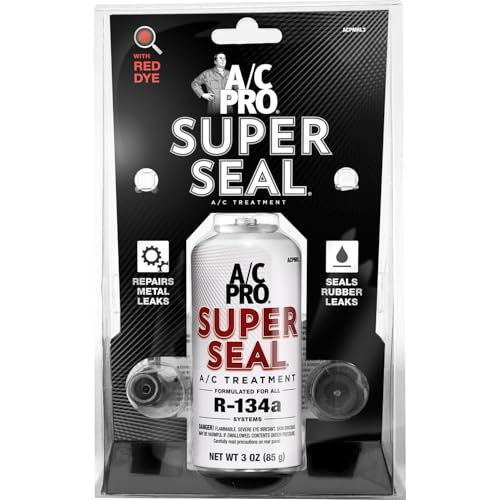
- 1.5 oz R-134a plus 1.5 oz additives
- Seals metal and rubber leaks
- Red dye helps show leak points
- Push-button dispenser, no extra tools
Super Seal is A/C Pro’s stop leak treatment for R-134a systems, sold here as a single 3 oz can. According to the listing, the can holds 1.5 oz of R-134a and 1.5 oz of additives, and it includes a push-button dispenser so no separate hose is needed. A red dye in the formula helps you spot where the system is leaking.
A/C Pro says the treatment seals leaks in both metal and rubber components and is compatible with common A/C system lubricants. The intended routine is to add the sealer first, then recharge with refrigerant, so it works alongside a kit such as the ACP100 rather than replacing it. Red residue at a fitting then shows where the leak is.
This is a product for an older R-134a car with a slow leak that the owner would rather not open up yet. It won’t connect to an R-1234yf port, and it won’t fix a large leak, a seized compressor or an electrical fault. The usual sealer caution applies too: tight passages can clog, and any shop that works on the system later should be told that a sealer was used.
View A/C Pro Super Seal on Amazon
Matching a Kit to the Car in Your Driveway
Use the label first, then decide how much you want in one box.
| Your situation | Product to consider | Why | Watch for |
|---|---|---|---|
| Older car, R-134a label, slow loss of cooling | A/C Pro ACP100 | Refrigerant and trigger gauge together | Confirm the can label says R-134a |
| Newer car, R-1234yf label, first top-off | ZeroR R1234YF kit | Two yf cans plus a 24-inch gauge | Charge in small steps |
| yf car, you already own refrigerant | A/C Pro R-1234yf gauge and hose | Reusable gauge, no can included | Needs a yf can to work |
| yf car, you own a gauge | Chemours Opteon YF can | Refrigerant only, 12 oz | Hose not included |
| Small leak you accept sealing | National R1234yf Leak Stop or A/C Pro Super Seal | Refrigerant with sealer | Tell any shop sealer was used |
West Michigan summers are humid, so a slightly low system may feel fine on a dry day and fall behind when the dew point climbs. The compressor also dries the air your defroster uses, which is why a weak system can show up as windows fogging up inside on a cold, wet fall morning.

EPA Rules That Apply to a DIY Recharge
The EPA’s servicing page says anyone who works on a car A/C system for payment of any kind, including bartering, must be certified under section 609 of the Clean Air Act and must use approved refrigerant handling equipment. It also says refrigerant cannot be intentionally released into the air. So never open a line or bleed off pressure to start over.
That is also why an overcharged system is a shop job: removing refrigerant takes recovery equipment. Whichever best car AC recharge kit you choose, charge slowly and stop once the gauge settles in the target range.

When a Can Won’t Bring the Cold Back
A can only helps when the system is slightly low and the rest of it works. If the compressor clutch never engages, the fault may be a fuse, a relay, a pressure switch or an empty system, and refrigerant won’t cure any of them.
Low airflow is a separate problem too. A clogged cabin filter or a blower that only works on high will make even a full system feel weak. If you need to recharge more than once a season, there is a leak, and finding it with dye or a sniffer, as covered in our guide to AC leak detection kits, beats feeding it cans.

Heating and air conditioning is one of the services our shop handles, and Hendrick is ASE and State of Michigan certified in it. If the gauge reads normal and the air is still warm, or the system won’t hold a charge, book car heater and A/C repair in Grand Rapids and we will find the cause before anything else goes in.
More Buying Guides
Frequently Asked Questions
Can I use an R-134a kit on a car that takes R-1234yf?
No. The two refrigerants use different service fittings, and the EPA says adapters should not be used to convert one to the other. Buy a kit and cans made for the refrigerant on your under-hood label.
What is the best car AC recharge kit for a newer vehicle?
Most newer light-duty vehicles use R-1234yf, so look for a kit with yf cans and a yf coupler, such as the ZeroR R1234YF kit. If you already own a yf gauge, a single can of Chemours Opteon YF is enough for a top-off.
Is a recharge kit with stop leak a good idea?
It can seal a very small leak, but sealer may clog tight passages and can complicate later shop service. Use plain refrigerant if you expect the system to need professional repair, and tell the shop if sealer went in.
Why is my AC still warm after I added refrigerant?
The system may have been overcharged, the compressor clutch may not be engaging, or the problem may be electrical, a blend door or low airflow. A low-side gauge can’t show those faults, so stop adding cans and have the system checked.
Still sweating behind the wheel after a recharge in Grand Rapids? Call 456 AutoFix at 616-279-3832, Monday to Friday 8am to 5pm, or schedule A/C service on our contact page.
Prefer to drop the car off on your way home? Our after-hours drop-off at 456 Carrier St NE in Creston lets you leave it whenever it suits your day.