
As an Amazon Associate, 456 AutoFix earns from qualifying purchases. Product links below go to Amazon, where each listing shows the base metal, temperature range and suggested uses before you order.
A bolt that went in with a thin film of compound comes out years later with a normal wrench. The best anti seize for your job depends on two things: the metals that touch and how hot the joint gets. Pick the wrong base and you can trade a seized bolt for corrosion or a stretched thread.
This guide sorts the main compound types, the places they belong and the places they don’t, then reviews six tubs and bottles you can buy today.
Quick answer
Which anti-seize should you use on a car?
For general bolts, an aluminum, copper and graphite blend such as Permatex 80078 covers most garage work. Choose a nickel compound like Permatex 77124 for stainless exhaust hardware or where copper is not allowed. Use a thin film, and follow the vehicle maker’s torque guidance once threads are lubricated.
Our Quick Picks
Three compounds that cover most garage jobs: an everyday blend, a copper-free nickel paste for stainless parts and a copper and graphite can with the widest listed temperature range.

Permatex 80078
The general-purpose silver compound for most bolts.

Permatex 77124 Nickel
A nickel paste for the hottest joints on the car.

Never-Seez Regular Grade
An industrial copper and graphite compound.
Which Anti Seize to Use: Aluminum, Copper or Nickel
Every anti-seize is a grease carrier loaded with fine solids. The solids stay in the threads after heat cooks the carrier away, keeping the metal surfaces apart so rust cannot bond them.
- Aluminum, copper and graphite blends (often silver gray): the general-purpose type, typically rated to about 1600°F.
- Copper compounds: aimed at hot engine fasteners, often rated to 1800°F.
- Nickel compounds: copper-free, made for stainless steel and titanium, rated up to 2400°F.
Metal pairing matters as much as heat. Many mechanics avoid copper where aluminum and steel meet, because dissimilar metals can corrode each other. The best anti seize choice is the one your service manual names, if it names one.
Where Anti-Seize Helps and Where It Hurts
Good places for a thin coat include exhaust studs and flange bolts, oxygen sensor threads when the listing allows it, caliper bracket bolts and the hub face where a wheel touches it. These are the parts salt and heat attack.
Skip it on lug nut and wheel stud threads unless your vehicle maker says otherwise, and keep it off brake pad friction surfaces and rotors. Many spark plug makers sell plated plugs and say they need no compound at all, so read the plug box first.
Torque is the part people miss. A lubricated thread turns more easily, so the same wrench setting stretches the bolt further. NGK’s spark plug installation guide explains how torque controls the way a plug passes heat into the head, which shows why guessing is risky. Use the torque the vehicle or part maker gives for your situation.
Best Anti Seize for Cars: Six Compounds Reviewed
These six cover the three main bases, from an everyday brush-top bottle to a nickel compound for stainless hardware.
1. Permatex 80078 Anti-Seize: 8 oz Brush Top, Aluminum, Copper and Graphite Blend
- 8 oz bottle with brush in the cap
- Aluminum, copper and graphite blend
- Listed range -80°F to 1600°F
- Guards against galling, corrosion and seizing
The Permatex 80078 is a general-purpose anti-seize in an 8 ounce bottle with a brush attached to the cap. For many owners it is the best anti seize starting point: a refined blend of aluminum, copper and graphite in a grease carrier, the familiar silver-gray paste. Permatex lists a working range from -80°F up to 1600°F.
The listing describes two jobs: during assembly, the paste keeps metal parts from galling, corroding or seizing because of weather or chemicals. Later, it makes disassembly easier, including on parts that have been through high heat. On a car, that covers exhaust flange bolts, caliper bracket bolts, suspension hardware and the fasteners that sit under the body in salty slush. The brush top lets you paint a thin, even coat without dipping a rag into the bottle.
This bottle suits an owner who wants one compound for mixed repairs and rarely needs a specialty product. It is not the right pick for stainless steel or titanium hardware where a copper-free compound is called for, and it should not go on any thread your service manual says to install clean and dry. Use the torque figure the maker gives for lubricated threads.
2. Loctite Silver Anti-Seize: 8 oz Brush Top, Petroleum-Based, Up to 1600°F

- 8 oz brush top bottle (PN 501000)
- Graphite and metallic flake fortified
- Protects to 1600°F
- Listed for spark plug threads and connections
Loctite’s Silver Anti-Seize, part number 501000, comes in an 8 ounce brush-top bottle. It is a heavy-duty, petroleum-based compound fortified with graphite and metallic flake. The listing says it won’t evaporate or harden in extreme cold and heat, and it rates protection against rust, corrosion, galling and seizing up to 1600°F.
Loctite recommends this compound for spark plug threads and electrical connections, which sets it apart from listings that stay vague about car use. Before you put it on plugs, check the plug box, because many plated plugs are meant to go in dry, and the torque changes once threads are lubricated. On connections, a light coat can help keep moisture away from the metal. Like the other silver pastes, it also works on general bolts such as bracket and heat shield hardware, and the brush in the cap makes a thin layer easy.
Pick this bottle if your plug or part maker calls for anti-seize and you would rather use a product that names that job in its listing. It is a general-temperature compound, so very hot stainless exhaust parts are better served by a nickel compound. Wipe away any excess so it does not collect dirt.
View Loctite Silver Anti-Seize on Amazon

3. Permatex 77124 Nickel Anti-Seize: 8 oz, Copper-Free, Up to 2400°F
- 8 oz copper-free nickel compound
- Protects up to 2400°F
- For stainless steel, titanium and nickel alloys
- Suggested for exhaust manifold and muffler bolts
The Permatex 77124 is a nickel-based anti-seize in an 8 ounce container. Its listing rates protection against seizing and galling at temperatures up to 2400°F, the highest figure among the Permatex compounds in this guide. The formula is copper-free and is made for extreme pressure as well as extreme heat.
Permatex points it at stainless steel, titanium and nickel alloys, and recommends it wherever copper contamination must be avoided. The suggested applications are all exhaust jobs: manifold bolts, exhaust system bolts, muffler clamps and tailpipe assemblies. Those parts run hot, sit in road spray and are the fasteners most likely to snap when you try to remove them years later. A thin coat on the studs before the nuts go on can make the next repair far less of a struggle, as long as you torque to the figure the maker gives.
This compound suits anyone replacing manifold studs, installing a stainless exhaust or working on hardware where the manual or part maker specifies a copper-free product. It is more than you need for ordinary chassis bolts, where a general blend works fine. Nickel compounds are also messy, so keep a rag close and wear gloves while you work.
View Permatex 77124 Nickel on Amazon
4. Permatex 09128 Copper Anti-Seize: 8 oz, -30°F to 1800°F, Electrically Conductive
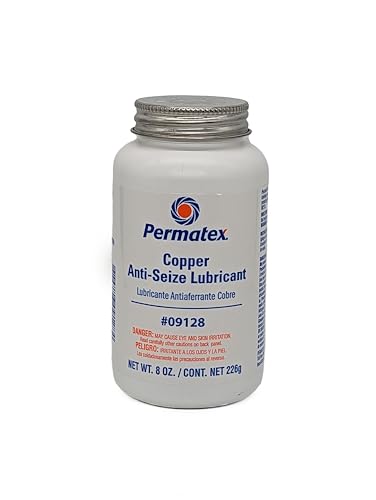
- 8 oz copper compound
- Listed range -30°F to 1800°F
- Rust and corrosion inhibitors added
- Provides good electrical conductivity
The Permatex 09128 is a copper anti-seize in an 8 ounce container. Its listing gives a temperature range of -30°F to 1800°F and says the compound is fortified with rust and corrosion inhibitors. It is designed to prevent seizing, corrosion and galling where high temperature conditions exist.
Permatex gives a detailed list of suggested applications: spark plug threads in aluminum heads, exhaust manifold bolts, engine bolts, oxygen sensors, knock sensors, thermostat housing bolts, fuel filter fittings and battery cable connections. The listing also notes good electrical conductivity, which matters on sensor threads and grounds. That long list makes this tub useful for engine-bay jobs where a part has to come out again at the next service. Remember that a plug or sensor maker’s instructions still come first, and some ship parts already coated or meant to go in dry.
This copper compound suits someone who does engine and sensor work and wants a product that names those jobs. Because copper and aluminum can corrode each other when moisture gets between them, follow the listing and your manual on aluminum parts, and choose a nickel compound when copper is ruled out. Apply a thin film only.
View Permatex 09128 Copper on Amazon

5. Never-Seez Regular Grade: 8 oz Brush-Top Can, Copper and Graphite, -297°F to 1800°F
- 8 oz brush-top can
- Copper and graphite extreme-pressure formula
- Listed range -297°F to 1800°F
- Resists rust, steam, salt water and chemical vapors
Never-Seez Regular Grade, made by Bostik, is a copper and graphite anti-seize sold in an 8 ounce brush-top can. The listing describes it as an extreme-pressure compound that stops metal-to-metal binding under high pressure and heat. It gives the widest temperature range in this group, from -297°F to 1800°F.
Bostik aims this product at demanding industrial settings, and the listing says it resists rust, corrosion, steam, salt water and chemical vapors. It also lists standards it meets, including a Ford specification and specifications from aerospace and turbine makers. For a car owner, the salt water resistance is the part that counts, because brake, hub and exhaust hardware spends the winter soaked in brine. The brush-top can lets you lay a thin coat on studs and bolts so nuts and fittings come off faster after years of exposure.
This can suits a home mechanic or a small fleet that wants an industrial compound for rust-prone fasteners. Its copper base means the same caution applies as with other copper products: check the listing and your manual before using it on aluminum parts or near sensors. It is a big can for occasional jobs, so close the lid tightly between uses.
View Never-Seez Regular Grade on Amazon
6. CRC SL35901 Copper Anti-Seize: 8 Wt Oz Brush Top, Steam and Water Resistant

- 8 wt oz bottle with brush top lid
- Copper formula
- Steam and water resistant
- For fittings, flanges, studs, headers and manifolds
The CRC SL35901 is a copper anti-seize and lubricating compound in an 8 weight ounce bottle with a brush-top lid. CRC describes it as a general-purpose anti-seize that prevents seizing caused by high temperatures, heavy loads, corrosion and vibration. The listing does not state a temperature range, so check the product sheet if heat rating matters for your job.
The formula is steam and water resistant and is meant to stop galling, seizing, rust and corrosion. CRC lists a broad set of uses: fittings, bushings, flanges, headers, nuts, screws, studs, threaded surfaces, pipes, plugs and manifolds. On a car, that points to exhaust flange bolts, header studs and other hot or wet hardware under the vehicle. The brush in the lid helps you coat threads lightly, and a thin film is all the job needs, since excess compound only collects road grit and dirt.
This bottle suits owners who already use CRC shop chemicals and want a copper compound for exhaust and flange work. Without a listed temperature figure, it is harder to compare than the others here, and like every copper product it should be kept off aluminum parts unless the maker approves. As always, torque lubricated bolts to the figure given for lubricated threads.
View CRC SL35901 Copper on Amazon
The Six Compounds Side by Side
Temperature figures come from each Amazon listing.
| Product | Base | Listed temperature range | Suits |
|---|---|---|---|
| Permatex 80078 | Aluminum, copper, graphite | -80°F to 1600°F | General garage bolts |
| Loctite Silver Anti-Seize | Graphite and metallic flake | Up to 1600°F | Spark plug threads, connections |
| Permatex 77124 Nickel | Nickel, copper-free | Up to 2400°F | Stainless exhaust hardware |
| Permatex 09128 Copper | Copper | -30°F to 1800°F | Hot engine bolts, sensors |
| Never-Seez Regular Grade | Copper and graphite | -297°F to 1800°F | Salt and steam exposure |
| CRC SL35901 Copper | Copper | Not stated in the listing | Flanges, studs, headers |
If you want one bottle on the shelf, the best anti seize for general work is the blend type. The best anti seize to use on stainless or very hot hardware is a nickel compound, and a copper tub makes sense when a listing or manual calls for copper by name.

Anti Seize vs Grease, Loctite and Other Alternatives
Anti seize vs grease: grease lubricates moving parts, but on a hot or wet thread it washes out or burns off. The solids in anti-seize stay put. Grease belongs in bearings and fittings, as our wheel bearing grease guide explains.
Anti seize vs Loctite: they do opposite jobs. Threadlocker cures to stop a fastener from backing out, while anti-seize makes it easy to remove. Never put both on the same thread; our threadlocker buying guide covers which strength to use when vibration is the worry.
As for an anti seize alternative, oil and general grease are poor stand-ins on hot parts. If a bolt is already stuck, no compound helps until it comes out, so start with a soak from our penetrating oil comparison. To remove old compound, use parts cleaner and a brass brush.

Road Salt, Tune-Ups and When to Hand It Over
Grand Rapids winters coat every underbody bolt in brine, and the freeze-thaw cycle pushes moisture deep into threads. That is why the best anti seize habit here is simple: any exhaust, brake or hub fastener you take apart should go back with a thin film, so the next repair is not a fight with a torch.
If you are pulling plugs during a tune-up because the engine runs rough, a tank of cleaner from our fuel system cleaner roundup is a cheap first step. Fresh oil matters too: pick a grade with our synthetic oil buying guide, or let us handle it with an oil change in Creston. Drain plugs rely on a fresh washer and correct torque, not anti-seize.

Some jobs are better left to a lift and the right tools. A snapped exhaust stud or a manifold bolt that will not budge is routine work for our exhaust repair team in Grand Rapids. Rusted caliper bracket bolts and seized slide pins are part of brake repair at our shop, where they go back together clean and to spec.
More Buying Guides
Frequently Asked Questions
What is the best anti seize for cars?
For most owners, an aluminum, copper and graphite blend such as Permatex 80078 handles everyday bolts. Add a nickel compound if you work on stainless exhaust parts or very hot fasteners, and use copper only where the listing or your service manual suggests it.
Should I lower the torque when I use anti-seize?
Lubricated threads clamp harder at the same wrench setting, so the dry figure can overtighten a bolt. Follow the torque the vehicle or part maker gives for lubricated threads. If the manual says threads must be clean and dry, leave the compound off.
What removes anti seize?
Wipe off the excess with a rag, then spray the part with brake or parts cleaner and scrub the threads with a brass brush. Wear gloves, because the metal particles stain skin and are hard to wash off.
Can I use anti-seize on spark plugs?
Only if the plug maker allows it. Many plugs come with a plated shell and the maker says to install them without compound. If yours calls for it, use a very small amount on the threads, keep it off the electrode and follow the stated torque.
Facing a bolt that has already rusted solid? Phone 456 AutoFix at 616-279-3832 between 8am and 5pm, Monday to Friday, or use our contact page to set up a visit.
If weekday hours don’t work for you, our after-hours drop-off at 456 Carrier St NE lets you leave the car whenever suits. Write down which part is stuck or noisy so we can start in the right place.