As an Amazon Associate, 456 AutoFix earns from qualifying purchases. Product links below go to Amazon, where you can confirm the right part for your vehicle.
A flashlight only shows you what is in a straight line from your eye. The best borescope for car inspection puts a small camera where your eye can’t go: down a spark plug hole, inside a rocker panel, behind a bumper cover or along a frame rail that West Michigan salt has been working on for years.
This guide covers what separates a useful car camera from a frustrating one, then six fixed-tip inspection cameras with built-in screens. If you are putting together a full kit for looking at a car for sale, start with our guide to the tools for a used car inspection and come back here for the camera.
Quick answer
Which borescope should you buy for checking a car?
For most car checks, pick a self-contained unit with a 1080P dual-lens probe, a semi-rigid cable and adjustable LEDs, such as the DEPSTECH DS300. If you mainly want to look inside cylinders, choose a slim probe like the 5.5 mm Klein Tools ET17. A larger 5-inch screen, as on Teslong’s dual-lens model, helps with careful viewing.
Our Quick Picks
Three cameras that cover most car checks: a two-view all-rounder, a slim probe for spark plug holes and a larger screen. All six are reviewed below.
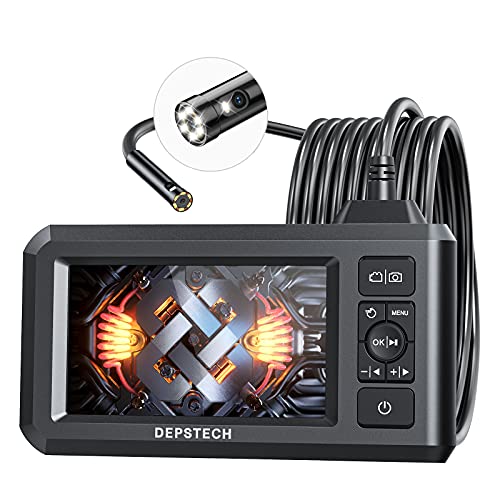
DEPSTECH DS300
Switches between a forward and a side camera without fitting a mirror.

Klein Tools ET17
A narrow head that slips into spark plug holes and small openings.

Teslong Dual Lens Borescope
A larger display and a long-running battery for slow, careful looks.
What Makes a Borescope Good for Car Work
A camera that works well inside a drain can be awkward under a hood. Five details decide how useful one is on a vehicle.
- Probe diameter: most spark plugs use a 14 mm thread, and some engines use 12 mm or 10 mm. A probe of about 8 mm or less is needed to look inside a cylinder, and a narrower head makes it easier to tilt once it is in.
- Lens layout: a forward lens shows what is ahead of the tip. A side lens shows the wall beside it, which is what you need for cylinder walls and the inside of a body panel.
- Cable type: a semi-rigid cable holds a bend so you can steer it along a frame rail. A very floppy cable just drops to the lowest point.
- Screen: a built-in screen needs no phone or app, and a bigger one is easier to read in a dark garage.
- Lighting and focus: adjustable LEDs cut glare on shiny metal, and a focus range of a few centimeters suits the short distances inside an engine.
Fixed Tip, Articulating or Phone Camera?
Fixed-tip cameras, covered here, point where the cable points and use a side lens or mirror for angled views. Articulating tips steer with a thumb control and phone cameras send the picture to an app. For checking a car you might buy, a fixed-tip unit with a second lens handles most jobs with less fuss.
Best Borescope for Car Inspection: Six Cameras Reviewed
All six run from a built-in screen, so nothing needs pairing at the curb. Check the probe size on each listing against the job you have in mind.
1. DEPSTECH DS300: 1080P Dual-Lens Borescope with 4.3″ Split Screen
- Front and side lenses, one-button switching
- 4.3" IPS screen with split view
- 16.5 ft semi-rigid cable, IP67 probe
- About 4 hours per charge
The DEPSTECH DS300 is a self-contained inspection camera with two lenses at the tip, one looking forward and one looking sideways. A single button flips between them or shows both on a split screen, so you can look straight down a gap and then check the wall beside it without pulling the probe out. That side view is handy for reading the face of a part you can only reach edge-on, such as the back of a brake rotor or the seam of a pinch weld.
Images appear on a 4.3-inch IPS screen, and the camera records 2 MP photos and 1080P video. DEPSTECH lists seven adjustable LEDs with three brightness steps, a 180-degree image rotation and focal ranges of roughly 3 to 8 cm for the front lens and 2 to 6 cm for the side lens. The built-in battery runs for about four hours and recharges over USB.
The 16.5-foot semi-rigid cable bends and holds its shape, which helps when you feed it along a frame rail or up behind a bumper cover. The probe is rated IP67, and a hook and magnet come in the box. A memory card is not included, so buy one if you want to save what you find on a used car.
2. Teslong Dual Lens Borescope: 5″ IPS Screen with 16.5FT Semi-Rigid Cable
- Forward and side cameras with separate LEDs
- 5" IPS display, no phone or app
- 8 mm semi-rigid 16.5 ft cable
- 5000mAh battery, about 4.5 hours
Teslong’s 5-inch dual-lens borescope suits anyone who finds a small screen hard to read in a dim garage or a driveway at dusk. It pairs a forward camera with a side camera, each with its own lighting, and the 5-inch IPS display gives you more room to judge what you are looking at. It works on its own, with no phone, Wi-Fi or app to set up.
The probe sits on an 8 mm, 16.5-foot semi-rigid gooseneck cable that keeps the shape you bend it into. Teslong lists six front LEDs and one side LED, all with brightness control, which helps cut glare off shiny metal or wet surfaces. The probe is rated IP67, so a damp underbody or a puddle under the car is not a problem.
Power comes from a built-in 5000mAh battery that Teslong rates at about 4.5 hours of use, with roughly five hours to recharge. That is plenty for a long inspection or a full Saturday of looking at cars. A hard case with a hook, magnet and mirror comes in the kit, and the 8 mm probe is narrow enough for a typical 14 mm spark plug hole, though there is little room to tilt it once inside.
View Teslong Dual Lens Borescope on Amazon
3. DEPSTECH DS620: Triple-Lens Endoscope with 5″ IPS Screen

- Three lenses selected by button
- 2 MP photos and 1080P video
- 10 LEDs in an 8+1+1 layout
- 16.5 ft semi-rigid cable, IP67
The DEPSTECH DS620 goes one step past a dual-lens design and puts three cameras in the tip. You press a button to move between them, which means fewer moments spent twisting the cable to see around a corner. For a car inspection, that matters most inside long, closed spaces such as rocker panels, frame rails and door bottoms, where rust tends to start out of sight.
Each lens captures 2 MP stills and 1080P video with a 76-degree field of view, shown on a 5-inch IPS screen. DEPSTECH lists ten adjustable LEDs in an 8+1+1 layout so every lens has its own light. Photos and video save to a microSD card, which is sold separately, and that record is useful if you want to show a seller or a mechanic what you found.
The 16.5-foot semi-rigid cable holds a bend, and the probe carries an IP67 rating. Battery life is listed at two to three hours, shorter than the DS300, so charge it before you head out to look at a car. The listing does not give a probe diameter, so check it on Amazon before you plan to use it in a spark plug hole.
4. Teslong 8mm Borescope: 4.3″ Screen, 8 LEDs and 1.5x Zoom

- 8 mm probe with 78-degree view
- 8 adjustable LEDs, 1.5x zoom
- 16.5 ft semi-rigid IP67 cable
- Up to 3 hours on a 1500mAh battery
This Teslong model keeps things simple with one forward-facing lens on an 8 mm probe. You switch it on and the 4.3-inch screen shows a live picture straight away, with no app or pairing step. For many car checks, a single good lens is all you need: looking for wet spots on an oil pan, a split boot, or the tops of pistons through a spark plug hole.
Teslong lists eight adjustable LEDs, a 78-degree viewing angle and a best focus range of about 30 to 80 mm. The screen rotates the image 180 degrees and offers 1.5x zoom, and a freeze-frame option holds a picture still so you can study it. Photos and video save to an SD card, which is not included, or transfer over the supplied cable.
The 16.5-foot semi-rigid cable is rated IP67 against water and dust, and the 1500mAh battery runs for up to three hours. A hook, magnet and side mirror come with it, and Teslong backs it with a 24-month warranty. Without a second lens, viewing the side of a bore or a cavity wall depends on the mirror, so a dual-lens unit is easier for rust checks.
View Teslong 8mm Borescope on Amazon
5. Klein Tools ET17: 5.5mm Utility Borescope with 10-Foot Snake
- 5.5 mm IP67 camera head
- 4.3" color LCD with 3x zoom
- Detachable USB-C snake, about 10 ft
- Self-storing kickstand
The Klein Tools ET17 stands out here for its narrow camera head. At 5.5 mm, it slips through small openings more easily than the 8 mm probes above, which makes it a sensible choice for looking into a cylinder through a spark plug hole or through a small access hole in a body panel. Klein is a long-running tool maker, and the ET17 is its utility-level borescope.
Klein’s ET17 product page lists a 720p camera with six LEDs adjustable over four levels, a 4.3-inch color LCD at 854 x 480, 3x zoom and 180-degree view rotation. The camera head and cable are rated IP67. The snake is a detachable nylon cable of about 10 feet that plugs in over USB-C.
A self-storing kickstand lets you stand the monitor on a fender or the floor and use both hands to steer the snake, which is useful under a car. Photos and video can be moved off over the USB-C connection. The resolution is lower than the 1080P units in this list, so fine detail on a cylinder wall shows less sharply, but the slim head reaches places the thicker probes can’t.
View Klein Tools ET17 on Amazon
6. RIDGID micro CA-25: Hand-Held Inspection Camera with 4′ Cable

- Pistol grip for one-handed use
- 3/4" aluminum camera head, waterproof
- 4 adjustable LEDs, 180-degree flip
- Video out, runs on 4 AA batteries
The RIDGID micro CA-25 is a trade-style inspection camera built around a pistol grip, so you can aim and hold it with one hand while the other moves a trim panel or a flashlight. It is a simple tool with few menus, which some people prefer when crawling under a car or reaching up behind the dash. The kit arrives in a blow-molded case with a hook, magnet and mirror.
The camera head is 3/4-inch anodized aluminum on a 4-foot cable, and both the head and cable are waterproof. Four adjustable LEDs light the view, and the image can be flipped 180 degrees so it reads the right way up. A video-out feature and the included 3-foot RCA cable send the live picture to another screen if you want a larger view.
It runs on four AA batteries, which are included, so a spare set in the glovebox keeps it going. The 3/4-inch head is too wide for a spark plug hole, and the 4-foot cable is short next to the 16.5-foot units here. It suits underbody checks, wheel wells, the back of an engine and under-dash wiring, not looking inside a cylinder.
View RIDGID micro CA-25 on Amazon
Which Camera Suits Which Car Job
Match the camera to the part of the car you most want to see. Probe sizes come from the Amazon listings.
| Job | What you need | Good fit from this list |
|---|---|---|
| Inside a cylinder through the plug hole | Probe around 8 mm or smaller, side view helps | Klein Tools ET17, Teslong dual lens |
| Rust inside rockers and frame rails | Long semi-rigid cable plus a side lens | DEPSTECH DS620, DEPSTECH DS300 |
| Oil or coolant leaks on the engine | Forward lens, adjustable light, freeze frame | Teslong 8mm Borescope, DEPSTECH DS300 |
| Under the dash and in wheel wells | Short, tough cable and a one-hand grip | RIDGID micro CA-25 |
If you can only buy one, the best borescope for car inspection is usually a dual-lens camera with a probe slim enough for the plug hole, since it covers the widest spread of these jobs. A pistol-grip trade camera is the specialist for under-dash work.
Using a Borescope on a Used Car in West Michigan
A car that has lived through Michigan winters can look clean outside while salt brine eats closed sections from within. Work through it in a set order:
- Rocker panels and door bottoms: feed the probe through drain holes or plug openings and look for flaking rust or fresh undercoating sprayed over it.
- Frame rails and subframe: run the cable along the inside of the rails, where salt and mud collect, and look for scaling or patched metal.
- Engine bay: check the back of the engine, the oil pan seam and around the timing cover for wet residue the seller may have wiped from the visible side.
- Behind bumper covers: crushed brackets or body filler point to past crash repairs.
Ask the seller before you remove anything, and only open cylinders on a car you are allowed to work on. Our used car buying checklist for Michigan buyers covers the paperwork and test-drive steps that go with this.
Pull spark plugs only on a cold engine, and start them back in by hand so the threads don’t strip. If the car has direct injection, the same camera can show deposits on intake valves; our guide to Audi carbon buildup symptoms explains what heavy deposits mean for the engine.
When the Camera Isn’t Enough
A borescope shows surfaces. It can’t measure compression, run a leak-down test, read stored fault codes or tell you how a car brakes and steers on the road. Steam-cleaned pistons or coolant marks inside a cylinder are worth a closer look, and our article on white smoke from the exhaust covers what burning coolant usually points to.
When you have narrowed it down to one car, a professional check fills the gaps your own camera can’t. Read what a pre-purchase inspection includes, then book our pre-purchase car inspection in Grand Rapids and bring your borescope photos along. They help us know where to look first.
More Buying Guides
Frequently Asked Questions
What size borescope fits in a spark plug hole?
Most spark plugs use a 14 mm thread, with some engines on 12 mm or 10 mm. A probe of about 8 mm or less fits most of them, and a 5.5 mm head such as the Klein Tools ET17 leaves room to angle the camera once it is inside.
Is a dual-lens borescope worth it for cars?
For most owners, yes. The side lens shows cylinder walls and the inner faces of body panels without a mirror attachment, which saves a lot of twisting and guessing during a used car check.
Can a borescope find a blown head gasket?
It can show warning signs, such as a steam-cleaned piston top or coolant residue in a cylinder. It can’t confirm the fault on its own, so a cooling system pressure test or a leak-down test is still needed.
What is the best borescope for car inspection if I already own a phone camera?
A unit with its own screen is still easier to use under a car, since you don’t need to hold a phone and keep an app connected. A dual-lens model like the DEPSTECH DS300 suits general checks, while a slim probe suits engine work.
Found something on a car you are about to buy? Call 456 AutoFix at 616-279-3832, Monday to Friday 8am to 5pm, or set up a pre-purchase inspection through our contact page.
Seller only free after work? Ask them to bring the car to 456 Carrier St NE in Creston and use our after-hours drop-off.