
As an Amazon Associate, 456 AutoFix earns from qualifying purchases. Product links below go to Amazon, where you can confirm the right part for your vehicle.
Your first set of A/C gauges should make the job feel less mysterious, not more. The best HVAC gauges for beginners working on a car are simple manifold sets with clear dials or a backlit screen, couplers that match your refrigerant, and hoses long enough to reach both service ports without a fight.
In this guide, “HVAC gauges” means automotive A/C manifold gauges for R-134a and R-1234yf systems, not the flare-fitting sets sold for home heat pumps. We explain what the two needles are telling you, then walk through six beginner-friendly sets. If your vents are already blowing warm, read our guide to a car A/C blowing warm air first, because refrigerant is only one possible cause.
Quick answer
What is the easiest A/C gauge set for a first-time DIYer?
For an older R-134a car, a plain 2-way analog set like the Robinair 45111 keeps things simple. If you would rather read numbers on a screen, the VIVOHOME digital set includes couplers for R-134a and R-1234yf. Newer R-1234yf cars suit the KJE 4-way kit, which ships with both coupler pairs.
Our Quick Picks
Three starter sets for common cases: simple analog R-134a, digital with couplers for both refrigerants, and a 4-way kit for newer cars. All six are explained below.

Robinair 45111
Two knobs and two dials, with little to set up or misread.

VIVOHOME Digital Manifold
A backlit digital gauge with couplers for older and newer cars.

KJE 4-Way Gauge Set
Couplers and gauge scales for both refrigerants in one case.
What Makes a Gauge Set Friendly to a Beginner
A beginner does not need the most valves or the widest refrigerant list. You need a set that connects on the first try and gives readings you can trust.
- The right couplers: pop the hood and find the refrigerant label, usually on the radiator support or under the hood itself. R-134a and R-1234yf cars use different service port fittings, so the couplers in the box have to match.
- Readable faces: large, color-coded dials or a backlit digital screen cut down on squinting and guessing.
- Hose length: five or six feet of hose lets the manifold hang from the hood latch while the couplers reach ports on opposite sides of the engine bay.
- Fewer valves to start: a 2-way manifold has only two knobs to think about. A 4-way set adds ports that are handy later but one more thing to keep closed today.
- Clear instructions: a parts diagram and a printed guide are worth more to a first-timer than an extra refrigerant scale.
Low Side and High Side in Plain Terms
Your A/C loop has two halves. The compressor squeezes refrigerant into the high side, where it is hot and under high pressure, and the low side carries cool, low-pressure refrigerant back from the evaporator behind the dash. The blue gauge watches the return trip and the red gauge watches the push.
The point of two gauges is comparison. A low reading on both sides often hints at a low charge, while a very high red needle can point to a condenser that cannot shed heat. That is a big step up from the single dial on a recharge can, which our guide to car AC recharge kits treats as a quick top-up tool rather than a diagnosis.
Correct pressures change with the weather and the vehicle. Look up the pressure chart in your car’s service information for the outside temperature that day instead of chasing one number from a video.
Best HVAC Gauges for Beginners: Six Sets Explained
The six sets below include analog and digital options for R-134a and R-1234yf cars. Check that the listing names your refrigerant before you buy.
1. Robinair 45111: R-134a Brass Manifold Kit with 72-Inch Hoses and Manual Couplers
- Brass manifold with easy-grip handles
- R-134a gauges in psi and Fahrenheit
- 72-inch red and blue hose set
- 90-degree manual couplers (pair)
The Robinair 45111 is a straightforward 2-way manifold kit for R-134a car A/C systems. Robinair builds it around a brass manifold with easy-to-grip handles, a low-side and high-side gauge, a 72-inch red and blue hose set and a pair of 90-degree manual couplers. For someone hooking up gauges for the first time, that short parts list is a strength, because there are only two knobs to keep track of.
The R-134a gauges read in pounds per square inch and also show Fahrenheit temperatures, which helps when you compare a reading against a pressure chart. The hoses use 1/2-inch ACME fittings on one end and 14 mm on the other, matching common R-134a equipment, and rear fittings on the manifold give the hoses a place to park when the kit is not in use. The 90-degree couplers help in tight engine bays where a straight coupler would hit a bracket or hose.
This set is about reading and charging an R-134a system, not every refrigerant on the market. It does not include R-1234yf couplers, so it does not suit a newer car labeled for that refrigerant. Brass is heavier than aluminum, which matters little at home but is worth knowing if you plan to carry it around.
2. FJC 6761: R-134a Aluminum Manifold Gauge Set with Sight Glass and 72-Inch Hoses

- Aluminum manifold block
- Built-in sight glass
- 72-inch hoses included
- R-134a quick couplers included
The FJC 6761 is an R-134a manifold gauge set built on an aluminum block. FJC lists three main features: a sight glass in the manifold, 72-inch hoses and quick couplers, which together cover the basics a beginner needs to connect to an R-134a car and read both sides of the system. Aluminum keeps the block lighter than brass, so it is easier to hang from a hood latch while you work.
The sight glass is the part many first-timers appreciate. As refrigerant moves through the manifold during charging, you can see it pass the window instead of relying only on the needles. That gives a second visual cue that the valves are doing what you think they are, which builds confidence on the first few jobs. The 72-inch hoses give enough reach to connect ports that sit on opposite sides of a wide engine bay.
Quick couplers snap onto the service ports, which is simpler than threading a fitting while holding a hose in place. The listing describes an R-134a set, so it is not the right choice for a car whose under-hood label calls for R-1234yf. Check the listing for the exact parts included before ordering, since FJC sells several similar sets.
3. Mastercool 84472: R-134a 2-Way Mini Digital Manifold with Backlit LCD

- Compact anodized aluminum block
- P/T calculation for 91 refrigerants
- Blue backlit 4-digit LCD
- Large sight glass and grip knobs
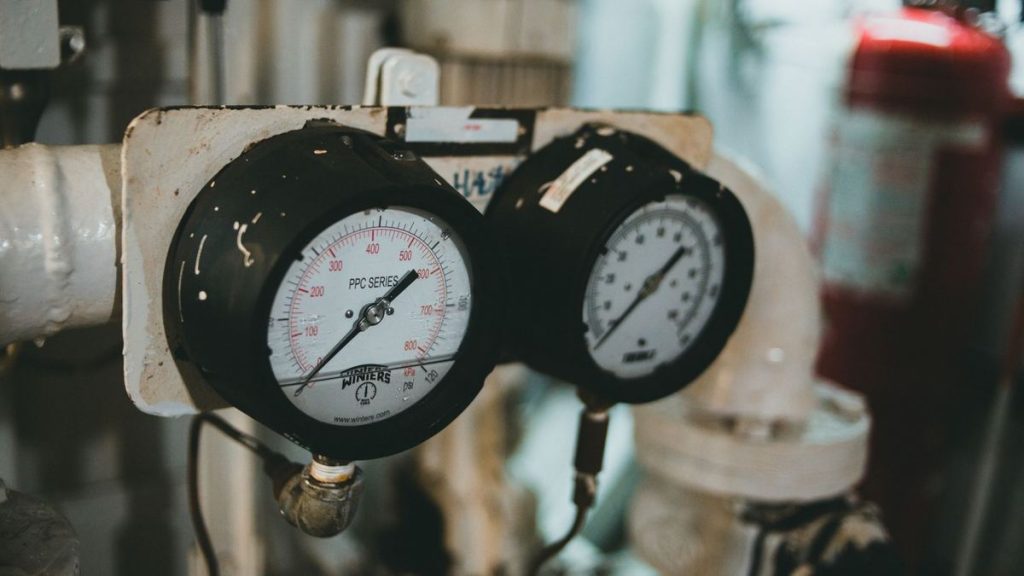
The Mastercool 84472 is a compact 2-way digital manifold for R-134a work. Mastercool describes a black anodized aluminum block with matte chrome fittings, sized to be easy to carry. Instead of two round dials, it uses a large 4-digit LCD with a blue backlight, so the numbers stay readable under a dark hood or late in the evening. That makes it a reasonable step for a beginner who finds needle dials hard to judge.
The gauge can perform pressure and temperature calculations for up to 91 refrigerants, including R-134a, so you do not have to look up a separate chart to find saturation temperature. It converts between MPa, kPa, bar, psi, kg/cm2 and inHg, and shows Celsius or Fahrenheit. The screen also displays an over-range alarm and a low battery warning, which helps you avoid trusting a reading from a dying battery.
A large sight glass and easy-to-grip knobs carry over from Mastercool’s analog sets. The listing focuses on the manifold itself, so confirm which hoses and couplers come in the box before you plan your first job. As a 2-way R-134a manifold, it suits older cars and keeps the valve layout simple for someone learning.
View Mastercool 84472 on Amazon
4. VIVOHOME Digital Manifold Gauge Set: 3-Way Kit with R-134a and R-1234yf Couplers
- -14.5 to 800 psi, ±0.5% FS accuracy
- 88 refrigerants selectable
- Backlit LCD with auto power-off
- R-134a and R-1234yf couplers and can taps
The VIVOHOME Digital Manifold Gauge Set is a 3-way digital kit that VIVOHOME packs with both R-134a and R-1234yf quick couplers and matching self-sealing can taps. For a beginner whose household has one older and one newer car, that removes the need to buy a second set of fittings just to connect. A hook lets you hang the gauge hands-free, and a carry case keeps the parts together.
VIVOHOME lists a measuring range of -14.5 to 800 psi with ±0.5% full-scale accuracy and support for 88 refrigerants, which you select before reading. The large backlit LCD uses a simple menu, and an automatic power-off shuts it down when idle. The maker also mentions an A2L refrigerant warning, pressure-hold leak testing and a visual window for watching refrigerant during charging. Three hoses with shut-off valves complete the kit.
Two practical notes from the listing matter for a first use. The gauge runs on three AAA batteries that are not included, and the quick couplers ship in the open position, so turn the knobs closed before connecting them to a port. Readers who only want an analog needle may find the menu more than they need.
View VIVOHOME Digital Manifold on Amazon
5. KJE 4-Way Manifold Gauge Set: R-1234yf and R-134a Couplers with Dual-Scale Gauges
- Low -30 to 260 psi, high -30 to 500 psi
- Dual R-134a and R-1234yf scales
- Both coupler pairs plus two can taps
- Four color-coded hoses, hanging hook
The KJE 4-Way Manifold Gauge Set targets the newer cars that many beginners now own. KJE prints dual refrigerant scales for R-134a and R-1234yf on the gauges, and the kit includes two R-1234yf quick couplers, two R-134a quick couplers and a self-sealing can tap for each refrigerant. A valve core wrench and a dual-purpose screwdriver round out the case, so you do not need adapters to start.
The low-side gauge reads from -30 to 260 psi and the high-side gauge from -30 to 500 psi. Four color-coded hoses in blue, red, yellow and black make it easier to remember which line goes where, and separate VAC and REF control knobs handle the vacuum and refrigerant ports. A built-in hanging hook lets the manifold hang at eye level while you read it.
KJE gives a useful warning that a beginner should take seriously. To avoid cross-contamination, the maker recommends separate hoses when switching between R-134a and R-1234yf, or full evacuation and flushing of the manifold and hoses before changing refrigerants. The extra 4-way ports also mean more knobs to keep closed while you are still learning the layout.
View KJE 4-Way Gauge Set on Amazon
6. BACOENG 4-Way R-134a Manifold Gauge Set: 5 ft Hoses with Step-by-Step Guide

- Low 0-550 psi, high 0-750 psi gauges
- Four 5 ft color-coded hoses
- Adjustable couplers and can tap
- Parts diagram and step-by-step manual
The BACOENG 4-Way Manifold Gauge Set is listed for R-134a, R-410A and R-22, with automotive charging and evacuation among its intended uses. What sets it apart for a beginner is the paperwork: BACOENG includes a detailed parts diagram and step-by-step instructions written to help novices, along with a custom molded case that keeps every fitting in its place.
The kit comes with four 5 ft hoses in four colors: red for high pressure, blue for low pressure, yellow for the refrigerant source and black for a vacuum pump. The blue gauge reads 0 to 550 psi and the red gauge 0 to 750 psi, with a Fahrenheit scale on the face. Hoses are rated for 800 psi working pressure. Two adjustable couplers, an adjustable can tap, a valve core wrench and three ACME and tank adapters are also included.
The manifold and hoses use 1/4-inch fittings, and the included adapters bridge the step to other fitting sizes, so keep them with the kit. The listing does not mention R-1234yf couplers, which rules it out for newer cars on that refrigerant. Read the manual through once before your first hookup, especially the valve layout.
View BACOENG 4-Way Gauge Set on Amazon
Analog or Digital for Your First Set?
Analog gauges have no batteries to run flat and show trends well, since you can watch a needle swing as the compressor cycles. Digital units show exact numbers and can work out saturation temperature for you, but they add a menu to learn and batteries to keep fresh. Both styles appear among the best HVAC gauges for beginners above, so choose the one you find easier to read.
| Gauge set | Display | Car refrigerant | Beginner note |
|---|---|---|---|
| Robinair 45111 | Analog | R-134a | Two knobs, two dials, few surprises |
| FJC 6761 | Analog | R-134a | Sight glass lets you see flow |
| Mastercool 84472 | Digital | R-134a | Compact block with a backlit screen |
| VIVOHOME Digital | Digital | R-134a and R-1234yf | Needs 3 AAA batteries before first use |
| KJE 4-Way | Analog | R-134a and R-1234yf | Use separate hoses per refrigerant |
| BACOENG 4-Way | Analog | R-134a | Printed steps and a parts diagram |
Already comfortable with gauges and want sets built for repeated evacuation and charging? Our AC manifold gauge set guide for cars covers heavier-duty sets for regular use.

Safe First Hookup and the West Michigan Factor
Refrigerant can freeze skin on contact, and the high side runs under real pressure, so wear safety glasses and gloves every time.
- Close everything first: both manifold knobs closed and any manual coupler knobs backed out before anything touches a port.
- Engine off to connect: fit the blue coupler to the low port and the red coupler to the high port and keep hoses clear of belts and the fan.
- Run it and wait: start the engine, set the A/C to max with the blower on high, and give the readings a few minutes to settle.
- Look, do not adjust: read both gauges with the knobs closed. Never open the high-side knob with a can attached.
- Never vent: releasing refrigerant on purpose is illegal under federal rules and wastes the charge you are trying to measure.

Grand Rapids weather adds a twist. A sticky 85-degree afternoon reads very differently from a cool May morning, so check the chart against the actual temperature. Winter salt and road grime packed into the condenser fins can also push the red needle higher once summer arrives.
When the Readings Mean a Shop Visit
A gauge set tells you what is happening, but it does not fix a leak. The EPA notes in its guidance on recharging a vehicle air conditioner that topping off can improve cooling but does not permanently fix refrigerant leaks. It also points out that a leak check needs only a few ounces of refrigerant, about 10 percent of the normal charge.
Book a visit if both gauges read the same with the compressor running, the clutch never engages, or the needles look normal while the vents stay warm. Our car heating and A/C repair in Grand Rapids covers diagnosis, leak repair and proper recharging with recovery equipment.
More Buying Guides
Frequently Asked Questions
Are home HVAC gauges the same as car A/C gauges?
The gauges work the same way, but the fittings differ. Home sets often use 1/4-inch flare connections for R-410A, while cars need R-134a or R-1234yf quick couplers. A home set only suits a car if the kit includes the right automotive couplers.
Should a beginner buy analog or digital gauges?
Either works. Analog dials need no batteries and show needle movement clearly, while digital screens give exact numbers and can calculate saturation temperature. Pick the one you find easier to read in a dim garage.
Do the best HVAC gauges for beginners work on R-1234yf cars?
Only if they come with R-1234yf couplers. In this list, the VIVOHOME digital set and the KJE 4-way kit include them. The Robinair, FJC, Mastercool and BACOENG sets are listed for R-134a systems.
Can I let a little refrigerant out if the system is overcharged?
No. Venting refrigerant on purpose is prohibited under federal rules. An overcharged system needs the refrigerant recovered with proper equipment, which is a job for a shop.
Not sure what your gauges are telling you? Call 456 AutoFix at 616-279-3832, Monday to Friday 8am to 5pm, or book an A/C diagnosis through our contact page.
Can’t make it during the day? Use our after-hours drop-off. We’re at 456 Carrier St NE in Creston.