
As an Amazon Associate, 456 AutoFix earns from qualifying purchases. Product links below go to Amazon, where you can confirm the right part for your vehicle.
Oil running down the side of a small block is almost a rite of passage, and the valve covers are usually the first place to look. The best valve cover gasket for small block chevy engines depends on two things you can check in five minutes: how your covers bolt down and what they are made of.
Below we sort the 283, 305, 327, 350 and 400 family by cover style, then review six gaskets that cover stock rebuilds, aftermarket covers and later trucks.
Quick answer
Which valve cover gasket should a small block Chevy use?
For stock perimeter-bolt covers, an OE-style set such as Fel-Pro VS 12869 T is the safe choice. Covers that come off often suit a steel-core molded rubber gasket like Fel-Pro 1628. Later trucks with center-bolt covers need a center-bolt set such as VS 50088 R. Confirm your engine and cover style on Amazon first.
Our Quick Picks
Three quick picks: an OE-style Fel-Pro set for stock perimeter-bolt covers, a reusable Fel-Pro PermaDry gasket and a Fel-Pro set for center-bolt trucks. All six are reviewed below; confirm year, model and engine on Amazon before ordering.

Fel-Pro VS 12869 T
OE-style replacement built for imperfect sealing surfaces.

Fel-Pro 1628 PermaDry
Holds its shape for repeated cover removal.
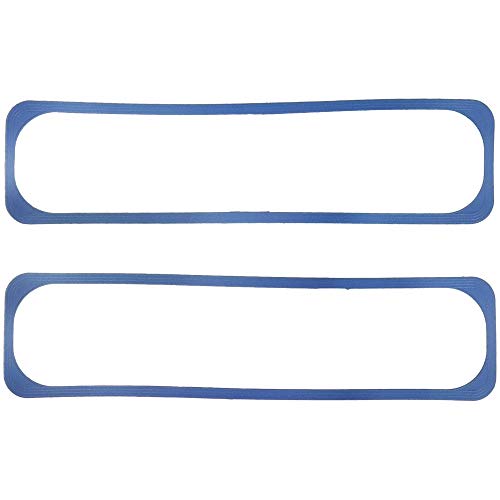
Fel-Pro VS 50088 R
Repair-grade set for later truck small blocks.
Perimeter Bolts or Center Bolts? Look at the Covers First
Small block Chevy valve covers come in two main styles, and the gaskets are not interchangeable. Pop the hood and count where the bolts sit before you shop.
- Perimeter-bolt covers: four bolts along the edge of each cover, the classic layout on first-generation small blocks from the 1950s through the mid-1980s. Most aftermarket chrome, stamped and cast aluminum covers use this pattern too.
- Center-bolt covers: bolts that run down the middle of the cover, used on many late-1980s and 1990s GM truck small blocks. These need a gasket shaped for that head casting.
- Not covered here: LS-family V8s, a different engine design with their own gaskets.
A swapped engine can carry heads from a different year than the chassis, so buy for the covers you actually have.
Cork, Molded Rubber, Cork-Lam or Composite
Material matters as much as shape. Fel-Pro’s own guide to its performance valve cover gaskets breaks the options into a few families, and the same split shows up across most brands:
- Cork-rubber: forgiving on stock stamped covers with slightly wavy rails, but it hardens with age and is usually single-use.
- Molded rubber with a steel core: holds its shape, resists squeezing out and can often be reused, which suits covers you remove for valve adjustments.
- Cork-Lam: a metal core with cork-rubber bonded to both sides. It is thicker than normal and adds a little room between the rockers and the cover.
- Thick composite: a reinforced sheet for performance builds with roller rockers close to the cover.
A thicker gasket can cure a rocker that ticks against the cover, but it also moves the cover relative to brackets and breathers, so dry-fit before you seal anything.
Best Valve Cover Gasket for Small Block Chevy: Six Picks for Stock and Built Engines
These six are sorted from stock replacements to performance and truck parts. Every listing names its own engines and years, so read the fit notes in each review and confirm year, model and engine on Amazon before you order.
1. Fel-Pro VS 12869 T: Molded Rubber Valve Cover Gasket Set with Torque Limiters
- Listed for 1967-1986 Camaro and 1975-1986 C10
- Molded rubber over a rigid carrier
- Locating tabs for alignment
- Torque limiters against overtightening
If your small block still wears its factory-style perimeter-bolt covers, this Fel-Pro set is the straightforward replacement. The Amazon listing names the 1967-1986 Chevrolet Camaro and the 1975-1986 C10 pickup, along with a long list of other GM and specialty vehicles that used the same engine family.
Fel-Pro describes it as molded rubber over a rigid carrier, with proprietary sealing beads meant to close off leak paths on surfaces that are no longer perfectly flat. Locating tabs help the gasket sit in the right place while you lower the cover, which is useful when you are working around brake lines, heater hoses and spark plug wires. Built-in torque limiters are there to stop the gasket from splitting or squeezing out if a bolt gets a little too much wrench.
That combination makes it a sensible pick for a cruiser, a weekend truck or a stock rebuild where you want the cover to seal and stay sealed. It is not aimed at center-bolt covers or engines with tall aftermarket valvetrains that need extra clearance. Confirm year, model and engine on Amazon before ordering, and check that the listing matches the covers on your engine rather than the car’s original build.
View Fel-Pro VS 12869 T on Amazon
2. Fel-Pro 1628 PermaDry: Steel Core Molded Rubber Valve Cover Gaskets for SBC
- Lists 283, 305, 327, 350 and 400 V8s
- PermaDry molded silicone rubber
- Solid steel core for strength
- Suits on-again, off-again use
Engines with solid lifters, adjustable rockers or a builder who likes to check things tend to have their covers off more often than most. Fel-Pro’s 1628 is aimed at exactly that use. The listing names a range of small block displacements, including the 283, 305, 327, 350 and 400, and its compatibility line also mentions an 18-degree high port application.
The gasket is PermaDry molded silicone rubber over a solid steel core. Fel-Pro says the molded rubber makes installation easier and suits on-again, off-again situations, so the same set can often go back on after a valve adjustment as long as it is clean and undamaged. The steel core keeps the gasket from stretching or wandering as you tighten the cover, which matters on cast aluminum covers with narrow rails.
Rubber gaskets need flat flanges to work well, so a stamped cover with dished bolt holes should be straightened first. This is a performance-line part rather than a direct factory replacement, so it suits a hot rod, a street engine or a cruiser with aftermarket covers more than a concours restoration. Match the listing’s fit data to your own year, model and engine before you add a valve cover gasket for small block chevy to the cart.
View Fel-Pro 1628 PermaDry on Amazon

3. Fel-Pro 1604 Cork-Lam: Thick Metal Core Valve Cover Gaskets for Extra Clearance

- Lists 283, 305, 327, 350 and 400 V8s
- Metal core with cork-rubber both sides
- Thicker than a standard gasket
- Built for high-vacuum or blowout conditions
When a set of roller rockers or longer valves leaves the rockers grazing the underside of the covers, a thicker gasket is often the first fix to try. Fel-Pro’s 1604 uses its Cork-Lam construction, a metal core with cork-rubber material bonded to both sides, and the listing names the same broad small block displacement list as the 1628.
According to the listing, the result is a thicker-than-normal gasket with very good torque retention, and that extra height allows additional clearance between the valvetrain and the cover. Fel-Pro also says Cork-Lam is used where high vacuum or blowout conditions are a particular problem, which describes many race and high-revving street engines. Its performance page notes the material is meant for applications such as the Chevrolet small block and big block.
There are two limits to keep in mind. The listing states it is not intended for use in emission-controlled vehicles, so it belongs on a race car, a show car or an older engine rather than a modern daily driver. Extra thickness also will not fix a cover that hits a stud girdle, so dry-fit the cover and check clearance first. Confirm fit for your vehicle on the listing.
View Fel-Pro 1604 Cork-Lam on Amazon
4. Edelbrock 7549: 5/16 in. Core-Reinforced Composite Valve Cover Gaskets for SBC

- 0.3125 in. thickness
- Core-reinforced composite material
- Standard 4-bolt SB Chevy pattern
- Set of 2, made in the USA
Edelbrock sells this pair for small block Chevy engines with the standard four-bolt perimeter pattern, which covers most of the aftermarket covers sold for the 283 through 400 family. At 0.3125 inch, or 5/16 inch, it is the thickest gasket in this list, and the listing says it is made in the USA.
The material is a core-reinforced composite rather than cork or molded rubber. The reinforcement keeps the gasket from crushing out under the bolt heads, and the thickness adds clearance under covers that sit close to roller rockers, stud girdles or rocker stud nuts. It also gives a cast aluminum cover with a slightly wavy rail more material to press into, which can help when a thinner gasket keeps weeping at one corner.
That extra height comes with trade-offs. A thick gasket raises the cover, so breathers, PCV grommets, spark plug wire looms and brake booster lines may sit differently, and some cover bolts may need to be longer. It is a sensible match for an engine already wearing Edelbrock or similar aftermarket covers, and less suited to a stock restoration where factory appearance matters. Check the fit chart before ordering.

5. Fel-Pro VS 50088 R: Center-Bolt Valve Cover Gasket Set for Later GM Truck V8s
- Listed for 1988-1999 Chevrolet K1500
- Proprietary cork-rubber formulation
- Designed for imperfect sealing surfaces
- Parts tested on-vehicle per Fel-Pro
Many late-1980s and 1990s GM trucks use center-bolt valve covers, and a perimeter-bolt gasket will not fit them. This Fel-Pro set is built for that later layout. The Amazon listing headlines the 1988-1999 Chevrolet K1500 and lists a long run of other GM trucks, vans and cars that shared the engine, so the fit chart is the part to read closely.
The listing describes a proprietary cork-rubber formulation that is highly conformable, which helps it seal heads and covers that have seen years of heat cycles and are no longer perfectly flat. Fel-Pro says the set is engineered for the repair environment and that its parts are tested on-vehicle, and it notes that its gasket sets include every part needed for the repair unless stated otherwise.
This is the pick for a high-mileage pickup with oil seeping down the heads onto the exhaust manifolds, a common smell on older trucks after a long drive. It is not a match for older perimeter-bolt engines or for later LS-family V8s, which use a different design. Confirm year, model and engine on Amazon before ordering, and check your cover style if the engine has ever been swapped.
View Fel-Pro VS 50088 R on Amazon
6. GOCPB 7484BOX: Steel Core Rubber Valve Cover Gaskets for Small Block Chevy

- Lists SBC 283, 305, 327, 350, 383 and 400
- Rubber with steel core insert
- Reusable, no sealant required
- 0.18 in. thickness, steel or aluminum covers
For a straightforward reseal on a perimeter-bolt small block, GOCPB’s pair follows the common 7484BOX interchange number. The listing names the 283, 305, 327, 350, 383 and 400, and asks buyers to check the description and compatibility chart before purchasing.
Each gasket is rubber molded around a steel core insert, and the seller says the set is reusable with no sealant required. The listing gives a thickness of 0.18 inch and says the gaskets suit both steel and aluminum valve covers, so they can go under stock stamped covers or aftermarket cast covers. The steel core helps the gasket keep its shape as the bolts come down, and the rubber is meant to resist heat around the heads.
The listing’s own install note is worth repeating: the cover should be tightened just right, not too tight and not too loose, or the gasket loses its seal. That makes a torque wrench and a crisscross pattern part of the job. These suit a street engine or project car with perimeter-bolt covers rather than a factory-correct restoration. Verify fitment by VIN first.
Matching a Gasket to Your Engine and Covers
Use the table as a starting point, then confirm against your cover style and the listing’s fit chart.
| Your setup | Material | Gaskets from this list | Reusable? |
|---|---|---|---|
| Stock perimeter-bolt covers, daily or cruiser | Molded rubber on carrier | Fel-Pro VS 12869 T | Check the listing |
| Covers removed often for lash checks | Steel-core molded rubber | Fel-Pro 1628, GOCPB 7484BOX | Yes, per listing |
| Roller rockers or tight valvetrain clearance | Cork-Lam or thick composite | Fel-Pro 1604, Edelbrock 7549 | Usually replace |
| Late-1980s and 1990s truck, center-bolt covers | Cork-rubber | Fel-Pro VS 50088 R | Usually replace |
If you want the best valve cover gasket for small block chevy builds with big rocker upgrades, measure first: a cover that hits a stud girdle needs a taller cover, not a thicker seal.

Fitting It So It Stays Dry
Most repeat leaks come from the install, not the gasket. Work on a cold engine, because the exhaust manifolds sit right below the covers and oil on hot iron can smoke or catch fire. Wear eye protection when you scrape old cork off the heads.
- Clean both rails: remove all old gasket and sealer, then wipe with a solvent that leaves no film.
- Check the flange: stamped covers bend around overtightened bolt holes. Flatten the rail or add spreader bars.
- Follow the torque figure: use the cover or gasket maker’s figure and a small torque wrench for home garage work.
- Look at the PCV system: a stuck PCV valve or blocked breather pressurizes the crankcase and pushes oil past any gasket.

West Michigan winters add a twist. Cork shrinks and hardens on a classic that sits in a cold garage for months, so a cover that was dry in the fall can seep after the first spring drive. When a weep reaches the exhaust manifold, the first sign is often a burning smell through the vents, the problem our post on a car heater that smells like burning walks through.
When the Leak, or the Warning Light, Is Something Else
Oil on the heads can also come from the intake end seals, a distributor O-ring or a loose filler cap. Clean the engine, drive it, then trace the wet line up to its highest point.

On a fuel-injected small block, a torn gasket or missing breather grommet can let unmetered air into the crankcase, which reaches the intake through the PCV system and leans out the mixture. That can show up as a car that hesitates when you accelerate or a light on the dash. If the light comes on while the truck still drives normally, read our post on a check engine light that stays on while the car runs fine.
When the scan data points at airflow readings rather than a leak, our guide to mass air flow sensor brands is the next stop. For a lean code you cannot pin down, our check engine light diagnostic service in Grand Rapids can read the live data and track down where the extra air is getting in.
More Buying Guides
Frequently Asked Questions
What are the best valve cover gaskets for small block chevy engines with stock covers?
For stock perimeter-bolt covers, an OE-style set such as Fel-Pro VS 12869 T is a sound choice. If the covers come off often, a steel-core rubber gasket like Fel-Pro 1628 can usually be reused.
Is cork or rubber better on a Chevy 350?
Cork-rubber suits stock stamped covers with slightly uneven rails, but it hardens with age. Steel-core rubber holds its shape and resists squeeze-out. Both seal well on clean, flat rails.
Do I need sealant on small block Chevy valve cover gaskets?
Most modern gaskets go on dry, and the GOCPB listing says no sealant is required. Follow the gasket maker’s instructions rather than adding sealant by habit.
Why do my new valve cover gaskets still leak?
The usual causes are bent cover rails around the bolt holes, overtightened bolts, old sealer left on the head, or crankcase pressure from a stuck PCV valve. Fix those first, then fit a new gasket and tighten it evenly to the maker’s figure.
Can’t tell whether that oil is coming from the covers, the intake or somewhere lower? Ring us at 616-279-3832 any weekday between 8am and 5pm, or set up a visit on our contact page.
If your workday overlaps our hours, the after-hours drop-off at 456 Carrier St NE lets you leave the keys with us on your way home.