As an Amazon Associate, 456 AutoFix earns from qualifying purchases. Product links below go to Amazon, where you can confirm the right part for your vehicle.
A door that groans every time you open it is usually asking for grease, not a new hinge. The best white lithium grease for car door hinges is one that reaches the pivot pin, stays put through slush and salt spray, and does not leave a greasy smear on the paint beside it.
This guide narrows the field to door hardware: hinge pins, door checks, latches and strikers. For a wider look at the category, including greases built for chassis and shop work, see our main guide to the best white lithium grease.
Quick answer
Which white lithium grease should go on a squeaky car door hinge?
Use an aerosol with a straw, such as WD-40 Specialist White Lithium Grease, to reach the hinge pin. Choose Gasoila WG16 when paint and plastic trim sit close to the hinge. For latches and check straps, a brush-top can or the AGS grease stick puts grease exactly where you want it with no overspray.
Our Quick Picks
Three quick picks for door hardware: a straw spray for hinge pins, a paint-safe aerosol and a no-spray stick. All five are reviewed below.

WD-40 Specialist White Lithium Grease
Thin spray that creeps into the hinge knuckle, then firms up.
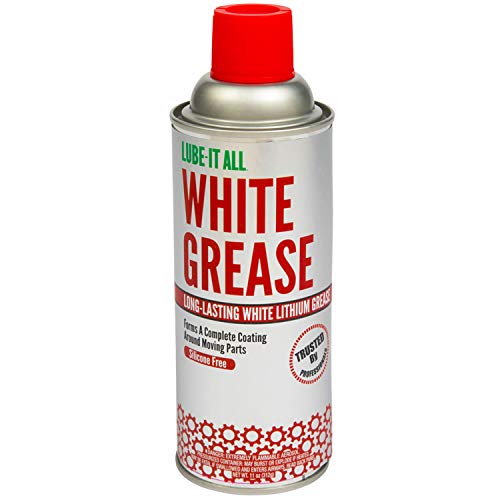
Gasoila WG16 White Lithium Grease
Drip-free film the listing calls safe on paint and plastics.

AGS White Lithium Crayon
Rub-on grease with no overspray or drips.
Is White Lithium Grease Good for Car Door Hinges?
Yes, for the metal parts. A car door hangs on two hinges, each with a steel pin turning inside a pair of knuckles, and a door check arm that clicks the door into its open positions. Those are slow, heavily loaded metal-to-metal contacts, which is the job white lithium grease is made for. It is thicker than a spray oil, so it stays in the joint instead of washing out with the first rain.
It is the wrong product for the rubber weatherstrip around the door opening. Grease on rubber attracts dirt and can leave a sticky film, while a silicone spray keeps seals supple and helps stop them freezing to the frame. Our guide to the best silicone spray for rubber door seals covers that half of the job.
Before you buy anything, open your owner’s manual to the maintenance section. Many manuals list the body lubrication points and some name a specific lubricant, and that instruction comes first.
Spray, Brush or Stick: Picking a Format for Door Hardware
The grease inside each container is broadly similar. What changes is how it reaches the part, and that matters more on a door than almost anywhere else on the car, because the hinge sits a finger’s width from painted metal.
- Aerosol with an attached straw: goes on thin, creeps between the hinge knuckles, then firms up. The straw keeps the spray aimed at the pin.
- Plain aerosol: quick and easy for a whole set of hinges, but the wider fan needs a rag held behind the hinge.
- Brush-top can: no propellant and no mist. Good for check arms and latches you can see, less good at reaching deep into a pin.
- Grease stick: rubbed on like a crayon. Clean and portable, but it cannot flow into a tight gap.
Many owners end up with two: a spray for the hinge pins and a brush or stick for the latch and striker.
Best White Lithium Grease for Car Door Hinges, Can by Can
These five products cover the four formats above. None of them is made for one vehicle, so check where your manual says to lubricate before you start.
1. WD-40 Specialist White Lithium Grease: Smart Straw Spray Rated 0°F to 300°F
- Smart Straw sprays a pinpoint jet or a wide fan
- Goes on as a liquid, sets into a thick coating
- Listed for auto hinges, latches and door tracks
- Six 10 oz cans, 50-state VOC compliant
WD-40 Specialist White Lithium Grease is an aerosol made for metal-to-metal parts that need a heavier lubricant than a light oil. This listing is a six-pack of 10 oz cans, more than one car will use in a season, but handy if you look after several vehicles or want one can in the garage and one in the trunk. Each can has the permanently attached Smart Straw, so there is no loose red tube to lose in the snow.
The WD-40 Specialist product page names auto hinges, latches and guide rails among the intended uses. The straw flips up for a narrow stream aimed into the gap between the hinge knuckles, or folds down for a wider spray across a door check arm. The grease goes on as a liquid that can work its way around the pivot pin, then sets into a thick coat that the maker says will not run off.
The listing rates it from 0°F to 300°F, so it stays usable through a cold West Michigan morning. Because it starts out thin, hold a rag behind the hinge before you press the button and wipe any drips at once. Spray it outdoors or with the garage door open.
View WD-40 Specialist White Lithium Grease on Amazon
2. CRC White Lithium Grease 03080: 10 oz Aerosol with a High-Viscosity Film

- High-viscosity, all-weather white lithium film
- Heat and water resistant
- Listed for hinges, locks and cables
- Single 10 oz aerosol, 50-state compliant
CRC’s 03080 is a single 10 oz aerosol of white lithium grease aimed at general automotive and shop use. CRC describes it as a high-viscosity formula, meaning it leaves a thicker, tackier film than a dry lube or penetrating oil. That film is what a door hinge pin needs, because the load is steady and the grease has to stay in place for months between applications.
The listing calls out heat and water resistance, plus use as a corrosion inhibitor, and it names hinges, locks, cables and guide rails as typical jobs. On a car door, that covers the hinge knuckles, the check arm that holds the door open and the latch inside the door edge. Salty slush that splashes into the jambs all winter is exactly the moisture a water-resistant grease is meant to handle.
The listing does not mention an attached straw, so plan for a wider spray and fold a paper towel behind the hinge to catch overspray before it reaches the fender. CRC lists it as 50-state compliant. Pick it if you want one plain can that covers the car and the rest of the garage.
View CRC White Lithium Grease 03080 on Amazon
3. Gasoila WG16 White Lithium Grease: 11 oz Drip-Free Aerosol, Safe on Plastics and Paint
- Stays on vertical surfaces without running
- Listed as safe on plastics and painted surfaces
- High-solid, non-staining white film
- 11 oz aerosol for auto, marine and home use
Gasoila’s WG16 is an 11 oz aerosol of white lithium grease with a high-solid, non-staining formula. Door hinges are bolted almost flush with painted panels, and many newer doors have plastic trim and wiring boots right beside them. The listing states the grease is formulated to be gentle on plastics and painted surfaces, which takes some of the worry out of a stray mist.
Its other strength is that it stays where it lands. Gasoila says it clings to vertical surfaces without dripping or running, and a door hinge is exactly that: an upright pin you spray from the side. Grease that sags downward ends up on the rocker panel or the door seal instead of inside the joint, so a drip-free film saves cleanup and leaves more lubricant at the pin.
The maker describes the coat as thick and even around moving parts, with protection against rust, wear and corrosion. That heavier film can feel tacky on the outside of the hinge, so wipe the exposed surfaces with a clean rag and leave the grease in the joint. It is a fair choice for a newer car where the paint and trim around the jamb are worth protecting.
View Gasoila WG16 White Lithium Grease on Amazon
4. AGS Lith-Ease White Lithium Grease: 4 oz Brush-Top Can for Mess-Free Application

- Applicator brush built into the lid
- Water and heat resistant
- Listed for hinges, slides and locks
- Listing rates it down to -40°F
Not every door job suits an aerosol. The AGS Lith-Ease brush-top can holds 4 oz of white lithium grease with an applicator brush attached to the lid, so you paint the grease onto the part instead of spraying it. There is no propellant, no overspray drifting onto the fender and no fumes building up in a closed garage during a cold-weather job.
AGS lists it as water and heat resistant, with protection against moisture and corrosion, and names hinges, locks, slides and garage door parts among its uses. The listing rates it down to -40°F, which comfortably covers a Grand Rapids winter. Brushing works well on the door check arm and the latch striker, where you can see the wear surface and want a measured layer rather than a coat over everything nearby.
The trade-off is reach. A brush cannot push grease deep between the hinge knuckles the way a thin aerosol can, so it suits a hinge you have cleaned and can swing open and shut to spread the grease. Keep the lid tight after use so the brush does not pick up grit, and store the can upright on a shelf.
View AGS Lith-Ease Brush-Top Can on Amazon
5. AGS White Lithium Crayon: 0.43 oz Grease Stick for Door, Hood and Trunk Hinges
- Solid white lithium grease in a stick
- Listing names door, hood and trunk hinges
- Water and heat resistant film
- Small enough for a glovebox
The AGS White Lithium Crayon puts Lith-Ease grease into a small 0.43 oz stick that you rub onto a part like a crayon. The listing names hood, door and trunk hinges, hood and trunk latches, window regulators and seat tracks among its uses, so it lines up well with the car jobs this guide covers. Because nothing sprays, there is no mist to settle on the paint, glass or door seals.
AGS describes the grease as water and heat resistant, with good film strength and corrosion protection. In practice, a stick works best on surfaces you can touch directly: the door check arm, the latch jaw, the striker on the body pillar and the outer faces of the hinge. Rub a little on, open and close the door several times, and the grease works itself into the contact points.
It is not the tool for a dry, squeaking hinge pin buried between two knuckles, because a solid stick cannot flow into that gap. Use a spray for the pin and keep the crayon for touch-ups between full lubrication jobs. At this size it fits in a glovebox or the winter bag in your trunk, ready for a latch that starts to stick on a cold morning.
View AGS White Lithium Crayon on Amazon
Which Grease Goes Where on a Car Door
A typical door has four places that wear: the two hinge pins, the check arm, the latch inside the door edge and the striker bolted to the body pillar. Each one suits a slightly different format.
| Door part | Format that suits it | Tip |
|---|---|---|
| Hinge pin and knuckles | Aerosol with straw | Spray at the top of the pin and let it run down inside |
| Door check arm | Brush-top can or aerosol | Coat both faces of the arm, then cycle the door |
| Latch mechanism | Short aerosol burst or brush | Keep grease off any wiring or plastic housing |
| Striker on the pillar | Grease stick or brush | A thin layer is enough; wipe the rest |
| Rubber weatherstrip | Silicone spray, not grease | Grease on rubber collects grit |
If you only buy one product, an aerosol with a straw handles the most points. A plain can such as the CRC is fine too, as long as you shield the paint while you spray.
Hood and trunk hinges, the hood latch and the fuel door hinge use the same approach. Grease the hood latch lightly, since that is the part you least want sticking when you need to check fluids on the side of the road.
Greasing Door Hinges Before Salt Season
Late fall is a sensible time to do this in Grand Rapids. Salty slush splashes into the door jambs all winter, and freeze-thaw cycles push water into any hinge that is running dry. Add it to the list in our winter car maintenance checklist.
- Clean first: wipe old, gritty grease off the hinge and latch with a rag. Grit mixed into fresh grease keeps wearing the pin.
- Shield the paint: hold a folded towel behind the hinge or tape a sheet of paper over the fender edge.
- Apply sparingly: a one-second burst at the top of each hinge pin, a light coat on the check arm and a thin layer on the striker.
- Work it in: open and close the door ten or so times to spread the grease through the joint.
- Wipe the excess: grease on the outside of the hinge only collects road grime.
Wear safety glasses, since an aerosol aimed upward into a hinge can bounce back, and work outdoors or with the garage door open. Aerosol cans are flammable, so keep them away from heaters and open flames. If a mist lands on the paint, wipe it off and refresh the finish with one of the options in our guide to the best car wax.
A door frozen shut is a different problem from a dry hinge. Ice usually forms at the rubber seal, so keep a de-icer and the other basics from our best car emergency kit for winter guide in the car, rather than prying at a frozen door.
When the Door Needs More Than Grease
Grease quiets a dry hinge. It cannot fix one that is worn. If the door drops noticeably when you open it, or you have to lift it to close it, the hinge pins or bushings have worn and need replacing, which is body hardware work. A clunk over bumps can also come from a loose striker rather than the hinge.

If the latch is greased and the door still will not lock or unlock reliably, the fault may be electrical. Our article on door lock actuator symptoms explains the signs, and our car electrical repair in Grand Rapids covers power lock and body electronics faults. Hinge lubrication is also part of many factory schedules, which our factory scheduled maintenance service follows.
More Buying Guides
Frequently Asked Questions
How often should I grease my car door hinges?
Follow the interval in your owner’s manual where it gives one. Without one, once a year before winter plus any time a hinge starts to squeak is a reasonable routine for a car that sees road salt.
Can I use regular WD-40 on car door hinges?
The classic blue-and-yellow can is a light penetrant and water displacer, so it can free a stiff hinge but thins out quickly. Follow it with a white lithium grease, such as the WD-40 Specialist version, for a coat that lasts.
Will white lithium grease damage car paint or rubber seals?
Gasoila lists its WG16 as safe on paint and plastics, and with any brand the bigger issue is overspray that looks messy and holds dirt. Wipe stray grease off the paint and keep it off the rubber seals, which suit silicone spray instead.
Why does my door still squeak after I greased the hinge?
The noise may come from the door check arm, the striker or a dry weatherstrip rather than the hinge pin. Grease each metal contact point in turn, treat the seals with silicone, and have the hinges checked for wear if the door also sags.
Door sagging, lock acting up or something else bothering you before winter sets in? Reach Hendrick and the team at 456 AutoFix on 616-279-3832 between 8am and 5pm on weekdays, or request a visit through our contact page.
Busy until after closing? Pull into 456 Carrier St NE, use the after-hours drop-off and leave a short note naming the door that bothers you, and we will look at it once the shop opens.