
As an Amazon Associate, 456 AutoFix earns from qualifying purchases. Product links below go to Amazon, where you can confirm the right charger for your battery.
NOCO vs Schumacher comes up the moment you stand in a parts store aisle looking at two walls of battery chargers. NOCO built its name on compact smart chargers that you clip on and forget. Schumacher says it has made automotive power products since 1947, and it is known for value units, engine start models and wheeled garage chargers.
The gap between the two brands is smaller than it used to be. Schumacher now sells weatherproof units that handle lithium, and NOCO now sells big 24-volt shop chargers. Below we compare how each maker approaches charging, then set three chargers of a similar class side by side, one NOCO and two Schumachers, using only what the makers’ documents and the Amazon listings state.
Quick answer
Is a NOCO or a Schumacher charger the right buy for your car?
Choose NOCO if you want a compact smart charger with a 12V supply mode, a thermal sensor and a 3-year warranty in the manual. Choose Schumacher if you want more amps for the size, an engine start model, or a rugged mountable unit like the SC1685. Both brands sell chargers that handle AGM and lithium.
Our Quick Picks
A NOCO and a pair of Schumachers, all in the 10 to 15 amp class, with each one reviewed in full below.
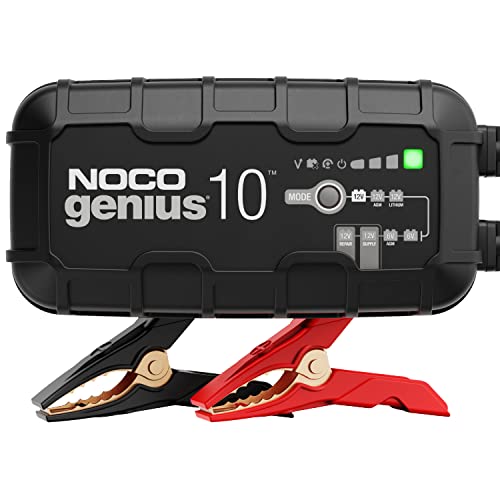
NOCO GENIUS10
Sealed smart charger with thermal sensor, repair and supply modes.

Schumacher SC1685
Weatherproof 4-in-1 charger, maintainer and desulfator with service mode.

Schumacher SC1684
Fully automatic 4-in-1 charger with clamps that convert to ring leads.
Two Makers, Two Ideas of a Battery Charger
NOCO’s GENIUS line is built around one idea: a small, sealed box that reads the battery, picks a charge program and then holds it full for months. The range steps up in output, from the 1-amp GENIUS1 through the GENIUS2, GENIUS5 and GENIUS10, and then to the GENIUSPRO25 and GENIUSPRO50 for 24-volt trucks and shop use. None of the GENIUS chargers we looked at offers an engine start function.
Schumacher covers a wider spread of jobs. Its lineup on Amazon runs from 2-amp maintainers such as the SC1339 to the SC1281, whose listing names a 100-amp engine start, and up to wheeled DSR units with a 330-amp engine start and 24-volt support. Many of its chargers are sold on how quickly they get a car running, not only on how gently they maintain it.
So the brand question is really a job question. If your car sits in a garage from November to April, a NOCO-style maintainer is what you need. If you also want to crank a stalled engine on a cold morning, Schumacher’s engine start models do something a GENIUS charger does not.
What to Compare Before You Pick a Brand
Brand loyalty matters less than five practical points. Check each one against the battery in your car before you buy.
- Charge rate: a 2-amp unit maintains well but takes a long time to refill a flat battery. A 10 to 15 amp unit can recharge a car battery in hours instead of a day.
- Modes: look for a separate AGM setting if your car has an AGM battery, and a repair or desulfation mode if you want to try reviving a tired one.
- Lithium support: a LiFePO4 battery needs a charger whose listing names lithium. A lead-acid program can damage it.
- Cold-garage use: a charger that adjusts for temperature avoids undercharging in January. Check the stated operating range too.
- Warranty: read the length in the maker’s manual or on its own site, not only on a retailer page.
Our guide to the best AGM battery charger explains why the AGM setting matters on newer cars, many of which leave the factory with an AGM battery under the hood or in the trunk.
NOCO vs Schumacher: GENIUS10 and SC1685 Up Close
To keep the comparison fair, we picked a charger of a similar class from each maker: around 10 to 15 amps, 6-volt and 12-volt support, lithium capable and able to live in a garage full time. On the NOCO side that means the GENIUS10, the brand’s most familiar 10-amp model. Schumacher gets two entries, the 15-amp SC1685 and the 10-amp SC1684, so you can see its lineup at both outputs.
Our NOCO Genius 10 vs CTEK MUS 4.3 comparison puts the GENIUS10 head to head with CTEK. Every spec below comes from the maker’s manual or the Amazon listings.
NOCO GENIUS10: 10A 6V/12V Smart Charger with Lithium and Supply Modes
- 10A charging for 6V and 12V batteries
- Lead-acid, AGM and LiFePO4 lithium modes
- Integrated thermal sensor adjusts the charge
- Force Mode for batteries below 1 volt
The GENIUS10 is the largest of NOCO’s standard GENIUS chargers, below the GENIUSPRO shop units, and the model most people picture when they think of the brand. It delivers 10 amps to 6-volt and 12-volt batteries and covers flooded, gel, AGM, maintenance-free, deep-cycle and LiFePO4 lithium types. NOCO describes it as a charger, maintainer, trickle charger and desulfator in one sealed unit.
Its main selling points are the extras around the charge itself. An integrated thermal sensor adjusts the charge to the room temperature, which helps in a garage that swings from freezing to humid. It starts charging from as low as 1 volt, and Force Mode lets you begin manually on a battery that reads close to zero. Pulse charging aims at sulfation, and NOCO’s manual adds a 13.6-volt supply mode and a three-year limited warranty.
In practice it suits an owner who wants to clip on in November and check back in spring. The 80-inch DC cable comes with both clamps and eyelet terminals, and a mounting bracket is in the box. It has no engine start function, and 10 amps is slow for a large truck battery that is completely flat.

Schumacher SC1685: 15A 6V/12V Rugged Charger with IP66 Case and Lithium Support
- 15A charging for 6V and 12V batteries
- Works with AGM, gel, EFB and lithium types
- Low-voltage override under 1 volt
- IP66 case with folding hook and mounting option
The SC1685 is one of Schumacher’s rugged chargers and the closest match in its lineup to a NOCO-style smart charger. The listing calls it a 4-in-1 unit: charger, maintainer and desulfator with a service mode, rated at 15 amps for 6-volt and 12-volt batteries. It names a long list of battery types, including wet cell, gel, deep-cycle, EFB, calcium, AGM and lithium.
Automatic operation and a repair mode are aimed at keeping batteries healthy and recovering some lost performance from older ones. A low-voltage override lets you manually start charging a battery that has dropped below one volt, which many automatic chargers refuse to touch. Schumacher’s low-profile clamps are designed to reach terminals tucked into tight engine bays, and the IP66 case is rated to resist water and dust.
For a shared garage or a pole barn, the folding hook and the option to screw it to a wall keep it off the floor, and two mounting screws come with it. Its 15-amp output refills a flat battery sooner than the NOCO. The listing does not mention temperature compensation or an engine start function, so look elsewhere in Schumacher’s range if you need to crank a stalled engine.
View Schumacher SC1685 on Amazon
Schumacher SC1684: 10A 6V/12V Automatic Charger with 2-in-1 Clamps and Push-to-Start Override
- 10A charging for 6V and 12V batteries
- Lists AGM, EFB, gel, calcium and lithium
- Push-to-start override below 1 volt
- 2-in-1 clamps convert to ring leads
The SC1684 sits a step below the SC1685 in Schumacher’s current 6V/12V family, and its 10-amp rating lines it up directly against the GENIUS10. Schumacher sells it as a 4-in-1 unit that charges, maintains and desulfates, with a service mode on top. Its battery list matches the 15-amp model: wet cell, gel, deep-cycle, EFB, standard, maintenance-free, calcium, AGM and lithium.
The headline difference is the connection hardware. Schumacher’s patented 2-in-1 clamp converts from ordinary battery clamps into ring leads, so a car parked for the season can keep leads bolted to its terminals while the charger itself comes and goes. A push-to-start override begins charging on batteries that have sagged below one volt, and the repair mode targets older batteries that have lost some capacity.
What it leaves out matters as much. The listing makes no mention of the IP66 case, folding hook or mounting screws that ship with the SC1685; the box holds the charger, a clamp assembly and a user manual. Temperature compensation and engine starting are not mentioned either. If you want Schumacher’s battery coverage at the same output as the NOCO, and a weatherproof shell is not a priority, this is the closer match.
View Schumacher SC1684 on Amazon
Schumacher vs NOCO Spec Sheet
Here is how the three chargers line up on the points that decide most purchases. Where a maker does not state a figure, the table says so rather than filling the gap.
| Feature | NOCO GENIUS10 | Schumacher SC1685 | Schumacher SC1684 |
|---|---|---|---|
| Charge rate | 10A at 6V and 12V | 15A at 6V and 12V | 10A at 6V and 12V |
| Lithium | 12V LiFePO4 mode | Lithium named on the listing | Lithium named on the listing |
| Repair mode | Yes, 12V lead-acid | Yes, plus desulfator | Yes, plus desulfator |
| Very flat batteries | From 1V, Force Mode below that | Low-voltage override under 1V | Push-to-start override under 1V |
| Extra mode | 13.6V supply mode | Service mode | Service mode |
| Temperature | Built-in thermal sensor | Not stated on the listing | Not stated on the listing |
| Housing | IP65 | IP66, folding hook, mountable | No rating stated; 2-in-1 clamps |
| Warranty | 3-year limited (NOCO manual) | Check Schumacher’s warranty card | Check Schumacher’s warranty card |
The SC1685 leads on raw output, the SC1684 ties the NOCO at 10 amps, and NOCO leads on documented extras. The GENIUS10’s thermal sensor and supply mode are written into NOCO’s GENIUS10 user guide, along with its rated operating range of -4°F to 104°F. Neither Schumacher listing mentions temperature compensation, so ask the seller or check the manual if a freezing garage is part of your plan.

Warranty is the other point where shoppers get mixed messages. NOCO’s guide states a three-year limited warranty for the GENIUS10. Several retailers quote a warranty length for Schumacher’s rugged chargers, but we could not load a Schumacher page that confirms it, so read the card in the box before you rely on it.
Cold Garages and West Michigan Winters
A Grand Rapids winter is hard on batteries. Cold slows the chemistry inside, so a battery that cranked fine in October can struggle in January, and short winter trips rarely put back what the starter takes out. A maintainer keeps a parked car’s battery topped up so it does not sit half charged in the cold.
On cold-weather duty, NOCO vs Schumacher is close: either brand handles the job when you pick the right model. Never charge a battery that looks frozen, swollen or cracked; bring it inside to warm up, and replace it if the case is damaged. For a wider look at winter maintainers from more makers, our car battery charger for winter guide covers single-car units in more depth.

Mounting matters in a crowded garage too. The GENIUS10 and SC1685 can be fixed to a wall or bench, which keeps the cables off a cold, wet floor where salty slush drips off the car. If a battery is fully charged and the car still will not crank on a frosty morning, read our article on a car not starting in cold weather to narrow down the cause.
When a New Charger Won’t Fix the Problem
Whichever way you settle the NOCO vs Schumacher question, no charger cures a battery that keeps going flat for a reason. If yours charges to full and is dead again two days later, something is drawing current with the key off. Our guide to a car battery that dies overnight explains how that drain is traced.

A battery that only runs down while you drive points at the charging system instead, and our page on bad alternator symptoms lists the signs. When you want it tested properly, our car electrical repair in Grand Rapids covers drains, charging checks and wiring faults on foreign and domestic vehicles.
More Buying Guides
Frequently Asked Questions
Is NOCO better than Schumacher?
Neither brand wins every job. NOCO’s GENIUS chargers focus on compact, sealed smart charging with features such as a thermal sensor and supply mode. Schumacher offers more engine start and high-amp models, plus rugged units like the SC1685. Match the charger to your battery type and how you use the car.
Can a Schumacher charger charge a lithium battery?
Some can. The SC1685 listing names lithium alongside AGM, gel and flooded batteries, but older Schumacher models are often lead-acid only. Check the listing or manual for your exact model before you connect it to a LiFePO4 battery.
Does the NOCO GENIUS10 have an engine start mode?
No. The GENIUS10 charges, maintains and repairs batteries and has a 13.6V supply mode, but it is not built to crank an engine. If you want that function in a charger, look at a Schumacher engine start model or carry a portable jump starter.
Can I leave a NOCO or Schumacher charger connected all winter?
All three chargers compared here switch to maintenance once the battery is full, so they are meant to stay connected through storage. Check on the battery now and then, keep the charger off a wet floor, and unplug it if the battery case looks swollen.
Battery still going flat after a full charge? Call 456 AutoFix in Grand Rapids at 616-279-3832, Monday to Friday 8am to 5pm, or book a battery and charging check through our contact page.
Can’t make it during the day? Use our after-hours drop-off. We’re at 456 Carrier St NE in Creston.