
As an Amazon Associate, 456 AutoFix earns from qualifying purchases. Product links below go to Amazon, where you can confirm the right part for your vehicle.
A misfire code that keeps coming back, a cylinder that smokes on startup or an engine that idles like it is missing a beat all lead to the same question: is the problem inside the cylinder? Finding the best compression tester for that job is less about the brand name and more about whether the kit threads into your spark plug holes, holds a steady reading and lets you see the gauge from where you stand.
This guide covers what a compression test tells you, how to pick a kit that fits your engine, and five gauge kits worth a look. If a scan tool already pointed you toward one cylinder, our OBD2 scanner guide for DIY mechanics explains how to read those misfire counts first.
Quick answer
Which compression tester should a home mechanic buy?
Pick a gasoline kit with a 0-300 psi gauge, threaded adapters that match your plug size and reach, and a release valve. The OTC 5605 covers deep plug wells and 16 mm Ford plugs. The Innova 3614 suits simpler engines, and the OTC 5605-DG records every cylinder digitally.
Our Quick Picks
Three starting points: a deluxe dial kit for deep plug wells, a simpler kit for common engines and a digital gauge that stores every cylinder. All five kits are reviewed below.
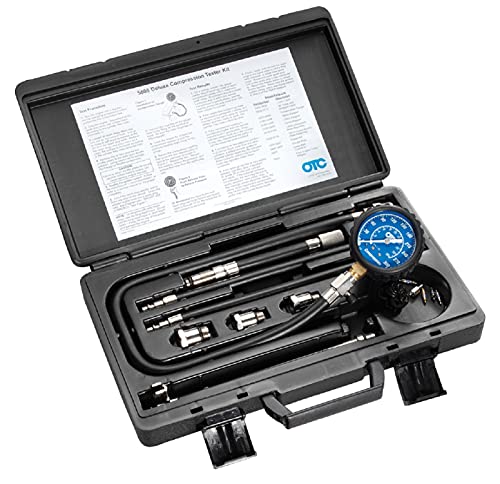
OTC 5605 Deluxe
A dial kit with the specialty adapters that tight, recessed plug tubes call for.

Innova 3614
A compact six-piece kit that covers the common plug threads without extra bulk.

OTC 5605-DG Digital
Stores each cylinder's reading so you can compare them after the last crank.
What a Compression Test Can and Cannot Tell You
A compression tester measures the peak pressure each cylinder builds while the starter cranks the engine. Healthy cylinders build similar numbers. One that reads well below the others points to a leak past the piston rings, a valve that is not sealing or a head gasket that has let go between cylinders.
What the gauge cannot do is tell you exactly where the air escapes. That is the job of a leak-down test, which pressurizes the cylinder from shop air and lets you listen at the intake, exhaust and oil filler. A compression test is the quick first screen, and it is also a smart check before you buy a used car with a rough idle.
Low compression is not the only cause of a misfire, since coils and wiring trigger the same codes. Our guide to multimeters for automotive use covers the meters that handle coil and sensor checks.
How to Choose a Good Compression Tester Kit
The best compression tester for your garage is the one whose adapters, hose and release valve suit your engine, since most kits share a 0-300 psi gauge.
- Thread size: most modern car engines use 14 mm plugs, but some use 12 mm or 16 mm, and small engines often use 10 mm or 18 mm.
- Reach and plug wells: engines with deep, narrow plug tubes need a long flexible adapter or a deep-well connector to reach the threads.
- Threaded vs push-on: screw-in adapters seal more reliably than rubber cones you hold in place by hand.
- Hose and valve: a long hose keeps the gauge readable, and a release valve allows quick retests.
- Analog or digital: a dial is simple and needs no battery, while a digital gauge can store each cylinder’s result.
Gasoline kits are not built for diesel engines, which run far higher compression and need a dedicated diesel tester. If you are still collecting the sockets and extensions you will need to pull the plugs, our mechanic tool set guide is a good starting point.
Best Compression Tester Kits: Five Gauges Reviewed
Each of these five kits is a gasoline engine compression tester listed on Amazon US, with specs taken from the listings.
1. OTC 5605 Deluxe: 0-300 PSI Dual-Scale Compression Tester Kit with Deep Well Adapter
- 2-1/2 in gauge reads 0-300 psi and 0-2100 kPa
- 25 in flex hose with quick coupler
- 8 in deep well 14 mm and 5 in Ford Triton 16 mm adapters
- 10, 12 and 18 mm thread adapters in a hard case
The OTC 5605 Deluxe is a gasoline engine compression kit built around a 2-1/2 inch dial gauge that reads 0 to 300 psi and 0 to 2100 kPa. The gauge has a chrome bezel and a rubber outer boot, and it sits on a 25 inch flexible hose with a quick coupler. That hose length lets you set the gauge on a fender or cowl where you can read it while someone else turns the key.
Its main strength is the adapter set. Along with 12 inch flexible 14 mm adapters in standard and long reach, the kit includes an 8 inch deep well 14 mm connector for recessed plug tubes and a 5 inch flexible adapter for 16 mm plugs on Ford Triton engines. Thread adapters in 10, 12 and 18 mm round out the set, and OTC says they seal on both flat and tapered seat plugs.
The parts have a nickel plated finish to resist corrosion and pack into a blow molded case with a removable lid. This kit suits a home mechanic who works on several cars, including trucks and engines with deep plug wells. It is a gasoline tester only, so it is not the tool for diesel engines, and anyone checking a single small engine may find the deep well pieces unnecessary.
View OTC 5605 Deluxe on Amazon
2. Innova 3614 Compression Tester Plus: 6-Piece Kit with Side Release Valve
- 2-1/2 in dual-calibrated, color-coded dial
- 15 in rubber hose with stainless steel casing
- 10, 12, 14 and 18 mm adapters plus 14 mm long reach
- Side release valve for repeat tests
The Innova 3614 Compression Tester Plus is a six-piece kit for finding damaged pistons, worn rings, burnt valves and blown head gaskets. It uses a 2-1/2 inch dial with dual calibrated, color coded scales, which makes it easy to see at a glance whether a reading sits in a healthy range or needs a second look.
The gauge connects to a 15 inch rubber hose protected by a stainless steel casing. Innova uses a properly rated fuel hose and brass fittings, which helps the kit hold pressure over years of use. A side release valve lets you bleed off the reading and test the same cylinder again without unthreading the hose, which speeds up a dry and wet test on a suspect cylinder.
The adapter set covers 10, 12, 14 and 18 mm threads, plus a 14 mm long reach adapter for engines with deeper plug bores. That range handles most passenger cars, motorcycles and small engines. The shorter hose and lack of a deep well connector mean it can be awkward on engines with long, narrow plug tubes, and there is no 16 mm adapter for some Ford engines, so check your plug size first. It suits a first kit for a home garage.

3. OTC 5605-DG Deluxe Digital: Backlit Compression Tester that Records 1 to 12 Cylinders
- Backlit LCD gauge, 0-300 psi and 0-2100 kPa
- Records and plays back 1 to 12 cylinders
- Displays psi, kPa, bar and kg/cm2
- 26 in hose with release valve and deluxe adapters
The OTC 5605-DG takes the adapter set from the deluxe kit and pairs it with a 2-1/2 inch digital gauge. The display is a backlit LCD inside a protective rubber boot, and it measures from 0 to 300 psi or 0 to 2100 kPa. It can also show results in bar and kg per square centimeter if your service information uses those units.
The feature that sets it apart is memory. The gauge can measure, record and play back compression readings on engines with 1 to 12 cylinders, so you can work around a V8 without writing anything down and then scroll through the results to spot the low cylinder. The 26 inch flexible hose includes a release valve, and the kit adds a repair kit for the hose end.
Adapters include 12 inch flexible 14 mm standard and long reach pieces, an 8 inch deep well 14 mm adapter, a 5 inch flexible Ford Triton 16 mm adapter and 10, 12 and 18 mm thread adapters, all for flat or tapered seat plugs. It suits anyone who tests larger engines or wants a clear record to compare over time. The digital gauge needs batteries, and a simple dial may be enough if you test only now and then.
View OTC 5605-DG Digital on Amazon
4. Mityvac MV5530: Compression Test Kit with 2-3/4 in Gauge and Air-Hold Adapter

- 2-3/4 in (70 mm) Bourdon tube gauge
- Manual pressure release for peak readings
- Quick-disconnect coupler for fast adapter swaps
- Motorcycle, marine, small engine and air-hold adapters
The Mityvac MV5530 is a compression kit for dry and wet tests, the two checks used to tell worn rings from head or valve trouble. Its gauge is a 2-3/4 inch, or 70 mm, Bourdon tube dial, a little larger than the 2-1/2 inch faces on many kits, which helps when you are reading it from an awkward angle.
A manual pressure release holds the peak reading until you clear it, and a quick disconnect coupler lets you swap adapters without fighting threads. Mityvac describes threaded adapters that seal against leaks and extended hoses for hard to reach plug holes. The kit also includes an air-hold adapter, which lets you keep a cylinder pressurized from shop air so valves stay closed while valve seals are replaced without pulling the head.
The listing leans toward motorcycles, marine engines and small engines such as lawn mowers and chainsaws, so this kit fits a garage that services a mix of outdoor equipment and bikes. If your main interest is a passenger car, compare its included thread sizes against your spark plugs before ordering, since the OTC and Innova kits list more car-specific adapters. It suits owners who want one gauge for many small engines.

5. AUTOWN 13-Piece Compression Tester: 300 PSI Fluorescent Triple-Scale Gauge with Spark Testers

- Fluorescent 0-300 psi, 0-20 bar triple-scale gauge
- Five metal adapters, M10 to M18
- Two spark plug testers included
- Built-in Schrader valve and quick-release valve
The AUTOWN Professional Compression Tester Kit is a 13-piece set for gasoline engines in cars, trucks, ATVs and small equipment. Its gauge face is fluorescent and reads in three scales: 0 to 300 psi, 0 to 20 bar and 0 to 21 kg per square centimeter. The bright face is easier to read under a hood light or in a dim garage than a plain white dial.
The kit includes five metal adapters from M10 to M18, an extension hose and a protective case. AUTOWN places the Schrader valve inside the gauge itself, so the hose and adapters do not need their own valve fittings, and a quick release valve lets you bleed off pressure with one hand after each reading. The gauge is designed to hold the peak value until you release it.
Two spark plug testers come in the set, which helps when a misfire could be ignition or compression. You can confirm spark on a cylinder first, then thread in the gauge to check its seal. AUTOWN states clearly that the kit is not for diesel engines, and it has no deep well or long flexible adapters, so engines with recessed plug tubes may need a different kit. It suits occasional testing on common engines.
View AUTOWN 13-Piece on Amazon
Comparing the Five Kits
Use the table to match a kit to the engines you work on most.
| Kit | Gauge | Adapters and hose | Good fit for |
|---|---|---|---|
| OTC 5605 | 2-1/2 in dial, 0-300 psi | 10 to 18 mm, deep well, Ford 16 mm, 25 in hose | Cars and trucks with deep plug wells |
| Innova 3614 | 2-1/2 in dial, color-coded | 10, 12, 14, 18 mm plus 14 mm long reach, 15 in hose | A first kit for common engines |
| OTC 5605-DG | Digital, records 1 to 12 cylinders | OTC deluxe adapter set, 26 in hose | Logging results on V6 and V8 engines |
| Mityvac MV5530 | 2-3/4 in Bourdon dial | Small engine, motorcycle and marine adapters, air-hold adapter | Mixed fleets of small engines and bikes |
| AUTOWN 13-piece | Fluorescent, 0-300 psi | Five metal adapters M10 to M18 | Low-light garages, plus spark checks |
For one family car, the best compression tester is often a basic dial kit with the right thread. If you help friends with several engines, the extra adapters in the larger kits earn their space.

Running a Dry and Wet Compression Test
Warm the engine, then let it cool enough to pull the plugs safely. Disable the fuel pump and ignition by pulling the right fuse or relay from your service information, then remove every spark plug so the engine spins evenly. Wear eye protection, keep hands and hair away from belts and fans, and work in a ventilated space.
- Thread the adapter in by hand and connect the gauge.
- Hold the throttle open and crank the engine for four to six compression strokes.
- Write down the peak reading, release the pressure and move to the next cylinder.
- On any low cylinder, add about a teaspoon of engine oil through the plug hole and test it again.
Compare the cylinders to each other as much as to the factory figure. A common rule of thumb treats a spread of more than about 10 to 15 percent as worth a closer look. If the wet reading jumps after the oil, the rings are the likely leak, and if it barely moves, suspect a valve or the head gasket.
A digital gauge that stores each result, such as the OTC 5605-DG profiled by VehicleServicePros, saves you the notebook. Skip the wet test on horizontally opposed engines, where the oil pools on one side of the bore and skews the result.

When the Numbers Point to the Shop
A low cylinder is a diagnosis, not a repair, so confirm it with a second test, because a loose adapter or weak battery can read falsely low. West Michigan winters are hard on starters and batteries, so make sure the engine cranks at full speed before you trust the result.
If a misfire or flashing check engine light sent you here, our check engine light diagnostic service in Grand Rapids can trace the fault from the code to the cause. Overdue care such as stretched oil changes plays a part too, and our factory scheduled maintenance service in Grand Rapids keeps on schedule.

Shopping for a used car that idles rough? A compression check belongs on the list, and our pre-purchase inspection in Grand Rapids gives you a second set of eyes before you sign.
More Buying Guides
Frequently Asked Questions
What is the best compression tester brand?
No single brand suits every engine. OTC, Innova and Mityvac have long made compression gauges, and newer brands such as AUTOWN offer larger adapter sets. Match the adapters and hose to your engine before you look at the name.
Should I use a compression tester or a leak down tester?
Start with a compression tester, because it quickly shows whether one cylinder is weaker than the rest. A leak-down tester then tells you where the air escapes: past the rings, through a valve or across the head gasket. Many home mechanics own both.
Can I use a gasoline compression tester on a diesel?
No. Diesel engines build much higher compression than a 300 psi gauge can read, and they need adapters that fit the injector or glow plug holes. Buy a kit made for diesel engines instead.
Does the engine need to be warm for a compression test?
A warm engine gives the most consistent readings because the rings and valves seal as they do in normal driving. Let it cool enough to remove the plugs safely, and keep the battery charged so every cylinder cranks at the same speed.
Got a reading you do not like? Give 456 AutoFix a call at 616-279-3832 any weekday from 8am to 5pm, or send us a note on the contact page to set up a diagnosis.
If your workday overlaps our hours, the after-hours drop-off is open to you. Park at 456 Carrier St NE in Grand Rapids, leave the keys as directed, and we will pick it up from there.