As an Amazon Associate, 456 AutoFix earns from qualifying purchases. Product links below go to Amazon, where you can confirm the right part for your vehicle.
A blowing muffler rarely fails at a good time. The best exhaust repair kit for your car depends on the damage: a wrap for a split pipe, a putty for a pinhole or seam, or a clamp for a joint that has worked loose. Every one of them is a stopgap, and that matters more than which brand you buy.
Below we sort tapes, pastes and clamps by the job they actually do, then review six products. If you aren’t sure where the noise is coming from yet, start with our guide to exhaust leak symptoms.
Quick answer
Which exhaust patch should you buy for a leak?
Use a resin fiberglass wrap such as J-B Weld ExhaustWeld for cracks or holes in a pipe, a putty like Permatex 80333 for pinholes and seams on a muffler, and a stainless band clamp for a leaking slip joint. Treat all of them as temporary, and replace any pipe that has rusted through.
Our Quick Picks
Three quick picks: a resin wrap for cracked pipes, a putty for muffler pinholes and seams, and a stainless clamp for a leaking joint. All six products are reviewed below.

J-B Weld ExhaustWeld
A resin-soaked bandage that hardens around a cracked or holed pipe.

Permatex 80333
A thick sealer pressed into pinholes, seams and loose joints.

EVIL ENERGY 2.5 Inch Band Clamp
A wide stainless band that seals two pipe ends together.
Tape, Putty or Clamp: Which Damage Each One Fixes
Exhaust patch products fall into three groups, and each one handles a different kind of failure. Buying the wrong type is the most common reason a repair lets go within a few days.
- Wraps and tapes: a resin-soaked fiberglass bandage or an aluminum tape that goes around the outside of a pipe. They suit cracks and small holes on pipe you can reach all the way around.
- Putties and pastes: a thick cement pressed into a hole or a joint. They suit muffler pinholes and leaky seams.
- Clamps: a steel band that squeezes two pipe ends together. They suit a slip joint that has started to leak.
Putty in the hole with a wrap over the top often seals better than either one alone. Note that woven header heat wrap is insulation, not a repair product, so it won’t seal a leak.
Prep Decides How Long a Patch Lasts
The product matters less than the surface it sticks to. Rust scale, road film and soot keep any wrap or cement from bonding, so the patch peels at the edges and the leak returns.
- Let it cool: work on a cold exhaust, with the car safely on stands or ramps.
- Clean to bare metal: wire-brush a few inches past the damage on every side.
- Check what’s left: if the metal flexes or crumbles when you press it, a patch has nothing to grip.
- Follow the cure: skipping it is how a patch blows out on the first drive.
J-B Weld’s own ExhaustWeld instructions call for at least five layers over the break and 2 to 4 inches of wrap on both sides of it.
Best Exhaust Repair Kit Options: Six Products Reviewed
These six cover two wraps, three pastes and one band clamp. Each suits a specific kind of damage, so read the “doesn’t suit” notes before you choose the best exhaust repair kit for your own car.
1. J-B Weld ExhaustWeld: 2 x 72 Inch Resin Fiberglass Exhaust Repair Wrap
- Resin-impregnated fiberglass wrap, 2 x 72 inches
- Rated to 1100F once fully cured
- Cures in 20 minutes with heat or 2 hours without
- For manifolds, converters, mufflers and tailpipes
ExhaustWeld is a fiberglass wrap that comes soaked in a heat-resistant resin. You knead the sealed pouch, open it and wind the strip tightly around the damaged section, where it hardens into a stiff shell. The listing rates the cured wrap to 1100F, and J-B Weld names manifolds, catalytic converters, mufflers and tailpipes as places it can go.
The cure is flexible, which helps in a driveway repair. With heat from a heat gun or a running engine, it cures in about 20 minutes. Without heat, the listing says it sets in 20 minutes and cures in 2 hours. At 72 inches, the strip is long enough to build the five or more layers J-B Weld recommends over a break, with a few inches of support on each side.
This wrap is a good match for a crack, split seam or small hole on a round pipe that you can reach all the way around. It is less useful on the wide oval body of a muffler, where a strip can’t make a full loop. It also needs solid metal to grip, so it won’t rescue a pipe that has rusted soft or a joint that moves on every bump.
View J-B Weld ExhaustWeld on Amazon
2. ABRO Exhaust Tape: 2 x 40 Inch Aluminum Muffler Repair Tape with High-Temp Bond

- Aluminum tape with a high-temperature bonding agent
- 2 inches wide by 40 inches long
- Seals cracks and holes in mufflers, pipes and joints
- No dismantling or special tools needed
ABRO’s exhaust tape is an aluminum strip backed with a high-temperature bonding agent. The listing says it seals cracks and holes in mufflers, pipes and joints and hardens under heat, which cuts down on fumes and the rasping noise of a small leak. The roll measures 2 inches wide by 40 inches long, about 80 square inches of coverage.
The appeal is simplicity. There is no resin pouch to knead, no mixing and no tools beyond a wire brush and something to clean the pipe. You wrap the tape over the damage with plenty of overlap and let engine heat set the bond. It is small enough to keep in a trunk organizer as a get-home fix for a pipe that starts blowing on a trip.
Tape suits small leaks on a section of solid pipe or a tight seam on a muffler. Its limits match its thin build: it won’t bridge a large hole, and it struggles on a manifold or the front pipe, where heat is highest. Clean metal matters even more here than with a resin wrap, because aluminum tape has little body to fill rough, rusty surfaces. Treat it as a stopgap and plan a proper repair.
View ABRO Exhaust Tape on Amazon
3. Permatex 80333 Muffler and Tailpipe Putty: 4 oz Exhaust Sealer, Safe for Converters
- Seals holes and leaks in exhaust systems
- Seals out fumes up to 2000F, per the listing
- Listed as safe for catalytic converters
- Bonus pack with 2 pouches
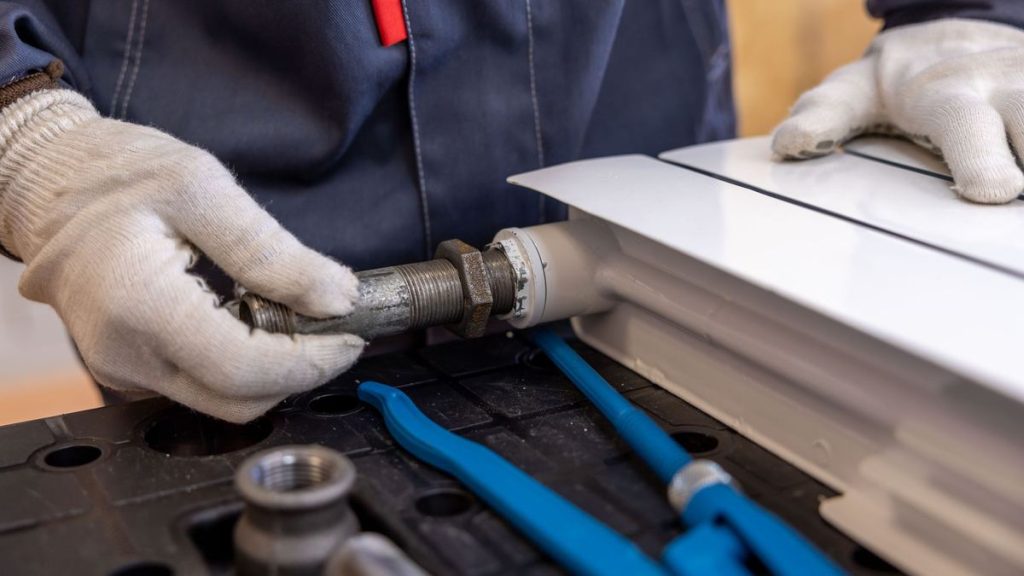
Permatex 80333 is a ready-to-use putty that you press into holes and leaky spots in an exhaust system. The listing says it seals out fumes at temperatures up to 2000F and is safe for catalytic converters. It names mufflers, tailpipes, joints and converters as suggested uses, and this version comes as a bonus pack with two pouches.
Putty fills the job that wraps and tapes handle poorly. A pinhole in a muffler shell or a seam that has started to weep is often on a flat or oval surface where a strip won’t loop around. Pressed in with a putty knife or a gloved finger, the putty fills the gap and hardens as the exhaust heats up. The second pouch is handy for a second patch or for building up a thin area.
It pairs well with a wrap on a pipe: press putty into the hole, then wrap over the top to hold it in place. On its own, it is a poor match for a large hole or a split, because there is nothing behind the putty to support it. The listing calls it permanent, but on a salted Michigan muffler, the metal around the patch keeps rusting, so expect to revisit it.
4. J-B Weld MufflerSeal 37912: 12 oz Iron-Reinforced Muffler Cement, 700F

- Iron-reinforced paste for mufflers and pipe joints
- Resists up to 700F
- Cures in up to 24 hours or faster with heat
- Large 12 oz plastic tube
MufflerSeal is an iron-reinforced paste that J-B Weld sells for sealing mufflers, pipe joints and the rest of the exhaust system. The listing rates it to 700F, which places it in the cooler rear half of the system rather than near the engine. This version is the 12 oz plastic tube, a lot of cement for one car.
There are two ways to cure it. Left alone, it hardens fully in up to 24 hours, and the listing notes that cold or humid conditions can stretch that time. With heat from the running engine, it cures faster, and you know it is done when it is hard. The iron filler gives it more body than a basic putty, so it builds up well in a gap between a pipe and a muffler inlet.
Joint cement is the classic choice when you assemble a slip joint during a muffler swap, and it also seals a seam or pinhole on the muffler body. The 700F rating is the main limit: keep it away from the manifold, the front pipe and the converter, where temperatures run higher. A small tube makes more sense if you only need one patch.
View J-B Weld MufflerSeal on Amazon
5. J-B Weld ExtremeHeat 37901: 3 oz High-Temp Metallic Paste for Cracks, 1000F

- Metallic paste rated to 1000F
- Contains no solvents or VOCs
- Can be drilled, machined or sanded after curing
- For cracks, gaps, seams and holes in iron and steel
ExtremeHeat is a metallic paste from J-B Weld’s cold-weld range, made for repairs to iron, steel and other metals in high-temperature spots. The listing rates it to 1000F, says it is non-flammable and states that it contains no solvents or volatile organic compounds. The tube holds 3 oz, enough for a few small repairs.
The listing names exhaust manifolds, pipe connections, mufflers and catalytic converters among its uses, along with grills and furnaces. It describes the paste as good for cracks, small gaps, seam connections and holes. Once it cures, you can drill, machine or sand it, which helps when a repair needs to be smoothed flush so a heat shield or clamp can sit back in place.
This is the product to reach for when a crack sits in a hot area where a 700F cement would cook. Even so, a crack in a cast manifold tends to grow with every heat cycle, so a paste repair there usually buys time rather than solving it. It also isn’t a hole filler for thin, rusted pipe. Clean the area to bright metal, work it into the crack and cure it fully.
View J-B Weld ExtremeHeat on Amazon
6. EVIL ENERGY 2.5 Inch Butt Joint Band Clamp: 304 Stainless Exhaust Pipe Coupler
- Joins 2.5 inch OD pipe to 2.5 inch OD pipe
- 3 inch wide 304 stainless steel band
- Zinc-plated M10 bolt and nut with steel gasket
- No-weld design, 63 N·m torque spec
This is a band clamp, a wide strap of 304 stainless steel that wraps fully around a joint and squeezes it shut with a single bolt. The listing gives its size as 2.5 inch OD pipe to 2.5 inch OD pipe, so it butts two pipe ends of the same outside diameter together. The band is 3 inches wide, with a zinc-plated M10 bolt and nut, a steel gasket and an aluminum alloy block.
Unlike a U-bolt clamp, a band clamp spreads its force evenly around the pipe, so it seals the joint without crushing the pipe into an oval. That makes it easy to remove later if you replace a muffler or a pipe section. The listing gives a torque figure of 63 N·m. No welding is needed, so you can fit it with hand tools.
A clamp is the most durable fix in this list, because it creates a proper joint instead of patching damaged metal. The catch is size: measure the outside diameter of both pipes before you order, since this listing is 2.5 inch only and other sizes are sold separately. It won’t seal a hole in the middle of a pipe or help a joint whose pipe ends have rusted thin.
View EVIL ENERGY 2.5 Inch Band Clamp on Amazon
Matching the Fix to the Damage
Even the best exhaust repair kit can’t fix every kind of damage. Find yours in the left column, then check whether a patch is worth trying.
| Damage | Patch to try | Typical life | Better fix |
|---|---|---|---|
| Muffler pinhole | Putty or MufflerSeal | Weeks to months | New muffler |
| Crack or hole in pipe | Wrap over putty | Months with good prep | New pipe section |
| Leaking slip joint | Band clamp | Often lasts | Clamp or weld |
| Manifold hairline crack | ExtremeHeat paste | Short | New manifold or gasket |
| Rusted-through pipe | None | Fails at the edges | New pipe or muffler |
A hole in the muffler body is a very common failure, and it rarely stays one hole. Our post on a hole in a muffler explains why rust from the inside tends to spread once the first pinhole opens.

A pipe that knocks on bumps may have a broken exhaust hanger rather than a leak. Fix the hanger first, or a new patch will crack as the pipe swings.
Carbon Monoxide and the Limits of a Patch
An exhaust leak isn’t only noise. The EPA describes carbon monoxide as an odorless, colorless and toxic gas, and lists vehicle exhaust among its common sources. Headaches, dizziness, nausea and confusion are early signs of exposure.
Where the leak sits changes the risk. A hole near the tailpipe vents behind the car, while a leak at the manifold, front pipe or converter sits under the cabin, where fumes can reach the interior.
- Never run the engine in a closed garage to cure a patch.
- Stop driving on a patch if you smell exhaust inside the car.
- Keep the tailpipe clear of snow.

Think of the best exhaust repair kit as a way to reach a proper repair, not replace one. If the patch sits ahead of the rear axle, get it fixed soon rather than when it gets loud again.
Salt, Rust and Short Trips in West Michigan
Grand Rapids winters attack exhaust systems from both sides. Road salt eats the outside of the pipes, and short cold trips leave water condensing inside the muffler, so mufflers often rust through at the low seams first.
Cold weather also slows the cure of most putties and resins, so let engine heat finish the job where the maker allows it. For a sense of what wears out and when, see how long an exhaust system lasts.

When the Exhaust Needs a Shop
A patch is the wrong move when the metal is soft, the leak is at the manifold or flange, or the converter body itself is damaged. The same goes for a car that is loud again a week after you patched it.
Our exhaust repair in Grand Rapids covers mufflers, pipes, clamps and hangers on foreign and domestic vehicles. We can tell you whether a section can be saved and replace what can’t.
More Buying Guides
Frequently Asked Questions
Does exhaust tape really work?
Yes, as a short-term seal on a small crack or hole in solid pipe. It won’t hold on rusted, flaking metal or on a joint that flexes.
Is putty or wrap better for a hole in a muffler?
Putty suits a pinhole or seam on the muffler shell, where a wrap can’t loop around. For a hole in a pipe, a wrap over a little putty usually seals best.
What is the best exhaust repair kit for a catalytic converter?
Some putties, including Permatex 80333, are listed as safe for catalytic converters, so they can seal a leaking seam or joint there. A cracked or rattling converter needs replacing, not patching, because the damage is usually inside.
Is it safe to drive with an exhaust leak?
A small leak at the tailpipe is mostly a noise problem. A leak near the front of the car can let carbon monoxide into the cabin, so get it checked soon and stop driving if you smell exhaust inside.
Loud exhaust or a patch that keeps blowing out? Call 456 AutoFix at 616-279-3832, Monday to Friday 8am to 5pm, or set up an exhaust check through our contact page.
Can’t make it during the day? Use our after-hours drop-off. We’re at 456 Carrier St NE in Creston.