
As an Amazon Associate, 456 AutoFix earns from qualifying purchases. Product links below go to Amazon, where you can check the can size and pack count before you order.
Penetrating oil vs WD40 is a question most people ask while staring at a bolt that will not budge. The blue and yellow can is already on the shelf, so it is tempting to soak the threads and hope. Sometimes that works, and sometimes it only buys you a rounded nut.
This comparison explains what each product is made to do, using WD-40 Company’s own descriptions and the Amazon listings. Then it reviews three cans: a dedicated penetrant, the classic multi-use spray and WD-40’s own rust breaker, which sits between them.
Quick answer
Is a dedicated penetrating oil better than WD-40 for a seized bolt?
For light rust, sticky hinges and damp connectors, WD-40 Multi-Use is often enough. For a fastener that is truly seized, a dedicated penetrant such as PB Blaster or WD-40 Specialist Penetrant is the better tool. Either way, give it time to soak, tap the part and apply a second coat.
Our Quick Picks
One dedicated penetrant, the classic multi-use can, and WD-40's own rust breaker as a third option between the two.

PB Blaster Penetrating Oil
A focused rust breaker for nuts and bolts that will not turn.
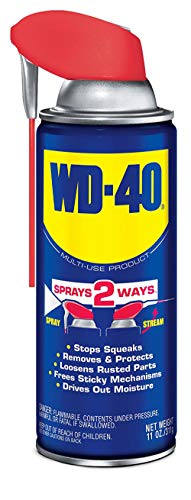
WD-40 Multi-Use Product
The all-round can for moisture, squeaks, grime and light rust.

WD-40 Specialist Penetrant
WD-40's dedicated penetrant, for owners who like the brand but need more bite.
What Each Can Is Built to Do
The name gives away the original goal. According to WD-40 Company’s brand history, Rocket Chemical Company set out in 1953 to make rust-prevention solvents for the aerospace industry, and the water displacing formula took 40 attempts. WD stands for Water Displacement, and the 40 marks the try that worked.
That does not make it a one-trick product. The company’s myths and facts page describes the Multi-Use Product as a blend of lubricants with anti-corrosion agents plus ingredients for penetration, water displacement and soil removal. The same page says it is about half mineral spirits and is not a grease.
A dedicated penetrating oil has a narrower job. It is formulated to creep into the tiny gap between threads, wick through rust scale and break the bond that locks a nut to its stud. Most also leave a film behind, so the part is easier to remove the next time.
So the real difference is focus. The multi-use can does many things reasonably well, while a penetrant puts nearly everything into freeing stuck metal.
Penetrating Oil vs WD40 Side by Side
The table below matches each product type to the jobs car owners run into most. It is a guide to what each formula is designed for, not a lab result.
| Job or question | Dedicated penetrant | WD-40 Multi-Use |
|---|---|---|
| Main purpose | Freeing rusted, seized fasteners | Displacing moisture, light lubrication, cleaning |
| Heavily rusted exhaust or suspension bolt | First choice, with a long soak | Often too light for the job |
| Light surface rust or a sticky latch | Works, but more than you need | Usually enough |
| Damp connectors or ignition parts | Not designed for it | Made to drive out moisture |
| Cleaning grease and grime off tools | Not its purpose | Listed use on the can |
| Film left behind | Lubricating, rust-slowing film | Light protective film against corrosion |
Keep one of each and you cover most garage needs. The multi-use can handles the everyday squeaks and damp parts, and the penetrant comes out when a wrench starts to slip.
Penetrating Oil vs WD40: Three Cans Compared
Each pick represents one side of the comparison, plus a third can that blurs the line. Read the listing for the size and pack count you want before ordering.
PB Blaster Penetrating Oil 2-Pack: 11 oz Aerosols with ProStraw Flow Control
- Penetrating catalyst for rusted, frozen parts
- Low surface tension creeps into threads
- Leaves a moisture-blocking film
- ProStraw with two spray patterns
PB Blaster is the penetrating oil side of this comparison, sold here as a pair of 11 ounce aerosol cans. The listing calls the formula a penetrating catalyst and says it breaks through rust and corrosion to loosen stuck nuts, bolts and mechanical parts. That single focus is what separates it from a general household spray.
The listing credits its low surface tension for the way it creeps deep into threads and tight spaces, which is exactly where a seized fastener holds on. Once it has done its work, it leaves a protective film that helps block moisture on bare metal. The ProStraw nozzle offers adjustable volume and two spray patterns, so you can aim a thin stream at one stud or wet a wider flange. The maker also lists it as 50-state VOC compliant.
In practice, this is the can to grab for exhaust clamps, rusted suspension bolts, hitch pins and old drain plugs. Spray the joint, give it time, tap the part and repeat before adding leverage. The two-pack makes sense if you keep one can in the garage and one in a truck box. It is not a cleaner, a moisture displacer for electrical parts or a long-term lubricant, and it should never reach brake friction surfaces.
View PB Blaster Penetrating Oil on Amazon

WD-40 Multi-Use Product: 11 oz Spray with Smart Straw for Moisture, Rust and Stuck Parts
- Displaces moisture
- Helps protect metal from corrosion
- Loosens stuck or rusted parts
- Smart Straw sprays two ways
This is the familiar blue and yellow can, in the 11 ounce size with the attached Smart Straw. It represents the WD-40 side of the comparison, and the listing gives it a broad job description: it penetrates and frees stuck, frozen or rusted parts, protects metal against moisture and corrosive elements, removes grease and grime, and displaces moisture.
WD-40 Company describes the formula as a blend of lubricants with anti-corrosion agents and ingredients for penetration, water displacement and soil removal. That mix is why one can covers so many small jobs around a car. The Smart Straw flips up for a narrow stream into a lock cylinder or folds down for a wide mist over a hinge, and it stays attached so it does not go missing in a drawer.
Reach for it when a door hinge squeaks, a hood latch sticks, a battery terminal area is damp or a bolt shows only light surface rust. It is also handy for wiping grime off hand tools after a job. On a fastener that has been rusting for years, it may need repeat soaks, and a dedicated penetrant often frees the part sooner. It is not a grease, so it does not replace chassis or bearing lubricant.
View WD-40 Multi-Use Product on Amazon
WD-40 Specialist Penetrant: 13.3 oz Fast-Acting Rust Breaker with Smart Straw
- Frees threads, locks, nuts and bolts on contact
- Low-odor formula
- Leaves a rust-slowing protective layer
- Larger 13.3 oz can
WD-40 Specialist Penetrant is the related third pick, because it answers the question many readers really have: does the WD-40 brand make a true penetrating oil? It does, and this is it. It also appears in our penetrating oil roundup, and it is repeated here because it is the only can that belongs to both sides of this comparison.
The listing describes an industrial-strength formula for automotive and heavy-duty work that frees stuck threads, locks, chains, nuts and bolts on contact. It leaves a protective layer behind that helps stop rust from forming again. WD-40 Company says it works by capillary action, reaching into tight threads and seams, and that it is safe on most metals, plastics and rubbers when used as directed, with a small test spot advised if you are unsure.
The low-odor formula is the practical reason to choose it over a harsher solvent spray, especially in an attached garage. The permanently attached Smart Straw gives a pinpoint stream or a wider spray, and this listing is the bigger 13.3 ounce can. Use it for the same seized hardware you would hit with PB Blaster. It is not meant to clean tools or dry out wet ignition parts, which remain jobs for the multi-use can.
View WD-40 Specialist Penetrant on Amazon

Can You Use WD40 as Penetrating Oil?
Yes, within limits. The Multi-Use listing says it penetrates, loosens and frees stuck, frozen or rusted parts, and WD-40 Company lists ingredients for penetration in the formula. On a bolt with light surface rust, a good soak and a firm wrench may be all it takes.
The limits show up on badly corroded hardware. A fastener that has sat through ten Michigan winters has rust packed into the threads, and a lighter, general formula may not wick far enough before you lose patience. That is the point where a dedicated product earns its place on the shelf.
Whichever can you grab, technique matters as much as chemistry:
- Brush off loose rust and dirt so the liquid can reach the threads.
- Spray the joint where the nut meets the stud, not just the head of the bolt.
- Wait at least several minutes, and leave very stubborn parts overnight.
- Tap the bolt head a few times with a hammer to open the seam, then spray again.
- Use a six-point socket and steady pressure rather than a sudden jerk.

If the bolt still will not move after two or three rounds, stop before the head rounds off or the stud snaps. A broken stud in a cast exhaust manifold turns a small job into a drilling and extraction job.
Salt-Seized Hardware on West Michigan Cars
Road salt is the reason this question comes up so often in Grand Rapids. Brine and slush work into exhaust clamps, brake line fittings, sway bar links and trailer hitch pins, then freeze-thaw cycles keep the corrosion going all winter. By spring, hardware that came apart easily a few years ago may need a real soak.
For the worst cases, our guide to the best penetrating oil for rusted bolts looks at long-soak formulas, and the penetrating oil picks for exhaust bolts cover heat-soaked manifold and flange hardware. Flaky pipes and hangers may need the treatments in our rust remover for exhaust guide instead.
Drain plugs are another common fight. A plug that has been overtightened for years can feel welded in place, and a light spray around the threads before an oil change in Creston can help. Wipe the area clean afterward so leftover film does not hide a slow leak.

Once a bolt is out, think about the next removal. A thin coat of anti-seize on clean threads keeps salt from locking them again, and our anti-seize compound guide explains where it fits. Follow the vehicle maker’s torque figures, because a lubricated thread can reach tension with less wrench effort.
Jobs Where Neither Spray Belongs
Both products leave an oily film, so keep them away from brake pads, rotor faces and shoe linings. If overspray lands on a brake part, clean it off with brake cleaner before the car moves. A contaminated pad can lose grip, and the fix is usually new pads.
Neither can is an engine or fuel treatment either. Injector deposits call for one of the products in our fuel system cleaner roundup, and crankcase protection comes from the right motor oil, which our synthetic oil buying guide covers. Spraying a penetrant into the intake or oil fill is not a substitute.

A few of these jobs go easier with a lift and proper tooling. If an exhaust flange bolt snaps, a hanger rusts through or the pipe itself is perforated, our exhaust repair in Grand Rapids can cut, extract and replace what is needed. The same goes for seized brake or suspension hardware, where a broken bolt affects safety.
More Buying Guides
Frequently Asked Questions
What is the main difference in penetrating oil vs WD40?
A penetrating oil is made mainly to wick into rusted threads and free seized parts. WD-40 Multi-Use is a general product that displaces moisture, lubricates lightly, cleans and protects against corrosion, with some penetrating ability. On heavy rust, the dedicated product usually works faster.
Does WD-40 make a penetrating oil?
Yes. WD-40 Specialist Penetrant is a separate product from the classic multi-use can. WD-40 Company describes it as using capillary action to reach tight threads and seams, with a low-odor formula that leaves a lubricating layer.
How long should penetrating oil soak before I try the bolt?
Give it at least several minutes, then tap the bolt and spray again. Badly rusted hardware often responds better to an overnight soak with a second application in the morning. Follow the directions on the can you use.
Is WD-40 Multi-Use a real lubricant?
WD-40 Company says it is a blend of lubricants, along with anti-corrosion and cleaning ingredients. It is not a grease, so for wheel bearings, chassis points or anything that needs long-term heavy lubrication, use the grease or oil the vehicle maker specifies.
Fighting a rusted bolt you would rather not snap? Ring 456 AutoFix at 616-279-3832 between 8am and 5pm, Monday to Friday, or request a time on our contact page.
Working late? Use our after-hours drop-off. We are at 456 Carrier St NE in Grand Rapids.