
As an Amazon Associate, 456 AutoFix earns from qualifying purchases. Product links below go to Amazon, where you can confirm the right part for your vehicle.
A forward camera records the car you hit, but not the driver who rear-ends you at a red light. The best front and rear dash cam closes that gap with a second lens on the back glass, fed by one cable from the main unit, so both views land on the same memory card with matching time stamps.
Below are the specs that matter and six two-channel cameras listed on Amazon. If you are unsure you need a rear lens at all, start with our broader dash cam buying guide, which compares single-lens models too.
Quick answer
Which dual dash cam records clearly both ways?
For most drivers, the VIOFO A229 Pro pairs a 4K front with a 2K rear on STARVIS 2 sensors. The BlackVue DR970X Box Plus hides its recorder under a seat and includes a hardwiring cable. The THINKWARE ARC900 adds a 3.5 inch touchscreen and LTE readiness.
Our Quick Picks
A dual STARVIS 2 kit with HDR both ways, a hidden-recorder design with hardwiring included and a touchscreen model ready for LTE. All six dash cams are reviewed below.
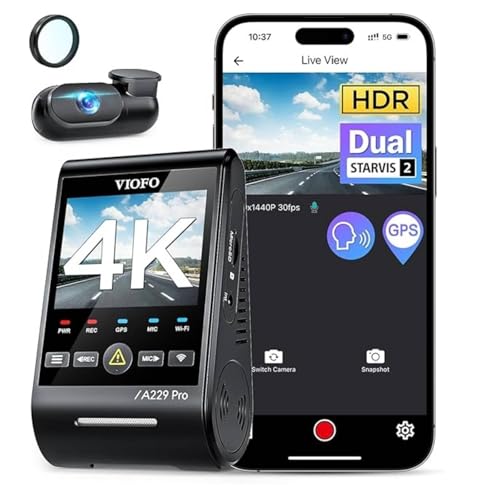
VIOFO A229 Pro 2CH
Sharp plates in both directions, day and night.

BlackVue DR970X Box Plus
Small cameras on the glass, memory card hidden away.

THINKWARE ARC900
Easy on-device playback with remote access as an option.
What a Rear Lens Adds, and the Install It Asks For
Rear-end collisions are where a single forward camera falls short. A rear channel shows following distance, the other car’s plate and whether it braked, which is what an insurer asks for when stories differ.
The trade-off is installation. The rear camera mounts at the top of the back glass, and its cable, often about 6 meters long on these kits, runs through the headliner and down a pillar to the front unit. Hatchbacks and SUVs also need the cable fed through the rubber boot at the liftgate hinge.
Specs to Compare on the Best Dash Cam Front and Rear Kits
Listings pile on features, but a handful of specs decide how useful the video is when you actually need it:
- Rear resolution: many kits pair a 4K front with a 1080p rear. A 2K or 2.5K rear sensor holds plate detail better behind you, where headlights flood the lens at night.
- Sensor and HDR: STARVIS 2 sensors with HDR balance bright headlights against dark roadsides. Check whether HDR covers both channels or only the front.
- Power design: a supercapacitor instead of a lithium battery copes better with a car that bakes in summer and freezes in January.
- Parking mode hardware: most parking modes need a hardwire kit, and some listings include one while others sell it separately.
- Storage: two channels fill a card twice as fast, so buy a high endurance card.
Best Front and Rear Dash Cam Choices, Reviewed One by One
All six picks below record both directions at once from a single kit, with the rear camera powered through the main unit’s cable.
1. VIOFO A229 Pro 2CH: 4K Front and 2K Rear with Dual STARVIS 2 HDR
- 4K front IMX678, 2K rear IMX675
- HDR on front and rear channels
- Supercapacitor rated 5 to 149°F
- CPL filter and 6 m rear cable included
The VIOFO A229 Pro two-channel kit records 4K at the front through a Sony STARVIS 2 IMX678 sensor and 1440p at the back through an IMX675. Both channels apply HDR, which evens out glare from headlights and dark road edges, and that matters most on the rear camera, where following cars shine straight into the lens at night.
A circular polarizing filter comes fitted to the front lens to cut windshield reflections, and the rear cable is 6 meters long, which covers most sedans and many SUVs. A quad-mode GPS logs speed and location, 5GHz Wi-Fi sends clips to the VIOFO app, and twelve voice commands let you lock a file or switch audio off without touching the unit. Power comes from a supercapacitor that VIOFO rates from 5 to 149 degrees Fahrenheit.
Parking mode offers event detection with buffering, low bitrate or time lapse, but it needs the HK4 hardwire kit, which is not in the box. There is no memory card included either, so budget for a high endurance card. Drivers who only want a forward view, or who need a cabin camera for passengers, should look at a different model.
View VIOFO A229 Pro 2CH on Amazon
2. BlackVue DR970X Box Plus: 4K Front and Full HD Rear with Hidden Recorder Box
- 4K front 146°, Full HD rear 131°
- Recorder box mounts out of sight
- Hardwiring cable and 64GB card included
- App-set low-voltage cutoff
The BlackVue DR970X Box Plus splits the usual dash cam into parts. Two small cameras go on the glass, a 4K STARVIS 2 unit with a 146 degree view at the front and a Full HD STARVIS unit with a 131 degree view at the rear, while the microSD card and processor sit in a separate box you can tuck under a seat or into the glove box.
With that layout, anyone who breaks in cannot simply pull the card from the windshield, and the processor stays away from the hot glass in summer. The kit includes both a 12V plug cable and a hardwiring cable, plus a 64GB card, so parking mode works without buying extras. When hardwired, the camera switches to parking mode as the ignition turns off and shuts down at a voltage cutoff you set in the BlackVue app.
Wi-Fi on the 5GHz band handles file transfers, and cloud features such as remote live view need a phone hotspot or the optional CM100G LTE module. The rear camera is 1080p rather than 2K, so plate detail behind you is not as fine as on some rivals. It suits drivers who park on the street and value a discreet setup.
View BlackVue DR970X Box Plus on Amazon
3. THINKWARE ARC900: 4K Front and 2K Rear with 3.5″ Touchscreen and LTE Ready
- 4K front IMX678, 2K rear IMX675
- Dual HDR on both cameras
- 3.5" IPS touchscreen
- Hardwiring cable and 64GB card included
The THINKWARE ARC900 pairs a 4K front camera on a Sony IMX678 sensor with a 2K rear camera on an IMX675, and both apply HDR. Where many dual kits rely only on a phone app, this one has a 3.5 inch IPS touchscreen, so you can review footage and change settings at the car.
Parking surveillance offers motion and impact detection, and THINKWARE lists energy saving and time lapse modes as well. The box includes a hardwiring cable and a 64GB card, which removes two common extra purchases. THINKWARE’s product page also describes a heat protection feature that drops the camera to impact-only recording when the cabin gets too hot while parked.
The ARC900 is LTE compatible: with the optional LTE module, sold separately, and the firmware version the listing names, you get live view, impact alerts and GPS tracking from the THINKWARE CONNECTED app, and the listing says a 3-year basic LTE plan comes with the module. The screen makes the front unit larger than a wedge-style camera, so it is harder to hide behind the mirror. It suits drivers who want remote alerts or who prefer checking footage without a phone.
View THINKWARE ARC900 on Amazon
4. Vantrue E2 Pro: 4K Front and 2.5K Rear with Voice Control and GPS

- 4K front, 2.5K (1440p) rear
- 155° and 160° wide-angle lenses
- Voice control, 5GHz Wi-Fi and GPS
- Supports cards up to 1TB
The Vantrue E2 Pro records 4K at the front and 2.5K, or 2560 by 1440, at the rear. Vantrue lists a STARVIS 2 sensor and lenses of 155 degrees ahead and 160 degrees behind, wide enough for up to four lanes. A higher-resolution rear channel helps when you need the plate of a car that pulled up close behind you.
Voice commands work in English and several other languages, letting you take a photo, lock a video or switch the camera view while driving. The 5GHz Wi-Fi connects to the Vantrue app for previews and downloads, and the built-in GPS stamps speed and location into each file. The G-sensor locks footage after a collision so loop recording does not overwrite it, and the camera accepts memory cards up to 1TB, though no card is included.
Parking mode offers buffered motion detection or low bitrate recording, but it needs a hardwire kit that is sold separately. Vantrue also notes that you should use the supplied car charger, since the camera does not work with PD fast chargers, and the rear camera must go into the port marked REAR. It suits drivers who spend time on multi-lane roads and want the widest picture from both ends.
5. 70mai A500S: 2.7K Front and 1080p Rear with ADAS and Built-in GPS

- 2.7K front 140°, 1080p rear 130°
- Sony IMX335 sensor, F1.8 lens
- ADAS collision and lane warnings
- 2" screen, Wi-Fi and GPS
The 70mai A500S kit pairs a 2.7K front camera, recording at 2592 by 1944 with a 140 degree view, with the RC06 rear camera at 1080p and 130 degrees. The front unit uses a Sony IMX335 sensor behind an F1.8 lens that 70mai says improves low-light detail.
This is the one kit here with driver assistance alerts. The ADAS system warns of a possible forward collision and of drifting out of a lane, which some drivers find useful and others switch off. Built-in GPS records your route and speed, Wi-Fi connects to the 70mai app for previews and downloads, and a 2 inch IPS screen handles quick checks. 70mai states that customer data is saved locally, and over-the-air updates come through the app.
Parking monitoring wakes the camera when it senses a bump or collision, but it requires the 70mai hardwire kit, sold separately. The camera takes microSD cards from 16 to 128GB at U1 speed or faster, and no card comes in the box. Resolution is lower than the 4K kits in this guide, so distant plates are harder to read. It suits drivers of smaller cars who want a compact, easy two-channel setup.
6. VIOFO A329S 2CH: 4K 60fps Front and 2K Rear with Wi-Fi 6 and SSD Support

- 4K 60fps front, 2K rear, STARVIS 2
- HDR on both channels
- External SSD up to 4TB or 512GB microSD
- Slim 2.8 mm coaxial rear cable
The VIOFO A329S two-channel kit records the front at 4K and up to 60 frames per second, with a 2K rear camera. VIOFO uses a STARVIS 2 IMX678 sensor at the front and an IMX675 at the rear, with HDR available on both. The listing notes that 4K at 60fps is not available while HDR is switched on, so you choose between smoother motion and wider dynamic range.
Storage is the standout. Besides microSD cards up to 512GB, the A329S can record to an external SSD of up to 4TB through an optional VIOFO cable, which VIOFO says allows more than three weeks of continuous recording. Wi-Fi 6 on the 5GHz band moves large 4K files to the app quickly. The rear camera connects with a thin 2.8 mm coaxial cable that tucks into trim easily.
A circular polarizing filter comes fitted, along with a 6 meter rear cable and quad-mode GPS. Parking mode is a power-saving impact detection setting that needs the HK4 or HK6 hardwire kit, which is not included, and no card or SSD comes in the box. It suits rideshare, delivery and high-mileage drivers who want long recording without swapping cards.
View VIOFO A329S 2CH on Amazon
Front and Rear Channels Side by Side
| Dash cam | Front / rear video | Hardwire kit | Stands out for |
|---|---|---|---|
| VIOFO A229 Pro | 4K / 2K (1440p) | Sold separately (HK4) | Dual STARVIS 2 with HDR |
| BlackVue DR970X Box Plus | 4K / Full HD | Included | Recorder box hidden away from the glass |
| THINKWARE ARC900 | 4K / 2K | Included | 3.5″ touchscreen, LTE ready |
| Vantrue E2 Pro | 4K / 2.5K | Sold separately | Wide 155 and 160 degree lenses |
| 70mai A500S | 2.7K / 1080p | Sold separately | ADAS alerts, compact size |
| VIOFO A329S | 4K 60fps / 2K | Sold separately (HK4/HK6) | External SSD up to 4TB |
For driving-only coverage, any of these runs from the included 12V plug. For parking coverage, the BlackVue and THINKWARE save you buying a separate hardwire kit.

Parking Mode, Hardwiring and Your Battery
Parking mode keeps the camera running after the ignition is off, which means it draws from the starting battery. A hardwire kit taps a constant-power fuse and a switched fuse, then cuts the camera off when battery voltage drops to a set point. Without that cutoff, an all-night recording can leave you with a dead battery on a cold morning.
Makers handle power differently. THINKWARE describes an energy saving mode and a Smart Parking Mode on the ARC 900 that drops to impact-only recording when cabin heat climbs too high. If your car started failing to start after a camera went in, our guide to a car battery that dies overnight walks through finding a parasitic drain.
Tap the fuse box with the add-a-fuse adapter the kit calls for and keep the fuse rating the circuit was designed for. A camera spliced into the wrong circuit is a common reason a car fuse keeps blowing after an install. For a deeper look at the recording modes themselves, see our parking mode dash cam guide.

Winter Glass, Trucks and Routing the Rear Cable
In West Michigan, the rear camera faces road salt spray, snow on the back glass and long stretches of winter commuting in the dark. Mount the lens inside the rear defroster or wiper area where you have one. Supercapacitor cameras also handle a night parked outside better than battery-based ones.
For a car front and rear setup, route the cable along the headliner edge and keep it behind, not across, any side curtain airbag trim. Pickup owners, including those shopping for a Ram 1500 front and rear setup, often mount the rear lens on the cab’s back window, and a 6 meter rear cable like VIOFO’s usually reaches. Longer cabs and campers may need an extension, so check the maker’s cable options, and see our dash cam for trucks guide for cab-specific advice.

When a Dash Cam Install Needs a Mechanic
Hardwiring is where problems show up: warning lights after the install, blown fuses or a battery that keeps going flat. A quick probe with a tool from our automotive test light roundup confirms which fuse slots stay live with the key off.
If the drain or fuse trouble does not stop after you unplug the camera, the fault may sit elsewhere in the wiring. Our technicians handle car electrical repair in Grand Rapids, including parasitic draw testing and fuse circuit diagnosis. With the wiring sorted, the best front and rear dash cam you choose can run parking mode without leaving you stranded.
More Buying Guides
Frequently Asked Questions
Is a front and rear dash cam worth it over a single camera?
For most drivers, yes. Rear-end crashes and parking lot hits from behind are common, and a front-only camera misses both. The extra cost is mainly the rear lens and an hour of cable routing.
Does the rear camera need its own power source?
Not on the kits in this guide. The rear camera draws power and sends video through the cable that connects it to the main unit, so only the front unit needs a 12V plug or hardwire kit.
Will a front and rear dash cam drain my car battery?
Not while driving. In parking mode it can, which is why a hardwire kit with a low-voltage cutoff matters. Set the cutoff high enough to leave starting power, especially in winter.
Can I record audio inside the car?
Many dash cams record cabin audio, and the VIOFO models let you switch it off by voice command. Recording and privacy rules vary by state, so check local law, and tell passengers when audio is on.
Camera hardwired and now the car struggles to start? Reach 456 AutoFix at 616-279-3832 from 8am to 5pm Monday through Friday, or request a time on our contact page.
Busy during shop hours? Our after-hours drop-off at 456 Carrier St NE lets you leave the car and keys whenever suits you.