
As an Amazon Associate, 456 AutoFix earns from qualifying purchases. Product links below go to Amazon, where you can confirm the right part for your vehicle.
A dead taillight, a horn that won’t sound or a fuse that keeps popping all start with the same question: is power getting there? The best automotive test light answers that in seconds, without dragging a meter and two leads around the car, and it does it without putting sensitive control modules at risk.
Below we sort test lights into three kinds, explain “computer safe,” and review six tools. If you already own a meter, our guide to the best multimeter for automotive use covers that side of the toolbox.
Quick answer
Which test light should a DIYer buy for a modern car?
Start with a computer-safe LED tester that shows the voltage, such as the JASTIND 3-65V or VDIAGTOOL P60. If you also want to power motors, relays and bulbs straight from the battery, a powered probe like the Power Probe 3 or Autel PowerScan PS100 does that. Keep both away from airbag wiring.
Our Quick Picks
Three starting points: a powered probe, an everyday digital tester and a simple LED light. All six tools are covered below.

Power Probe 3 (PP3CSRED)
The original powered probe for reading voltage and running components.

JASTIND 3-65V Test Light
Digital test light that shows the voltage and polarity at a glance.

Innova 3420
No-screen tester that shows power or ground by color.
Three Kinds of Test Light, and What Each Does
Every test light works the same way: clip one lead to a known ground, touch the probe to a wire, and the tool shows whether voltage is present. The types differ in how much they tell you.
- Simple LED tester: a probe, a lead and a light that glows for power, often red for positive and green for ground.
- Digital readout tester: the same pen with a screen that shows the actual voltage, usually to a tenth of a volt.
- Powered circuit probe: a larger tool wired to the battery with a long cable that can also send power or ground to the tip, so you can run a fan motor or click a relay without jumper wires.
The powered probe needs the most care. Power Probe describes its PP3 circuit tester as a voltmeter and continuity tester that can also supply battery voltage or ground to activate components, protected by an 8 amp thermal circuit breaker. Sending power down the wrong wire can still damage a module, so read the wiring diagram first.
What “Computer Safe” Means on a Listing
An old-style test light uses an incandescent bulb that pulls real current through whatever circuit you touch. On a headlight feed that’s harmless, but on a sensor wire or computer output it can damage the electronics.
A computer-safe tester uses LEDs or a high-impedance circuit that draws very little current. Lisle, for example, states that its 24550 draws less than 21 mA at 12 volts. For a modern car, the best automotive test light is one with a computer-safe rating like this.
The trade-off: because an LED tester barely loads the circuit, a corroded wire with a few strands left can still light it. A glow means voltage is present, not that the wire can carry a load, so a voltage drop test with a meter comes next.
Best Automotive Test Light Options: Six Tools Reviewed
The list runs from powered probes to simple LED testers, and each listing describes a design that is safe around vehicle electronics.
1. Power Probe 3 PP3CSRED: 12-24V Circuit Tester That Supplies Power and Ground
- Digital voltmeter with Min/Max
- Supplies battery power or ground
- 20-foot cord with battery clips
- Audible circuit monitoring
The Power Probe 3 is the tool most people mean when they say “power probe.” Instead of a short lead to a nearby ground, it connects to the vehicle’s battery through a 20-foot cord with battery clips, so you can walk around the vehicle and test as you go. The listing rates it for 12 to 24 volt DC systems, which covers passenger cars and many heavier vehicles.
Touch the tip to a wire and a digital voltmeter shows the reading, with Min/Max capture for voltages that flicker. Audible circuit monitoring lets you listen to a signal while you watch the engine bay, and a 4 mm banana jack with an auxiliary ground lead accepts add-on accessories. The headline feature is the rocker switch: press it one way to send battery power to the tip, the other way to send ground. That lets you spin a fan motor, click a relay or light a bulb straight from the probe.
Power Probe’s own page lists an 8 amp thermal circuit breaker with a manual reset, which helps when you hit a short. Even so, applying power to a computer or sensor wire can do damage, so it suits someone who reads wiring diagrams first.
View Power Probe 3 (PP3CSRED) on Amazon
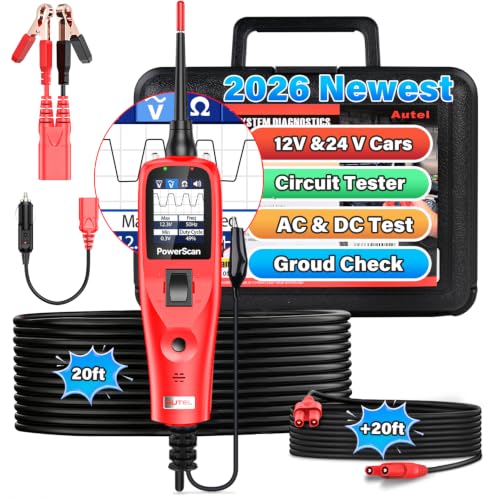
2. Autel PowerScan PS100: 12-24V Power Circuit Probe with Resistance and AC Modes
- DC, AC and resistance modes
- Component activation with 10A breaker
- 20 ft cord plus 20 ft extension
- Backlit LCD and work lights
The Autel PowerScan PS100 is a powered circuit probe in the same family as the Power Probe; it is the other half of the “Autel vs Power Probe” question. It connects to a 12 or 24 volt battery, and the listing says it works on 6 to 30 volt vehicle systems overall. Like other powered probes, it reads voltage at the tip and can also send power or ground to activate lights, motors, relays and fans without jumper wires.
Where it stands out is the number of readings in one handheld tool. A mode button steps through DC voltage at 0.1 volt resolution, an AC mode that shows maximum and minimum voltage, frequency and duty cycle, a resistance mode for continuity and open circuits, and a tone on or off setting. Red and green LEDs show polarity, a backlit LCD and two work lights help in poor light, and a resettable 10 amp breaker trips with a buzzer warning if a circuit draws too much.
The box includes a 20-foot cord, a 20-foot extension and a cigarette lighter plug, so it reaches the back of a long trailer. Because it can apply battery power, the same caution about computer and sensor wires applies. It suits someone who wants more readings without buying a separate meter.
View Autel PowerScan PS100 on Amazon

3. JASTIND 3-65V DC Test Light: Computer Safe LCD Tester with 140-Inch Spring Wire
- 3-65V DC range
- Backlit LCD, 0.1V resolution
- Computer safe, low current draw
- 140-inch spring wire, steel probe
The JASTIND 3-65V test light is a pen-style digital tester for 3 to 65 volt DC circuits, which takes in 12 volt cars, 24 volt trucks and most trailer and boat wiring. It clips to ground with a large alligator clip on a 140-inch PU spring wire. For many readers this kind of tool is the best automotive test light for everyday checks.
A blue backlit LCD shows the voltage to 0.1 volt, and the listing gives an accuracy of plus or minus 0.2 volt. It is bidirectional, so you can clip the lead to either ground or positive, and an indicator shows the polarity of what the probe touches. The listing describes it as computer safe, drawing much less current than an incandescent bulb, which makes it a sensible tool around modern control modules.
The sharp stainless steel probe can pierce insulation or slip into the back of a connector, and a rubber tip cover protects it in storage. It reads voltage only, so it cannot power a component the way a powered probe can, and like any LED tester it does not load the circuit.
View JASTIND 3-65V Test Light on Amazon
4. VDIAGTOOL P60: 3-70V Digital Test Light with Dual Polarity LEDs and Overload Shutdown

- 3-70V DC range
- Backlit LCD, ±0.2V accuracy
- Red/green polarity LEDs
- 118-inch spring wire, needle cover
The VDIAGTOOL P60 is a digital test light rated for 3 to 70 volt DC circuits, slightly wider than most pen testers. The listing names cars, motorcycles, heavy trucks, trailers and boats. It is meant for voltage detection, continuity, polarity and ground checks on lighting, sockets, relays and fuses.
Readings show on a blue backlit LCD with 0.1 volt resolution and a stated accuracy of plus or minus 0.2 volt, so you can read a battery or charging voltage, not just see a light. Red and green LEDs show positive and negative at a glance. VDIAGTOOL says the tester draws minimal current to protect the vehicle’s ECU, unlike a traditional bulb test light, and it adds an automatic overload shutdown to protect the tool and the circuit.
The ground lead is a 118-inch spring wire with a copper core and an oil-resistant sheath, ending in a large alligator clip with a non-slip sleeve. A needle cover keeps the steel probe from poking you in a tool bag, and a roll of PVC tape comes in the kit for sealing a pierced wire. The maker warns not to use it on circuits of 100 volts DC or more, and it has no power-feed function.

5. Innova 3420 Smart Test Light: LED Circuit Tester with Power Plug and 6-Foot Leads
- White, red and green LED indicators
- Lighter-plug or alligator connection
- 6-foot leads
- Designed for electronic systems
The Innova 3420 Smart Test Light is a simple, no-screen circuit tester from a company known for its code readers. Innova designed it to safely check voltage and ground on electronic systems, so it suits modern cars where an old bulb-style tester would be the wrong tool. It shows what it finds with colored LEDs inside a clear handle.
The color code is easy to learn. White means the tester is properly connected to its power source, red means voltage is present at the probe and green means ground is present. That last part matters, because it lets you check a ground wire directly instead of only testing for power. It connects through a power plug that fits the cigarette lighter or accessory socket, or through detachable twin alligator clamps when you would rather go straight to the battery.
Six-foot leads give enough reach for most under-hood and dash work, and the handle has an ergonomic grip. It will not tell you whether a battery reads 12.4 or 12.7 volts, so pair it with a meter for charging checks. As a first tester for someone learning to trace a dead light or blown fuse, it keeps things simple.
6. Lisle 24550 Computer Safe Circuit Tester: 3-28V Polarity Light Under 21 mA

- Safe for automotive computers
- Draws under 21 mA at 12V
- 3-28V operating range
- Red/green polarity light
The Lisle 24550 is a plain, traditional-looking circuit tester with one important difference from the bulb testers many people grew up with: it is built to be safe around automotive computers. The Amazon listing states it won’t damage sensitive electronic components, and Lisle’s product page adds that it draws less than 21 milliamps at 12 volts DC. That low draw is what makes it suitable for sensor and module wiring on a newer car.
Lisle gives an operating range of 3 to 28 volts, which covers 12 volt cars and 24 volt systems. The light also indicates polarity: red for positive and green for negative, so the same probe that finds power can confirm a good ground. It replaces Lisle’s older 27450 tester, and the maker lists a replacement bulb under part number 24560.
There is no screen, no voltage number and no power-feed switch, so this is a yes-or-no tool. It works well as a glove box backup, a spare for a second car or a first tester for someone on a tight budget. For reading battery voltage or diagnosing charging problems, a digital tester or a meter is the better fit.
Matching the Tool to the Job
Most home mechanics don’t need every type. The best automotive test light for you depends on the jobs in this table.
| Job | Simple LED tester | Digital readout tester | Powered probe |
|---|---|---|---|
| Check a fuse for power on both sides | Yes | Yes | Yes |
| Read battery or charging voltage | No | Yes | Yes |
| Find a bad trailer or taillight ground | Yes | Yes | Yes, and can power the bulb |
| Run a fan, motor or relay off the car | No | No | Yes |
A digital readout tester covers most driveway diagnosis, while a powered probe saves time on trailers and shorts. If a fuse keeps failing, our article on why a car fuse keeps blowing walks through how to narrow down the short before you start probing.

A test light can’t tell you whether a battery will crank a cold engine. Our review of the best car battery charger for winter covers keeping a weak battery charged once you’ve confirmed it’s the problem.
Salt, Corrosion and Bad Grounds in West Michigan
Road salt and slush work into connectors, ground straps and trailer plugs every winter. On cars driven through a Grand Rapids winter, a lot of electrical faults come down to a green, crusty terminal or a ground bolt that has rusted loose. Whichever you pick, the best automotive test light is the one you’ll carry to find where the power stops.
- Clip to a clean ground: a bare battery negative post or an unpainted bolt, not a rusty bracket.
- Work from the source outward: check the fuse, then the connector, then the part itself.
- Back probe when you can: slide the tip in beside the wire at the rear of the connector instead of piercing the insulation, since a hole lets salt water in.
- Seal what you open: tape a pierced wire and grease a cleaned terminal.

A horn that went quiet after a slushy drive is a classic case, and our guide to a car horn not working shows where to check for power at the fuse, relay and horn itself.
Where a Test Light Stops Being Enough
Some circuits are off limits for any test light. Never probe airbag (SRS) wiring or its yellow connectors, because a test current can set off an airbag or log a fault that needs a scan tool to clear. Ignition coil outputs and hybrid or electric vehicle high-voltage cables, which are usually orange, are also no place for a handheld tester.

Intermittent faults, network problems and overnight drains need a meter and wiring diagrams. Our article on why a car battery dies overnight explains the usual suspects. When you would rather hand it off, our car electrical repair in Grand Rapids covers body and engine electronics on foreign and domestic vehicles.
More Buying Guides
Frequently Asked Questions
Is an LED test light safe for car computers?
An LED or digital tester sold as computer safe draws very little current, so it is the right type for modern vehicles. Old incandescent test lights pull much more current and can harm sensor and control module circuits. Check the listing for a computer-safe statement.
Do I need a test light if I already have a multimeter?
Not strictly, but a test light is faster for yes-or-no power checks at fuses and connectors. Many people keep both: the test light for quick checks and the meter for exact readings, resistance and voltage drop tests.
Autel vs Power Probe: which powered probe should I buy?
Both read voltage and send power or ground to the tip. The Power Probe 3 is the long-established original, while the Autel PowerScan PS100 lists extra modes such as resistance, AC readings and an extension cord in the box. Pick based on the features you will use.
Can I use a test light on airbag wiring?
No. Probing airbag circuits can deploy an airbag or set a fault code. Leave SRS wiring, usually marked by yellow connectors, to a shop with the right scan tool and procedures.
Chased the power as far as you can and still stuck? Ring 456 AutoFix on 616-279-3832 between 8am and 5pm on weekdays, or request a wiring diagnosis on our contact page.
Need to leave the car outside our hours? Our after-hours drop-off at 456 Carrier St NE in Creston, Grand Rapids, lets you drop the keys whenever it suits you.