
As an Amazon Associate, 456 AutoFix earns from qualifying purchases. Product links below go to Amazon, where you can check the current listing before you buy.
A dead battery on a cold morning or a fuse that keeps popping is often the moment someone decides to buy a first meter. The best auto multimeter for beginners is one you can set without a manual open on the fender, that reads a 12V system clearly and that won’t upset the electronics in a modern car.
Below are the first tests worth learning, the features that matter and six meters that suit a new DIYer. For a broader comparison, our roundup of multimeters for automotive use goes further.
Quick answer
What should a first multimeter for car work have?
Look for auto-ranging, so you only choose the function and the meter picks the scale. Add a fused current input, a clear backlit screen and a high-impedance design that is safe on car electronics. The KAIWEETS KM200s keeps setup simplest, the AstroAI 6000-count covers more functions, and the Innova 3300 is built around automotive checks.
Our Quick Picks
Three starting points for a first meter: the simplest to set, the widest function list and a car-focused hands-free design. All six are reviewed below.
KAIWEETS KM200s
Touch the leads to a circuit and it chooses the measurement for you.

AstroAI 6000-Count TRMS Multimeter
A wide function list in a meter that still sets its own range.

Innova 3300
An automotive-minded meter you can strap to your wrist while you probe.
Your First Four Jobs With a Meter
Most first-year car work comes down to a few DC voltage and continuity checks:
- Resting battery voltage: with the engine off for a few hours, a healthy 12V battery typically reads around 12.6 volts. Noticeably lower means it needs a charge, and a smart charger built for winter use is the next tool to own.
- Charging voltage: with the engine running, most systems typically show somewhere around 13.5 to 14.5 volts at the battery. Check your service information for your vehicle’s exact range.
- Fuse checks: pull the fuse and test it on continuity. A beep means the link is intact. If one blows again soon after you replace it, our guide on why a car fuse keeps blowing explains what usually causes it.
- Wires, grounds and bulbs: with the circuit unpowered, continuity shows whether a wire, ground strap or bulb filament is unbroken.
Measuring current, such as hunting a slow battery drain, is a step up. It puts the meter in series with the circuit, where one mistake blows the meter’s fuse, so learn voltage and continuity first.
What Makes a Meter Friendly for a Newcomer
The specs that matter while you are learning:
- Auto-ranging: you turn the dial to DC volts and the meter chooses the scale. Manual meters make you pick 2V, 20V or 200V yourself.
- High input impedance: a digital meter with around 10 megohms of input barely loads the circuit, so it is gentle on sensors and modules.
- Fused current inputs: the internal fuse protects the meter when a lead sits in the wrong jack.
- Readable screen and stand: a backlight, data hold and a kickstand or hanger help in a dark engine bay.
- Clips as well as probes: alligator clips free both hands at the battery.
True RMS and higher counts are nice extras, but most car work is DC, where they matter less. CAT II and CAT III markings rate a meter for mains-type circuits; we quote them as each maker states them.
Best Auto Multimeter for Beginners: Six Meters Compared
Each meter below is listed on Amazon US, and none repeats the picks in our other multimeter guides. Features come from the maker or the Amazon listing.
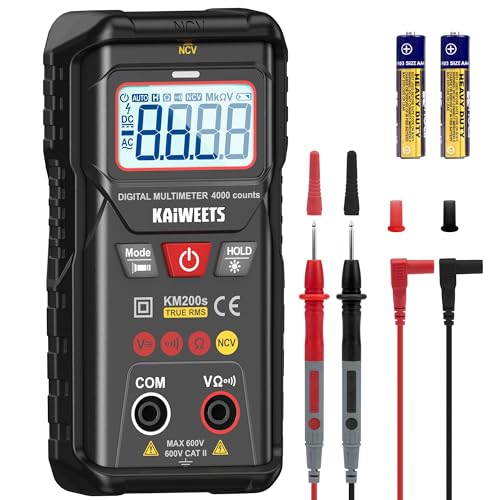
1. KAIWEETS KM200s: 4000-Count TRMS Multimeter with Smart Auto Mode
- Smart mode picks voltage, resistance or continuity
- True RMS, 4000-count backlit display
- Non-contact voltage alert and flashlight
- CAT II 600V rating and 3-year warranty
The KAIWEETS KM200s goes a step past ordinary auto-ranging. In its smart mode, the meter works out on its own whether you are measuring AC or DC voltage, resistance or continuity, so there is no dial position or range to think about. For someone who has never used a meter, that removes the most common source of confusion. You touch the probes to the battery posts or across a fuse and read the answer.
It is a True RMS meter with a 4000-count backlit display, and it adds a non-contact voltage detector with both a light and a beeper near a garage outlet or block heater cord. A built-in flashlight helps when you are leaning into a dark engine bay. Data hold freezes a reading until you are out from under the hood, and auto power-off saves the batteries.
The meter ships in a silicone sleeve with two test leads, two AAA batteries and a manual, and KAIWEETS lists a CAT II 600V rating and a 3-year warranty. The listing focuses on voltage, resistance, continuity and capacitance and does not describe current measurement, so it is not the tool for tracking a parasitic draw. As a first meter for battery, charging and fuse checks, it keeps things simple.
View KAIWEETS KM200s on Amazon
2. AstroAI Digital Multimeter: 6000-Count TRMS Auto-Ranging Meter with Temperature and Duty Cycle
- Auto-ranging True RMS, 6000 counts
- AC/DC volts and amps, duty cycle, temperature
- Backlit screen, data hold and kickstand
- Double ceramic fuses on the current inputs
AstroAI’s 6000-count True RMS meter is a good fit for a beginner who wants room to grow. It is auto-ranging, so you choose a function such as DC volts and let the meter select the scale. The function list is broad for a meter in this class: AC and DC voltage and current, resistance, continuity, diode, capacitance, frequency, duty cycle and temperature.
For car work, the useful parts are straightforward. DC volts covers battery and charging checks, continuity and resistance handle fuses, bulbs and grounds, and duty cycle becomes relevant later when you start looking at solenoids and other pulsed components. The current ranges let you try a parasitic draw test once you are comfortable placing a meter in series with a circuit.
The large backlit LCD and data hold make readings easy to catch, and the built-in kickstand lets the meter stand on a fender cover while you work. Auto shut-off protects the batteries. AstroAI fits double ceramic fuses rated F400mA/600V and F10A/600V to the current inputs, which is the protection you want when a lead ends up in the wrong jack. The trade-off for all those functions is a busier dial than the KAIWEETS, so spend a few minutes with the manual before the first test.
View AstroAI 6000-Count TRMS Multimeter on Amazon

3. Innova 3300: Hands-Free Digital Multimeter with 10 MegOhm Circuitry
- 10 MegOhm circuitry for car electronics
- Wrist band, stand and lead holders
- Automotive and household test uses
- UL certified
Innova builds tools mainly for car owners and technicians, and the 3300 reflects that. Its headline feature for beginners is 10 MegOhm circuitry, which Innova describes as preventing damage to sensitive automotive electronics. That high input impedance means the meter barely loads the circuit it is reading, so checking a sensor feed or a module supply does not disturb the signal.
The other selling point is in the name. The 3300 comes with a wrist-mounted band, a stand and lead holders, so you can strap the meter to your forearm or stand it nearby and keep both hands on the probes. That matters more than it sounds when you are reaching behind a fuse panel or into a tight engine bay and need to watch the display at the same time.
Innova lists automotive uses including circuits, breakers, wiring, battery and charging systems and electrical components, plus household jobs like outlets, fuses and general-purpose batteries. It is UL certified. The listing does not go into ranging type, display counts or extra functions like temperature, so read the full Amazon listing to confirm it covers the tests you plan to run. For straightforward voltage, continuity and resistance checks on a car, it is a sensible, automotive-first choice.
4. Crenova MS8233D: 6000-Count TRMS Multimeter with Auto or Manual Ranging

- Switch between auto and manual ranging
- CAT III 600V rating, two internal fuses
- Max/min, data hold and NCV detector
- Alligator clips and carrying box included
The Crenova MS8233D suits a beginner who wants auto-ranging now but would like to learn manual ranging later. The meter lets you switch between the two, so you can start by letting it choose the scale and then lock a range once you understand what reading to expect. It has a 6000-count backlit display, True RMS and a sampling speed of three readings per second.
Its function list covers AC and DC voltage and current, resistance, capacitance, frequency, duty cycle, continuity, diode and temperature, plus a non-contact voltage detector that beeps faster as the AC signal gets stronger. Max/min recording is worth learning for car work: clip the leads to the battery, crank the engine, and the minimum reading shows how far the voltage dipped.
That test is easier because the kit includes a pair of alligator clips alongside the probes, so the leads stay on the posts while you sit in the driver’s seat. Crenova lists an IEC61010-1 CAT III 600V rating, two built-in fuses for overload protection and an insulated rubber holster. Two AAA batteries and a carrying box are included. It is a bit bulkier than a pocket meter, so keep that in mind if space in your glovebox kit is tight.
View Crenova MS8233D on Amazon

5. Fluke 107: Palm-Sized 6000-Count Multimeter with CAT III 600V Rating

- Palm-sized at about 200 g
- 6000-count display with backlight
- CAT III 600V and 1-meter drop test
- SmartStrap magnetic lanyard
The Fluke 107 is the smallest meter here and the one most likely to live in a glovebox or a roadside kit. Fluke’s page for the 107 describes a palm-sized meter weighing about 200 grams, built to survive a 1-meter drop test and rated CAT III 600V. The 6000-count display has a backlight, and data hold keeps a reading on screen after you pull the probes away.
Fluke lists AC and DC voltage and current, resistance, continuity, capacitance, diode test, frequency and duty cycle. That covers every beginner test on a car, from resting battery voltage to checking a fuse or a ground strap. Fluke states that it is not a True RMS meter and positions it for everyday work where that accuracy is not needed, which describes most 12V automotive checks well.
In the box are Fluke’s TL75 test leads, two installed AAA batteries and a SmartStrap magnetic lanyard that lets you hang the meter from a hood or fender while you work. Fluke backs it with a 2-year warranty. There is no temperature or RPM function, so it is not a meter for engine analysis later on. As a durable, easy-to-carry first meter for basic checks, it is a solid choice.
6. GEARWRENCH GWDM107: Automotive TRMS Multimeter with RPM, Dwell and Battery Test
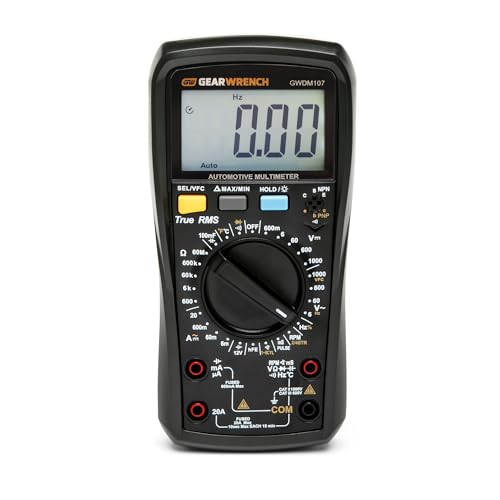
- RPM, dwell, pulse width and battery test
- AC/DC current up to 20A
- 6000-count backlit display, min/max, relative
- CAT III/CAT IV leads and thermocouple included
The GEARWRENCH GWDM107 is listed as an automotive pro multimeter, and it is the pick for a beginner who already knows they will want to go further than battery and fuse checks. Alongside the usual voltage, current, resistance, continuity, diode, capacitance and frequency functions, it adds dwell time, pulse width, RPM, a battery test, temperature and duty cycle.
Those extra modes are what make it a long-term tool. Pulse width and duty cycle are used when looking at fuel injectors and solenoids, and the battery test gives a quick read on a 12V battery. It is True RMS, measures AC and DC voltage up to 1000V and AC and DC current up to 20A, and reads resistance up to 60 megohms. The large 6000-count display is backlit, and relative, min/max and data hold functions help with comparisons and catching quick changes.
The kit includes a carrying case, CAT III/CAT IV rated test leads, a thermocouple for temperature readings, a user manual and two AAA batteries. The listing does not say how the RPM function connects to the engine, so check the details before relying on it. The dial has more positions than a basic meter, so a first-timer should start with the DC volts and continuity settings and add the rest gradually.
View GEARWRENCH GWDM107 on Amazon
Matching a Meter to Your First Projects
All six handle battery, fuse and continuity checks; they differ in setup effort and room to grow.
| Meter | Ranging | Helps a beginner with | Think twice if |
|---|---|---|---|
| KAIWEETS KM200s | Smart auto mode | Fewest dial choices to make | You want to measure current |
| AstroAI 6000-count | Auto-ranging | Wide function list, kickstand | You prefer a very simple dial |
| Innova 3300 | See listing | Hands-free wrist band and stand | You need temperature or duty cycle |
| Crenova MS8233D | Auto or manual | Alligator clips in the box | You want a compact meter |
| Fluke 107 | See maker page | Pocket size, drop-tested build | You need RPM or temperature |
| GEARWRENCH GWDM107 | See listing | Room to grow into engine tests | You only plan battery checks |
Shopping mainly on budget? See our best cheap multimeter for cars guide. A dedicated car battery tester can also estimate cranking health, which a multimeter can’t.

Habits That Keep You and the Car Safe
A few rules prevent the common beginner mistakes:
- Leave airbag circuits alone. Never probe the airbag (SRS) system or its connectors, which are usually yellow.
- Move the red lead back. After any current test, return the red lead to the voltage jack before the next reading.
- Never measure starter current through the meter. Cranking current is far beyond any handheld meter’s fused input.
- Stay away from hybrid and EV high-voltage parts. Orange cables are for trained technicians.

West Michigan winters add one more point. A battery tested below freezing in a Grand Rapids driveway reads differently from one in a warm garage, and corroded terminals from salty slush can skew readings. Clean the posts and retest before you blame the battery.
When the Numbers Point to the Shop
A meter tells you something is wrong, not always why. A battery that reads full in the evening and flat by morning points to a parasitic draw, covered in our guide to why a car battery dies overnight. Low charging voltage with the engine running can be one of the bad alternator symptoms worth checking next.

Tracing a drain, chasing an intermittent short or working near airbag wiring takes diagrams and experience. That is where our car electrical repair in Grand Rapids picks up, using your meter readings as a useful head start.
More Buying Guides
Frequently Asked Questions
Is auto-ranging worth it for a beginner?
Yes, for most people. You pick the function, such as DC volts, and the meter sets the scale, so there is no wrong range to choose. Manual-ranging meters work fine once you know roughly what reading to expect.
Which setting do I use to test a car battery?
Use DC volts, marked V with a straight line. Put the black lead on the negative post and the red lead on the positive. On a manual meter, choose the 20V range.
Can a multimeter damage my car’s computer?
A digital meter with high input impedance is safe for normal voltage checks on sensors and modules. The real risks are probing airbag circuits, shorting pins together with a probe tip, or measuring current on the wrong circuit.
What is the best auto multimeter for beginners who want to keep learning?
A meter with RPM, dwell and duty cycle functions, like the GEARWRENCH GWDM107, leaves room for engine tests later. If you only want battery and fuse checks, the KAIWEETS KM200s or AstroAI 6000-count is simpler.
Readings that don’t add up, or a battery that won’t stay charged? Bring the car to 456 AutoFix in Grand Rapids. Phone us at 616-279-3832 from 8am to 5pm on weekdays, or schedule an electrical diagnosis on our contact page.
If your workday clashes with ours, the after-hours drop-off is open for you. You’ll find us at 456 Carrier St NE, Grand Rapids.